Band 5.5 IELTS Writing Task 1 Model Answer
Overall Band Score: 5.5 · IELTS Momentum Workout · 2026-11-09
IELTS Writing Task 1 question
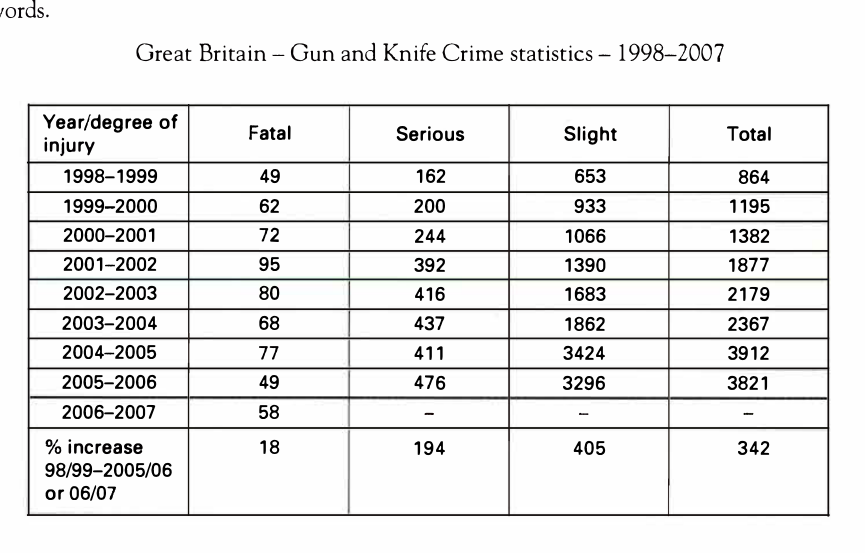
The table shows the number of fatal, serious and slight injuries resulting from gun and knife crime in Great Britain from 1998 to 2007 and the percentage increase for each degree of injury over the period.
Summarise the information by selecting and reporting the main features, and make comparisons where relevant.
Great Britain - Gun and Knife Crime statistics - 1998-2007
Student answer (Band 5.5)
The given table presents the number of three types of injuries caused by the gun and knife crime in Great Britain from 1998 to 2007. It also illustrates the percentage increase of each kind of injury during the whole period.
As can be seen, there was an increase in the number of all types of injuries including fatal, serious and slight over the period. Although, the number of all kinds of injuries increased, the slight injury also rose but rapidly. The number of fatal and serious also rosed but serious injury jumped than the fatal injury. As a result, there was an increasing trend in total number of injuries which was 98%.
It clear that there was an increasing trend in the number of slight injuries but sharply and reached the peak, at 3296. In addition, other two kinds of injuries also increased but the number of serious injury increased at more pace than the fatal and ended at 476 and 58 respectively. therefore, total increased was more and jumped at 3821 because the number of all types of injuries rose over the period.
AI examiner evaluation
| Criterion | Band |
|---|---|
| Task Achievement / Task Response | 5.5 |
| Coherence and Cohesion | 5.5 |
| Lexical Resource | 5.0 |
| Grammatical Range and Accuracy | 5.0 |
| Overall | 5.5 |
Task Achievement / Task Response: Band 5.5
You identify the table’s subject and note that injuries generally rose, which gives the response a relevant starting point. However, several key details are misreported or unclear. The total did not increase by 98%: the table gives a 342% rise through 2005–06, while 98% is not the total percentage. You also describe 3,296 as the peak for slight injuries, although the highest figure is 3,424 in 2004–05. The final figures 476 and 58 are assigned in the wrong order: 476 is serious and 58 is fatal. The overview needs to distinguish the much larger rise in slight injuries from the smaller increase in fatal injuries, and the missing 2006–07 figures for other categories should not be treated as a complete comparison.
Coherence and Cohesion: Band 5.5
The response has a basic sequence: an introduction, a general statement about trends, and further details. This makes the topic and intended comparisons identifiable. However, the two body sections repeat the same broad claim that all injury types increased, rather than developing separate comparisons or a clear progression through the data. Linking expressions such as “As can be seen,” “In addition,” and “therefore” are used, but some connections are unclear; for example, the conclusion that the total “jumped at 3821” does not clearly follow from the preceding figures. Organise the response around an overview and then grouped details, and use references that make clear which year and injury category each figure describes.
Lexical Resource: Band 5.0
You use relevant topic vocabulary, including “fatal,” “serious,” “slight,” “percentage increase,” and “trend,” so the reader can recognise the categories being discussed. However, the range of reporting language is limited, and several word choices or forms are inaccurate or awkward. “Rosed” is not the correct past form of “rise,” while “jumped than” and “increased at more pace” do not express comparisons naturally. Repetition of “increased” and “number” also makes the account less precise. Choose a small range of accurate verbs for changes and comparisons, such as “rose,” “fluctuated,” “climbed sharply,” and “increased more markedly than,” and use them with the correct grammatical pattern.
Grammatical Range and Accuracy: Band 5.0
The response attempts both simple and longer sentences, including a contrast beginning “Although” and a sentence explaining the relationship between injury categories and the total. However, complex structures are often faulty, and errors occur frequently enough to make some statements difficult to follow. Examples include “Although, the number … increased” (the comma and clause structure are incorrect), “It clear that” (missing verb), and “the number of serious injury increased” (number agreement). The final sentence also joins ideas in a way that obscures their relationship. Practise accurate clause construction, subject–verb agreement, articles, and punctuation, then check each sentence for a complete subject and verb before adding further clauses.
See this exact question answered at other band scores. The same prompt compared across bands.
Browse more IELTS Writing model answers or get your own writing scored by the same AI examiner.