Band 5.0 IELTS Writing Task 1 Model Answer
Overall Band Score: 5.0 · IELTS Momentum Workout · 2026-11-09
IELTS Writing Task 1 question
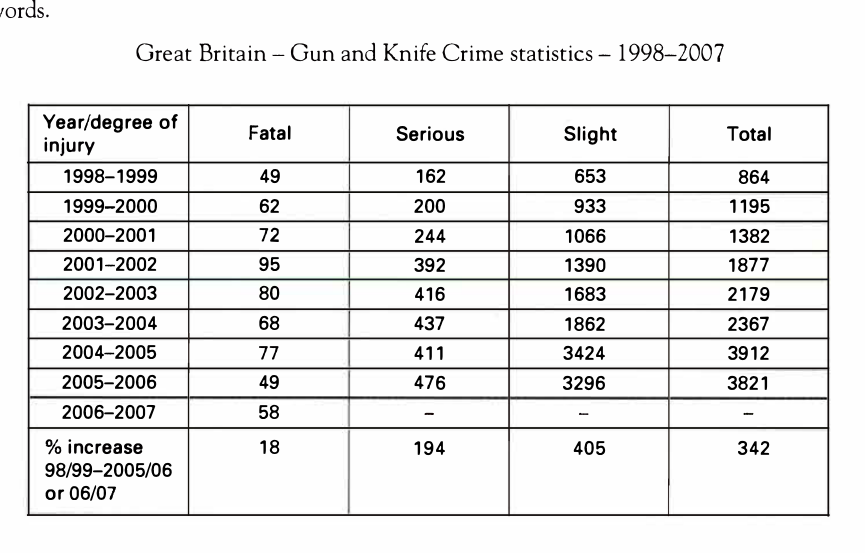
The table shows the number of fatal, serious and slight injuries resulting from gun and knife crime in Great Britain from 1998 to 2007 and the percentage increase for each degree of injury over the period.
Summarise the information by selecting and reporting the main features, and make comparisons where relevant.
Great Britain - Gun and Knife Crime statistics - 1998-2007
Student answer (Band 5.0)
The table illustrates the data of injuries occurs due to Gun and Knife in Great Britain from 1998 to 2007. Table contains the information about how harmful those injuries are ? wether they are Fatal, slight or serious.
In Great Britain From 2004 to 2005 a large number of crime was committed by Gun and Knife, according to the data a total number of 3912 peoples were injuried. Around 3424 people were seriously injured in this year which was massive in number .
In 1998 to 199 only 864 people were injured in Great Britain in which 162 were seriuosly injured and 49 got fatal injuries. But in 2000 it significatly reaches up to 1382. From 2001 to 2002 this number significantly increases up to 1877, in which 392 were seriously injured which is a massavie increase in serious injuries from past years.
However a massavie number of injuries were reported in 2004 to 2005, in the next year 2006 these were slightly dropped to 3821 injuries but seriuos injuries remains high of all time from 1998 to 2006.
AI examiner evaluation
| Criterion | Band |
|---|---|
| Task Achievement / Task Response | 4.5 |
| Coherence and Cohesion | 5.0 |
| Lexical Resource | 5.0 |
| Grammatical Range and Accuracy | 5.0 |
| Overall | 5.0 |
Task Achievement / Task Response: Band 4.5
You identify the table’s subject and report several relevant figures, including the total of 864 in 1998–99, 1,877 in 2001–02 and the peak total of 3,912 in 2004–05. However, the response only partially summarises the data: it gives no clear overview of the main trends across the period and focuses on selected years rather than comparing the injury categories overall. There is also a significant misreading: 3,424 in 2004–05 refers to slight injuries, not serious injuries. The final comparison correctly notes that the total fell to 3,821 in 2005–06, but the claim that serious injuries remained at an all-time high is not supported; they peaked at 476 in 2005–06, after rising from 162. A clear overview and accurate category comparisons would strengthen the report.
Coherence and Cohesion: Band 5.0
The response has some organisation: it begins by introducing the table, then discusses selected years in roughly chronological order, and uses transitions such as “But” and “However.” These features help the reader follow the broad topic. However, there is no clear overall progression from an overview to well-grouped details, and the paragraphs do not consistently organise the information by trend or injury category. Some links are unclear, as in “But in 2000 it significantly reaches up to 1382,” where the reference point and time period are imprecise. Repetition of “massive” and “significantly” also makes the progression feel mechanical. Grouping the figures into an overview and two focused comparison paragraphs would improve cohesion.
Lexical Resource: Band 5.0
You use some relevant vocabulary for describing data, including “total number,” “increases,” “dropped” and “injuries,” so the main subject is generally understandable. However, the range is limited and several word choices or collocations are inaccurate, sometimes affecting the meaning. For example, “3424 people were seriously injured” mislabels the slight-injury figure, while “a large number of crime was committed” describes crimes rather than the table’s injury statistics. Repeated use of “massive” and “significantly” is also imprecise for a formal report. Spelling errors such as “wether,” “injuried” and “seriuosly” are noticeable. Use precise terms such as “injury cases,” “rose,” “fell” and “accounted for” to report the data more accurately.
Grammatical Range and Accuracy: Band 5.0
You attempt both simple and longer sentences, including a time clause in “in the next year 2006 these were slightly dropped.” However, the range is limited, and errors occur frequently enough to make some sentences awkward or difficult to follow. Examples include “The table illustrates the data of injuries occurs,” where the verb form and sentence structure are faulty, and “serious injuries remains high,” where subject–verb agreement is incorrect. Articles and sentence boundaries are also inconsistent, as in “a total number of 3912 peoples were injuried” and the question mark after “are.” Aim for clear, controlled sentences such as “The total rose to 3,912 in 2004–05, before falling to 3,821 the following year.”
See this exact question answered at other band scores. The same prompt compared across bands.
Browse more IELTS Writing model answers or get your own writing scored by the same AI examiner.