Band 5.0 IELTS Writing Task 1 Model Answer
Overall Band Score: 5.0 · IELTS Momentum Workout · 2026-11-10
IELTS Writing Task 1 question
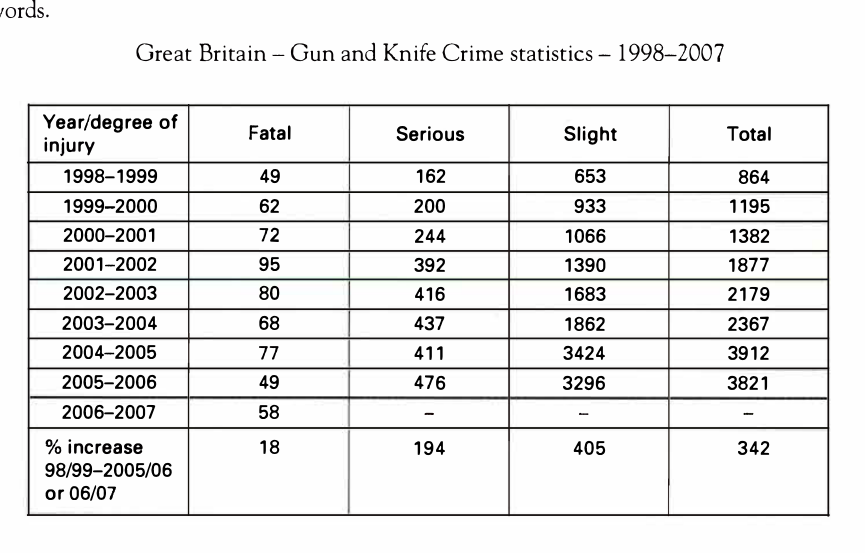
The table shows the number of fatal, serious and slight injuries resulting from gun and knife crime in Great Britain from 1998 to 2007 and the percentage increase for each degree of injury over the period.
Summarise the information by selecting and reporting the main features, and make comparisons where relevant.
Great Britain - Gun and Knife Crime statistics - 1998-2007
Student answer (Band 5.0)
The table represents the number of injured people and the increase percentage of injured people from gun shot and knife in Great Britain between 1998 and 2007. The injure type can be fatal, serious and slight.
Overall, the number of people for slight injured were the highest, serious injured people were the second highest, and fatal had the lowest. The percentage of increase rate also presenting data in this order.
The slight injured number of people were the highest and increased in every year compare to any other injured criteria. In [redacted phone], the slight injured people increased significantly, which was 3296, and it was a big number in comparison with other two injure categories. In contrast, the fatal had the lowest number of injured people. The highest number of fatal injured was in [redacted phone], which was 95.
In [redacted phone], there was only data about fatal. The increase percentage rate was also very high for slight injured people.
AI examiner evaluation
| Criterion | Band |
|---|---|
| Task Achievement / Task Response | 5.0 |
| Coherence and Cohesion | 5.0 |
| Lexical Resource | 5.0 |
| Grammatical Range and Accuracy | 5.0 |
| Overall | 5.0 |
Task Achievement / Task Response: Band 5.0
You identify the main ranking correctly: slight injuries were most numerous, followed by serious injuries, with fatal injuries lowest, and you note the peak fatal figure of 95 in 2001–2002. However, the account is only partial and some claims are inaccurate. Slight injuries did not increase every year: they fell from 3,424 in 2004–2005 to 3,296 in 2005–2006, and the largest recorded slight-injury figure was 3,424, not 3,296. The overview also says the percentage increases follow the same order, although the table gives increases of 18%, 194%, and 405% for fatal, serious, and slight injuries respectively. Include the overall rise in total cases and compare the categories more accurately.
Coherence and Cohesion: Band 5.0
The response has a recognisable structure, with an introduction, an overview and two detail paragraphs. Basic linking phrases such as “Overall” and “In contrast” help signal relationships. However, progression is limited: the final paragraph introduces 2006–2007 and the percentage increase without explaining how these details connect to the earlier comparisons. Several sentences repeat the same point that slight injuries were highest, while the total figures and the rise across the period are not organised into a clear comparison. Some references, such as “this order,” are also unclear because the categories and percentages are not explicitly matched. Group the main trends together, then use a separate paragraph for key figures and exceptions.
Lexical Resource: Band 5.0
You use relevant topic vocabulary, including “fatal,” “serious,” “slight,” “percentage,” and “increased,” so the reader can understand the subject. However, the range is limited and several phrases are repeated, especially “injured people” and “number of people.” Some word choices and collocations are noticeably inaccurate, such as “gun shot and knife,” “slight injured,” “injure criteria,” and “increase percentage rate.” These expressions make parts of the report awkward or less precise. Use standard forms such as “gun and knife crime,” “people with slight injuries,” “injury categories,” and “percentage increase.” More varied reporting verbs and comparison language would also help you describe the table more precisely.
Grammatical Range and Accuracy: Band 5.0
Your response includes simple statements and attempts some longer structures, for example, “In 2005-2006, the slight injured people increased significantly, which was 3296.” However, grammatical errors occur frequently and sometimes make the intended meaning difficult to follow. Examples include “The slight injured number of people were the highest,” where the subject and verb do not agree, and “The percentage of increase rate also presenting data,” which lacks a correctly formed verb. Articles, plurals and sentence construction are also inconsistent, as in “the fatal had the lowest number.” Aim for clear, controlled sentences such as “The number of slight injuries was the highest” and “The percentage increase was also greatest for slight injuries.” Check agreement and verb forms throughout.
See this exact question answered at other band scores. The same prompt compared across bands.
Browse more IELTS Writing model answers or get your own writing scored by the same AI examiner.