Band 5.5 IELTS Writing Task 1 Model Answer
Overall Band Score: 5.5 · IELTS Momentum Workout · 2026-11-10
IELTS Writing Task 1 question
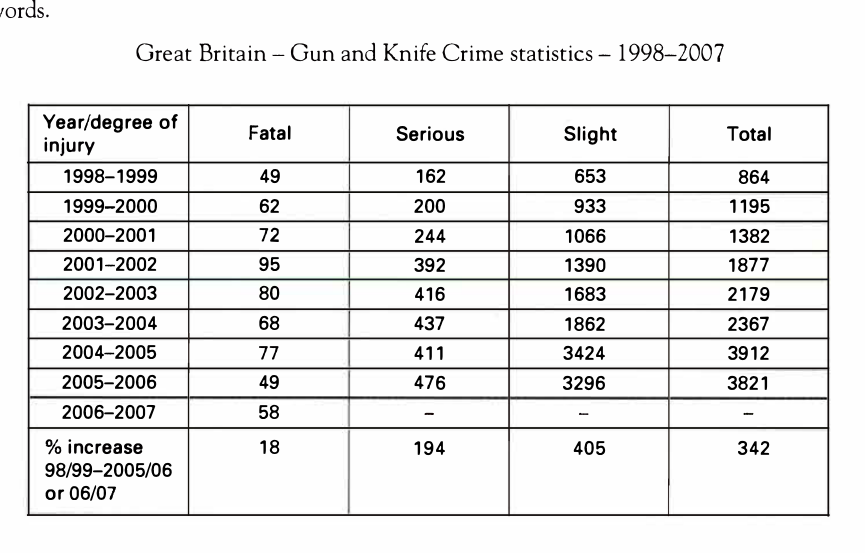
The table shows the number of fatal, serious and slight injuries resulting from gun and knife crime in Great Britain from 1998 to 2007 and the percentage increase for each degree of injury over the period.
Summarise the information by selecting and reporting the main features, and make comparisons where relevant.
Great Britain - Gun and Knife Crime statistics - 1998-2007
Student answer (Band 5.5)
The given data below shows the quantity of fatal, serious and minor injuries from gun shots and knife crime in Great Britian since 1998 to 2007 and the ratio rises for each injury over the period of time.
Overall the fatal injuries occured the most between [redacted phone], while serioius injuries ratio was mostly high between 2005 to 2006. Furthermore the slight injury rised from 2004 to 2005. As for the crime percentage from 2006 to 2007, only the fatal injuries are known while the rest informaton is unknown.
The total number of injuries (fatal, serious and slight) is 864 in [redacted phone]. The crime rate increased from 1999 to 2004 i.e 864 to 2367. Moving towards 2004 to 2005 where the criminal activities rose drastically from 2367 to 3912. Meanwhile a slight reduction took place in crime in time period between 2005 to 2006. During 2006 to 2007, no further information were known except fatal injury(58).
AI examiner evaluation
| Criterion | Band |
|---|---|
| Task Achievement / Task Response | 4.5 |
| Coherence and Cohesion | 5.5 |
| Lexical Resource | 5.5 |
| Grammatical Range and Accuracy | 5.5 |
| Overall | 5.5 |
Task Achievement / Task Response: Band 4.5
The response identifies several relevant features, including the peak in fatal injuries in 2001–2002 (95), the highest serious-injury figure in 2005–2006 (476), and the sharp rise in total injuries from 2,367 to 3,912 in 2004–2005. It also correctly notes that only fatal-injury data are provided for 2006–2007. However, the overview is incomplete and partly inaccurate: slight injuries did not simply rise from 2004 to 2005; they jumped from 1,862 to 3,424, then fell to 3,296. The opening claim about a general percentage rise is vague, and the response omits the overall pattern that injuries generally increased across the period. Develop a clearer overview and select key trends with accurate comparisons.
Coherence and Cohesion: Band 5.5
The response has a recognisable structure, with an introduction, an overview, and a paragraph describing total injuries. Sequencing is generally understandable, and phrases such as “Furthermore,” “Meanwhile,” and “During 2006 to 2007” help signal relationships between points. However, progression is not consistently clear: the overview moves between injury categories and the final paragraph shifts to totals without a clear organising principle. Some linking is mechanical or imprecise, such as “Moving towards 2004 to 2005 where,” and “As for the crime percentage” does not clearly connect to the table’s figures. Group the category trends together, then discuss totals, and use transitions that accurately express time or contrast.
Lexical Resource: Band 5.5
The response uses a reasonable range of task-related vocabulary, including “fatal,” “serious,” “slight,” “drastically,” “reduction,” and “percentage.” These choices make the general subject clear, and some variation avoids repeating “injuries” throughout. However, several word choices and collocations are inaccurate or unsuitable for describing the table. “Crime rate” and “criminal activities” refer to crime incidence rather than the number of injuries shown, while “ratio rises” does not describe the percentage increase clearly. There are also noticeable spelling errors, including “Britian,” “serioius,” “occured,” and “informaton.” Use precise terms such as “number of injuries,” “figure,” and “percentage increase,” and check spelling carefully.
Grammatical Range and Accuracy: Band 5.5
The response attempts both simple and more complex sentence forms, including “while” and “where” clauses, and most of the intended meaning can be followed. However, grammatical control is uneven. For example, “the slight injury rised” has problems with number and verb form, and “no further information were known” has incorrect agreement and an unnatural passive construction. The opening sentence also uses an awkward time expression (“since 1998 to 2007”), while “The total number … is 864” shifts tense when describing past data. Use past tense consistently, check singular and plural agreement, and form comparisons in complete, direct sentences. Greater accuracy in these patterns would make the report easier to read.
See this exact question answered at other band scores. The same prompt compared across bands.
Browse more IELTS Writing model answers or get your own writing scored by the same AI examiner.