Band 5.0 IELTS Writing Task 1 Model Answer
Overall Band Score: 5.0 · IELTS Momentum Workout · 2026-11-10
IELTS Writing Task 1 question
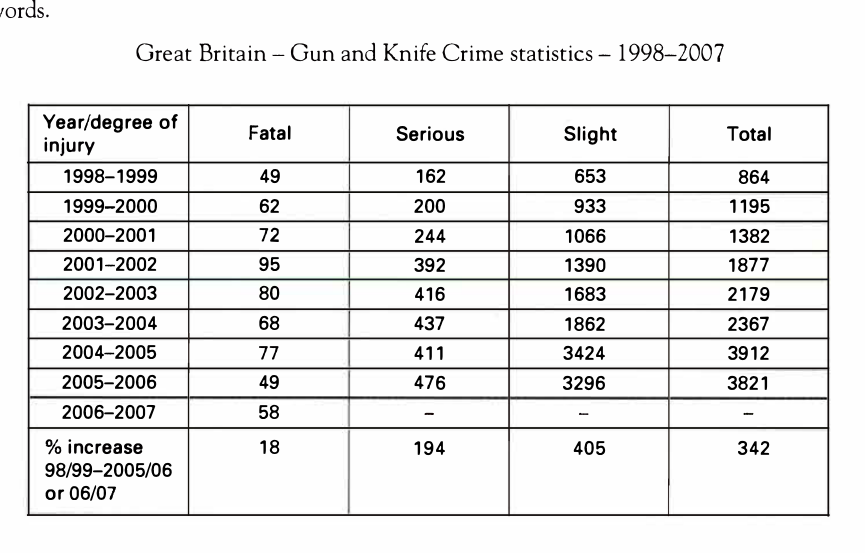
The table shows the number of fatal, serious and slight injuries resulting from gun and knife crime in Great Britain from 1998 to 2007 and the percentage increase for each degree of injury over the period.
Summarise the information by selecting and reporting the main features, and make comparisons where relevant.
Great Britain - Gun and Knife Crime statistics - 1998-2007
Student answer (Band 5.0)
Data presents different types of injuries caused by gun and knife crime and gives a percentage view of how much it increased between 1998 and 2007 in Great Britain. Overall we can see that almost all the types of injuries increased over the time though fatal showed a mixed result, slight injuries were all time high among all three types of injuries.
To start with the highest increased injuries which is slight injuries, it's increased over four hundred times over the period, while fatal increased the lowest among them with 18 percent and serious injuries doubled over the time.
Interestingly we can see a dramatic effect for the year 2006 and 2007 where the serious and slight injuries were totally null and the fatal injuries increased from it's last year. this shows us, even the injuries are low but 100% of the injuries were fatal for that year.
AI examiner evaluation
| Criterion | Band |
|---|---|
| Task Achievement / Task Response | 4.5 |
| Coherence and Cohesion | 5.5 |
| Lexical Resource | 5.5 |
| Grammatical Range and Accuracy | 5.0 |
| Overall | 5.0 |
Task Achievement / Task Response: Band 4.5
The response identifies the broad pattern that injury figures rose and notes that slight injuries were the largest category, but it does not accurately or sufficiently summarise the table. The claim that slight injuries increased “over four hundred times” confuses the 405% rise with a multiple; serious injuries rose by 194%, not merely “doubled” as a precise account, and the total also increased substantially. Most importantly, the final year has missing figures for serious and slight injuries, not zero values, so describing them as “totally null” and concluding that all injuries were fatal is unsupported. The response is also below the required 150 words. Include a clear overview and compare key figures across the years without interpreting missing data as zero.
Coherence and Cohesion: Band 5.5
The response has a basic sequence: an opening overview, a paragraph about percentage increases, and a final comment on 2006–2007. Linking phrases such as “Overall,” “To start with,” and “Interestingly” help signal this progression. However, the organisation is limited because the main body does not systematically compare the categories or trace their changes over time, and the final paragraph focuses on an unsupported interpretation of missing data. Some connections are also unclear, particularly “To start with the highest increased injuries,” which does not lead smoothly into the comparison. Group the information into a clear overview and focused comparisons, and use references such as “this figure” only when their meaning is unmistakable.
Lexical Resource: Band 5.5
There is enough vocabulary to communicate the general subject, including “fatal,” “serious,” “slight,” “increased,” and “dramatic.” However, the range is limited and several choices are inaccurate or unnatural for describing statistical data. “Increased over four hundred times” misrepresents a percentage increase, while “all time high among all three types” is imprecise and “totally null” is not an appropriate way to describe unavailable figures. Phrases such as “percentage view of how much it increased” are also awkward. Use precise terms such as “rose by 405%,” “accounted for the largest number,” and “figures are not provided” to make comparisons clearer and more formal.
Grammatical Range and Accuracy: Band 5.0
The response attempts some complex sentences, for example, “Overall we can see that almost all the types of injuries increased over the time though fatal showed a mixed result,” but control is inconsistent. Errors include the missing subject in “Data presents,” the faulty construction “it's increased,” and the agreement problem in “the highest increased injuries which is slight injuries.” The sentence beginning “this shows us” also runs on, and “from it's last year” contains incorrect pronoun punctuation and an unclear grammatical relationship. Capitalisation after full stops and comma use are inconsistent. Practise accurate subject–verb agreement, complete sentence boundaries, and past-tense reporting; these changes would make the intended comparisons easier to follow.
See this exact question answered at other band scores. The same prompt compared across bands.
Browse more IELTS Writing model answers or get your own writing scored by the same AI examiner.