Band 4.5 IELTS Writing Task 1 Model Answer
Overall Band Score: 4.5 · IELTS Momentum Workout · 2026-11-11
IELTS Writing Task 1 question
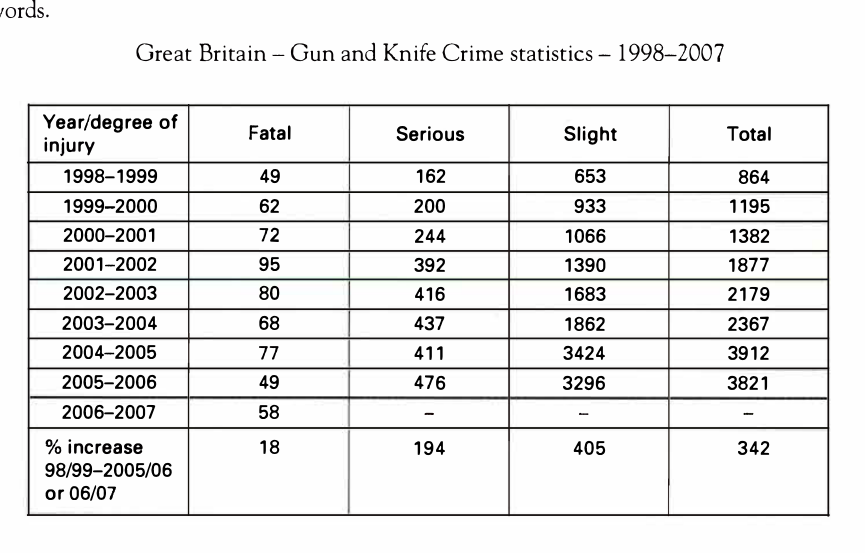
The table shows the number of fatal, serious and slight injuries resulting from gun and knife crime in Great Britain from 1998 to 2007 and the percentage increase for each degree of injury over the period.
Summarise the information by selecting and reporting the main features, and make comparisons where relevant.
Great Britain - Gun and Knife Crime statistics - 1998-2007
Student answer (Band 4.5)
The table before us contains the reported cases of weapon misuse over around a decade, nine years to be more accurate.it is arranged ascendingly since 1998 to 2007 and also has the severity listed in it too.
Before we begin we must emphasize on how dangerous being around weapons is, let alone using it in war, a fight or maybe a crime.
the number of fatal injuries goes up and down as we move towards 2007, While in the same time , the other severities grow steadily as we approach the present day.I believe the increasing number of cases is due to the development that occured to the weapon industry.Back in the days you could not hide a knife or a gun easily due to its large size,But currently it's completely the opposite. YOu can walk carrying gun in the shape of pen or stick and no ine would ever doubt you. the disguised weapons would be mistaken for a real object we use it in our normal day.
The number of crimes has risen due to many things including:
-songs that talks about gangs and the life of criminals and violence
-promoting the idea of the bad guy character and how you will look cool if you carry a gun
-many of the incidents may be due to psycological illness or disorer where the criminal is using weapons unconscioussly.
AI examiner evaluation
| Criterion | Band |
|---|---|
| Task Achievement / Task Response | 4.0 |
| Coherence and Cohesion | 4.0 |
| Lexical Resource | 5.0 |
| Grammatical Range and Accuracy | 5.0 |
| Overall | 4.5 |
Task Achievement / Task Response: Band 4.0
The response identifies two broad patterns: fatal injuries fluctuate, while other categories generally rise. However, it does not adequately summarise the table’s main information: there are no figures, no comparisons between injury types, and no mention of the sharp rise in slight injuries and the overall total around 2004–05. The statement that the other severities “grow steadily” is also too broad, since serious injuries fall from 437 to 411 before rising again, and the final year has no figures for those categories. Much of the response shifts to explanations about weapon design, music and psychological illness, which are not shown in the table. Focus on reporting the data and avoid unsupported causes or personal commentary.
Coherence and Cohesion: Band 4.0
There is a basic sequence from introducing the table to describing a trend and then discussing possible causes, but the ideas are not arranged as a clear data summary. The opening paragraph includes commentary about the danger of weapons, and the final list of possible causes takes the response further away from the task. The dash-led list is easy to distinguish visually, but it does not help organise the table’s information. Some linking phrases, such as “as we move towards 2007” and “in the same time,” connect ideas, though the progression is weak and references such as “the other severities” are imprecise. Use separate paragraphs for an overview and key comparisons, and connect each point directly to the relevant figures.
Lexical Resource: Band 5.0
The response uses some topic-related vocabulary, including “fatal injuries,” “severity,” “weapon misuse” and “disguised weapons,” so the general subject is understandable. However, vocabulary for describing numerical data is limited, and several choices are inaccurate or awkward, such as “reported cases” for injury totals and “arranged ascendingly” for the table’s chronological order. There are also noticeable spelling errors, including “occurred,” “psychological,” “disorder” and “unconsciously,” which reduce the accuracy of the writing. Some informal or unsuitable expressions, such as “look cool” and “bad guy character,” do not fit an academic report. Practise precise terms for increases, fluctuations, totals and comparisons, and check spelling and register.
Grammatical Range and Accuracy: Band 5.0
The response attempts a mixture of simple and longer sentences, including a contrast between fatal injuries and other categories. However, complex sentences are often faulty or difficult to follow. For example, “the number of fatal injuries goes up and down as we move towards 2007, While in the same time…” has incorrect capitalisation and punctuation, and the clause beginning “Before we begin” is not followed by a suitable report structure. There are also errors in agreement and sentence construction, such as “songs that talks” and “we use it in our normal day.” Capital letters and full stops are inconsistent, with several sentences joined or separated incorrectly. Build shorter, complete sentences first, then add controlled comparisons using accurate clauses and punctuation.
See this exact question answered at other band scores. The same prompt compared across bands.
Browse more IELTS Writing model answers or get your own writing scored by the same AI examiner.