Band 5.0 IELTS Writing Task 1 Model Answer
Overall Band Score: 5.0 · IELTS Momentum Workout · 2026-11-11
IELTS Writing Task 1 question
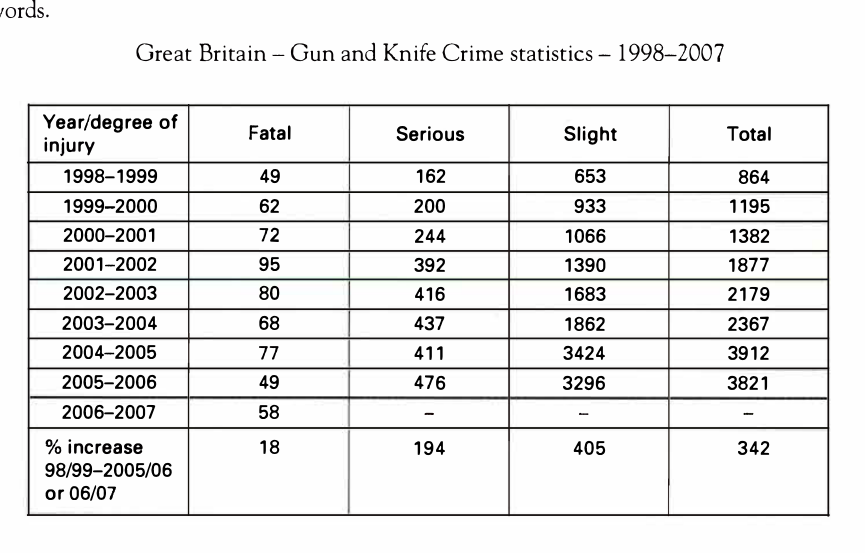
The table shows the number of fatal, serious and slight injuries resulting from gun and knife crime in Great Britain from 1998 to 2007 and the percentage increase for each degree of injury over the period.
Summarise the information by selecting and reporting the main features, and make comparisons where relevant.
Great Britain - Gun and Knife Crime statistics - 1998-2007
Student answer (Band 5.0)
The table illustrates the percentages and numbers of crime results from knife and gun in Great Britain for 9 years since 1998 to 2007 and the rate glow up for each degree of injury.
Overall, the biggest total number of crimes in GB is from 2004 untill 2005 (3912), most of them is Slights exactly like other years except [redacted phone] and minimal numeral of injuries is in the first year [redacted phone].
Year by year the total number of injuries increase but the figure of each categories is not. fatal injuries is the lowest section every year, the highest number was in [redacted phone] (95). Serious injuries is the second biggest categorie after slight and the peak was in [redacted phone] (476) and somehow we have only digit of fatal crimes in the last year.
The highest number of injuries is the slight one's, every year this section is always has the biggest number except the last year and in total the percentage of total crimes is 342 percent and the slights again the on the top if count only each sections.
AI examiner evaluation
| Criterion | Band |
|---|---|
| Task Achievement / Task Response | 5.0 |
| Coherence and Cohesion | 5.0 |
| Lexical Resource | 5.0 |
| Grammatical Range and Accuracy | 5.0 |
| Overall | 5.0 |
Task Achievement / Task Response: Band 5.0
You identify several relevant features, including the peak total of 3,912 in 2004–05, the dominance of slight injuries in most years, and the low fatal-injury figures. However, the summary is only partial and some comparisons are inaccurate or unclear. The total did not rise every year: it fell from 2,367 in 2003–04 to 3,912 in 2004–05, then to 3,821 in 2005–06. Also, the final year has a fatal figure only; the table does not show that slight injuries were absent. The percentage increases—18% for fatal, 194% for serious, 405% for slight and 342% overall—are not clearly reported. Select the main trends accurately and explain the incomplete final-year data.
Coherence and Cohesion: Band 5.0
The response has a basic structure, with an opening, an overview and further comments on the categories. This gives the reader some sense of how the information is organised. However, progression is limited: the final paragraph repeats that slight injuries were highest, a point already made in the overview, while the percentage figures are introduced without a clear explanation. Linking phrases such as “Year by year” do not accurately describe the changing totals, and references such as “this section” and “the last year” are not always precise. Organise the body around clear comparisons—for example, totals and slight injuries first, then fatal and serious injuries—and avoid repeating the same feature.
Lexical Resource: Band 5.0
You use some relevant terms, including “fatal injuries,” “serious injuries,” “slight” and “percentage,” so the topic is generally recognisable. However, the range is limited and several word choices or collocations make the meaning awkward, such as “rate glow up,” “crime results,” “minimal numeral” and “the slight one's.” There are also spelling and form errors, including “untill” and “categorie.” These choices sometimes make it difficult to tell whether you mean crimes, injuries, counts or percentages. Use standard data-reporting language consistently, such as “number of injuries,” “rose,” “fell,” “accounted for” and “percentage increase,” and check spelling and plural forms.
Grammatical Range and Accuracy: Band 5.0
The response attempts both simple and longer sentence forms, but complex sentences are often faulty and errors occur frequently. For example, “most of them is Slights” has subject–verb agreement and number problems, while “this section is always has the biggest number” combines incompatible verb forms. The sentence beginning “Year by year the total number of injuries increase” also has an agreement error, and “fatal injuries is” repeats this pattern. Articles and sentence boundaries are sometimes missing or awkward, as in “minimal numeral of injuries is in the first year.” These errors can make relationships between ideas difficult to follow. Practise accurate subject–verb agreement, singular and plural forms, and straightforward sentence patterns before adding more complex clauses.
See this exact question answered at other band scores. The same prompt compared across bands.
Browse more IELTS Writing model answers or get your own writing scored by the same AI examiner.