Band 4.5 IELTS Writing Task 1 Model Answer
Overall Band Score: 4.5 · IELTS Momentum Workout · 2026-11-11
IELTS Writing Task 1 question
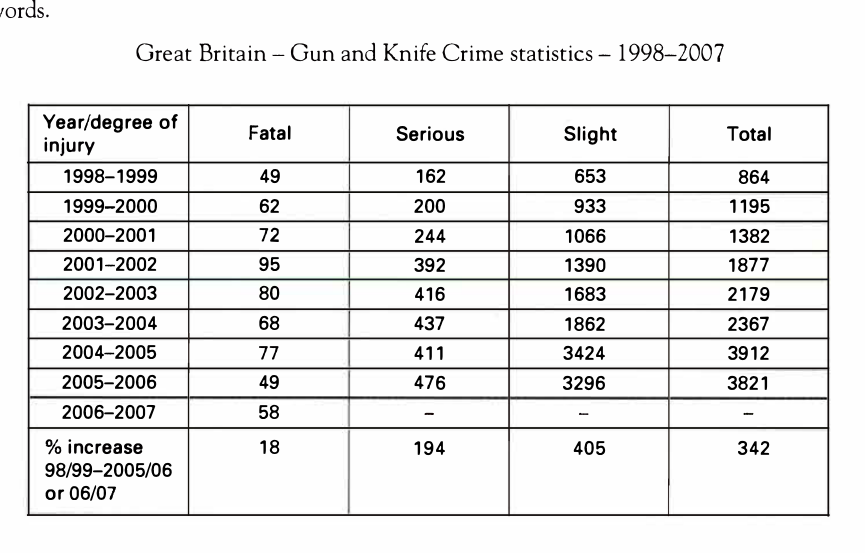
The table shows the number of fatal, serious and slight injuries resulting from gun and knife crime in Great Britain from 1998 to 2007 and the percentage increase for each degree of injury over the period.
Summarise the information by selecting and reporting the main features, and make comparisons where relevant.
Great Britain - Gun and Knife Crime statistics - 1998-2007
Student answer (Band 4.5)
The table shows the number of fatal,serious and less injured people from gun and knife crime in gerat britian from 1998 to 2007 and the percentage increases for each activity of injury throughout the period.
Overall, the degree of injury in the [redacted phone] has a greater proprotion while the lowest proportion of gun and crime statistics is from the year [redacted phone] , [redacted phone] or [redacted phone] followed by remaining statistics in great britian.
In [redacted phone], the total number of gun and knife crime are 3912 in total in which 77 were fatal, 411 were serious, 3424 were slight.The second largest proportion take place in [redacted phone] where fatal number was 49 followed by 476 who were serious and the number of slight were 3296 which make it a total of 3821.Also many other injuries occur in the early years and have a diffrenece in teir number.
However the lowest proportion of gun and knife statistics take place in 98/99 to 2005/06 or 06/07 in which the number of fatal are 18% followd by 194% who are serious and those slight as they are 405% which make a total of 342 which is the lowest proportion in the great britian.
AI examiner evaluation
| Criterion | Band |
|---|---|
| Task Achievement / Task Response | 4.0 |
| Coherence and Cohesion | 4.5 |
| Lexical Resource | 5.0 |
| Grammatical Range and Accuracy | 5.0 |
| Overall | 4.5 |
Task Achievement / Task Response: Band 4.0
You identify the table’s subject and report some relevant figures, especially the 2004–05 and 2005–06 totals and their injury categories. However, the overview is unclear and does not accurately summarise the main pattern: the total rises from 864 in 1998–99 to a peak of 3,912 in 2004–05, then falls slightly to 3,821 in 2005–06. Calling 1998–99, 2005–06 and 2006–07 the lowest years is misleading, and the final paragraph misreads the percentage increases as counts and describes 342 as the lowest proportion. The 2006–07 figures are only available for fatal injuries. To improve, select the main trends accurately and distinguish the percentage changes from yearly totals.
Coherence and Cohesion: Band 4.5
The response has a basic paragraph structure, moving from an introduction and overview to details and a final comparison. Some linking words, such as “Overall,” “Also” and “However,” show an attempt to connect ideas. However, progression is difficult to follow because the overview groups several years together without explaining their relationship, and the final paragraph shifts abruptly to percentage changes. Phrases such as “followed by remaining statistics” do not clarify which figures are being compared. Organise the body around a clear sequence—for example, the overall rise and later decline, followed by the injury categories—and use references that make each comparison explicit.
Lexical Resource: Band 5.0
You use some relevant task vocabulary, including “fatal,” “serious,” “slight,” “total” and “percentage increases,” so the reader can recognise the subject. However, the range is limited and several choices are inaccurate or repetitive: “less injured people” is not a suitable label for the slight-injury category, while “proportion” is repeatedly used where “number” or “total” is intended. There are also noticeable spelling errors, including “gerat britian,” “proprotion,” “diffrenece” and “followd,” which reduce clarity. Aim for precise table-reporting language and check spelling carefully. For example, describe figures as “the number of injuries” and use “accounted for” when reporting a category’s share.
Grammatical Range and Accuracy: Band 5.0
You attempt both simple statements and longer sentences, including clauses introduced by “where” and “in which.” However, control is inconsistent, and errors in sentence structure, agreement and punctuation sometimes make the meaning hard to follow. For example, “the total number … are 3912” has a singular subject with a plural verb, and “the number of fatal are 18%” lacks a clear grammatical structure. Several sentences run together without spaces after full stops, and commas are missing between listed figures. Practise building shorter, complete comparison sentences first, then combine them accurately. Check subject–verb agreement and use punctuation to separate each category and its value.
See this exact question answered at other band scores. The same prompt compared across bands.
Browse more IELTS Writing model answers or get your own writing scored by the same AI examiner.