Band 4.0 IELTS Writing Task 1 Model Answer
Overall Band Score: 4.0 · IELTS Momentum Workout · 2026-11-11
IELTS Writing Task 1 question
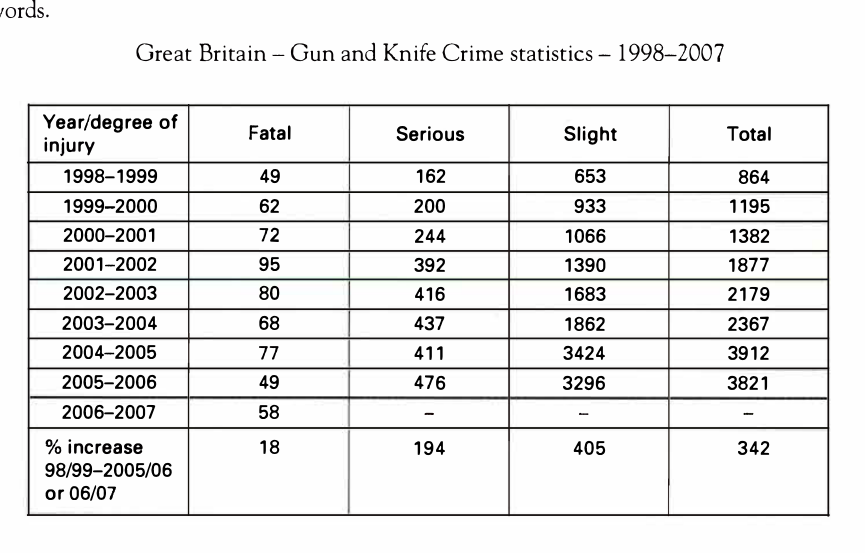
The table shows the number of fatal, serious and slight injuries resulting from gun and knife crime in Great Britain from 1998 to 2007 and the percentage increase for each degree of injury over the period.
Summarise the information by selecting and reporting the main features, and make comparisons where relevant.
Great Britain - Gun and Knife Crime statistics - 1998-2007
Student answer (Band 4.0)
The table illustrates the number of fatal, serious and slight injuries resulting from gun and knife crime in great britain between 1998 and 2007 and the proportion rises for each degree of injury over the period. It describes the year/degree of injury and total in this illustration.
Overall, it is clear that the great britain- gun and knife crime statistics changes from 1998 to 2007 in this table. In [redacted phone], the fatal, serious, slight, had the highest figure, whereas In [redacted phone] the full thing had the lowest number, in this representation.
Looking at the details, in [redacted phone], the fatal was start and percentage was 49, the serious proportion was 162, and the slight ratio was 653, and total 864 in this table. In [redacted phone], the same thing first the proportion was 62, and serious ratio was 200, and slight percentage was 933, and total 1195, in [redacted phone] the same things and the total percentage was 1382 in this illustration. In [redacted phone], the all thing and total percentage was 1877, in this table.
In addition, in [redacted phone] the fatal was 80, the serious was 416, the light was 1683, and the total percentage was 2179, in [redacted phone], the all thing and the total ratio was 2367% in this representation. In [redacted phone], the same thing and the total percentage was 3912, in [redacted phone], the fatal percentage was 58 in this table. The % increase 98/99-2005/6 the fatal percentage was 18, the serious ratio was 194%, the slight was 405, the total percentage was 342, in this table.
AI examiner evaluation
| Criterion | Band |
|---|---|
| Task Achievement / Task Response | 4.0 |
| Coherence and Cohesion | 4.0 |
| Lexical Resource | 4.0 |
| Grammatical Range and Accuracy | 4.5 |
| Overall | 4.0 |
Task Achievement / Task Response: Band 4.0
You identify the subject and include an overview, noting that the figures were lowest in 1998–1999 and that 2004–2005 had a high total. You also report several values accurately, including the 1998–1999 figures and the 2002–2003 total. However, the overview is vague and partly inaccurate: 2004–2005 had the highest total and slight-injury count, but not the highest fatal or serious figures. Several years are then described only as “the same thing,” leaving important trends unclear; for example, serious injuries peaked at 476 in 2005–2006. The 2006–2007 figures for serious and slight injuries are unavailable, and this limitation is not explained. Focus on the main trends and make precise comparisons rather than listing isolated data.
Coherence and Cohesion: Band 4.0
The response has an introduction, an overview and two detail paragraphs, so there is an attempt to organise the information. Basic sequencing phrases such as “Looking at the details” and “In addition” also signal movement between sections. However, the information is not arranged coherently enough: the account jumps between years, repeats “in this table” and “in this illustration,” and uses “the same thing” without making clear which figures or trends are being referred to. Some sentences combine several years and values without clear transitions, while other years receive little or no meaningful description. Group the data by trend or period, use clear references to the injury categories, and connect comparisons explicitly so the reader can follow the progression.
Lexical Resource: Band 4.0
The response uses some relevant task vocabulary, including “fatal,” “serious,” “slight,” “total,” and “percentage,” and the reader can generally recognise the categories being discussed. However, the range is basic and repetitive, with frequent imprecise substitutions such as “proportion,” “ratio,” and “percentage” for the number of injuries. Phrases including “the full thing,” “the same thing,” and “the all thing” are unclear and strain the reader’s understanding. “Light” is also not the table’s label for slight injuries. Use a consistent, accurate vocabulary for counts and trends—for example, “number of injuries,” “rose,” “peaked,” and “fell”—and avoid repeatedly referring to the table instead of describing its data.
Grammatical Range and Accuracy: Band 4.5
You produce several understandable simple statements and attempt longer sentences with time clauses and comparisons, such as “In 2004-2005 … had the highest figure, whereas … had the lowest number.” However, grammatical control is uneven: errors in sentence structure, agreement, articles and punctuation occur frequently enough to make some passages difficult to follow. For example, “the fatal was start” and “the fatal, serious, slight, had the highest figure” are not well-formed, while “the great britain … statistics changes” has a subject–verb agreement problem. Several sentences are joined by commas rather than being clearly separated, and capitalisation is inconsistent. Practise building complete sentences with a clear subject and verb, and check agreement and punctuation when combining comparisons.
See this exact question answered at other band scores. The same prompt compared across bands.
Browse more IELTS Writing model answers or get your own writing scored by the same AI examiner.