Band 5.5 IELTS Writing Task 1 Model Answer
Overall Band Score: 5.5 · IELTS Momentum Workout · 2026-11-12
IELTS Writing Task 1 question
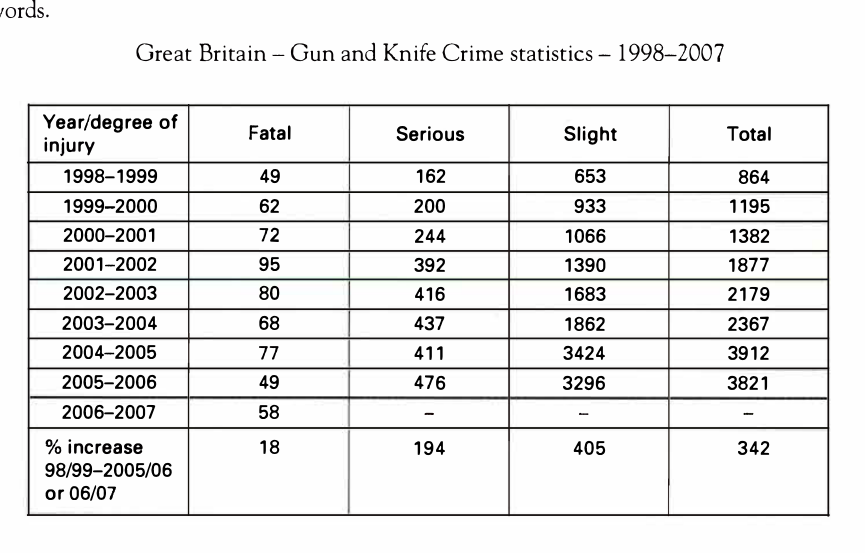
The table shows the number of fatal, serious and slight injuries resulting from gun and knife crime in Great Britain from 1998 to 2007 and the percentage increase for each degree of injury over the period.
Summarise the information by selecting and reporting the main features, and make comparisons where relevant.
Great Britain - Gun and Knife Crime statistics - 1998-2007
Student answer (Band 5.5)
The table below illustrates the gun and knife crime statistics, and the percentage rise for each degree in Britain between 1998 and 2007.
Overall, the table portrays three forms of injuries which include fatal, serious and slight. The intensity goes up from the fatal injuries to the slight ones.
From the first year, fatal injuries are minimal followed by serious and then the slight ones. For instance, in the first year, fatal recorded 49, serious 162, and slight 653. Between 2006 and 2007 only fatal injuries occured in the country accounting to 58 cases. The highest injury cases recorded was for the slight one amounting to 3296 while the least was the 49 cases for the fatal.
Totals for the whole crime increase from the first year to the year between 2005 and 2006. The first year accummulated 864 while latter recored 3821. The percentage increases from the fatal to the slight. The fisrt indicates 18% while the last one shows 405% which is very huge.
AI examiner evaluation
| Criterion | Band |
|---|---|
| Task Achievement / Task Response | 5.0 |
| Coherence and Cohesion | 5.5 |
| Lexical Resource | 5.5 |
| Grammatical Range and Accuracy | 5.5 |
| Overall | 5.5 |
Task Achievement / Task Response: Band 5.0
You identify the table’s subject and report several relevant figures, including the starting values and the overall total rising from 864 to 3,821. However, the response only partially summarises the main features. The overview that injury “intensity goes up” from fatal to slight describes the categories, not the changes over time, and the claim that only fatal injuries occurred in 2006–2007 is inaccurate: the table gives 58 fatal cases but does not provide figures for the other categories. You also call 3,296 the highest slight-injury figure, although the peak is 3,424 in 2004–2005. To strengthen the report, give a clear overview of the trends and compare the major changes accurately, including the substantial rise in slight injuries and the increase in serious injuries.
Coherence and Cohesion: Band 5.5
The response has a recognisable structure: an introduction, an overview, and paragraphs reporting figures and totals. This gives the reader some sense of organisation, and phrases such as “For instance” and “while” help connect examples and comparisons. However, the progression is not consistently clear. The overview focuses on the relative severity categories rather than the table’s changes over time, and the final paragraph moves from totals to percentage increases without explaining how these features relate. Some references are also unclear, such as “the first” and “the last one,” which require the reader to infer the injury categories. Organise the body around clear comparisons—overall totals and category trends—and use explicit labels when referring to figures.
Lexical Resource: Band 5.5
You use enough topic-related vocabulary to communicate the subject, including “fatal,” “serious,” “slight,” “accounting,” and “percentage increases.” There are also attempts at more formal reporting language, such as “illustrates” and “amounting to.” However, the range is limited and some choices are imprecise or unnatural: “the intensity goes up” does not clearly describe the data, and “the first year accumulated 864” is an awkward way to report a total. Spelling errors in “occured,” “accummulated,” “recored,” and “fisrt” are noticeable. Use precise data-reporting collocations and check spelling carefully; for example, say that the total “rose to” a figure and that a category “recorded” a number of cases.
Grammatical Range and Accuracy: Band 5.5
You produce several understandable simple sentences and attempt longer structures, for example, “The highest injury cases recorded was for the slight one amounting to 3296.” However, sentence patterns are repetitive, and errors in agreement and construction sometimes make the meaning less clear. In that example, “cases” is plural, so the verb should agree, and the phrasing needs restructuring. “Between 2006 and 2007 only fatal injuries occured in the country accounting to 58 cases” also combines clauses awkwardly and presents an unsupported meaning. There are some effective basic comparisons, such as “The first year accumulated 864 while latter recored 3821,” but the second clause needs a clearer subject and article. Practise accurate comparative clauses and vary sentence structures while checking agreement and punctuation.
See this exact question answered at other band scores. The same prompt compared across bands.
Browse more IELTS Writing model answers or get your own writing scored by the same AI examiner.