Band 5.5 IELTS Writing Task 1 Model Answer
Overall Band Score: 5.5 · IELTS Momentum Workout · 2026-11-12
IELTS Writing Task 1 question
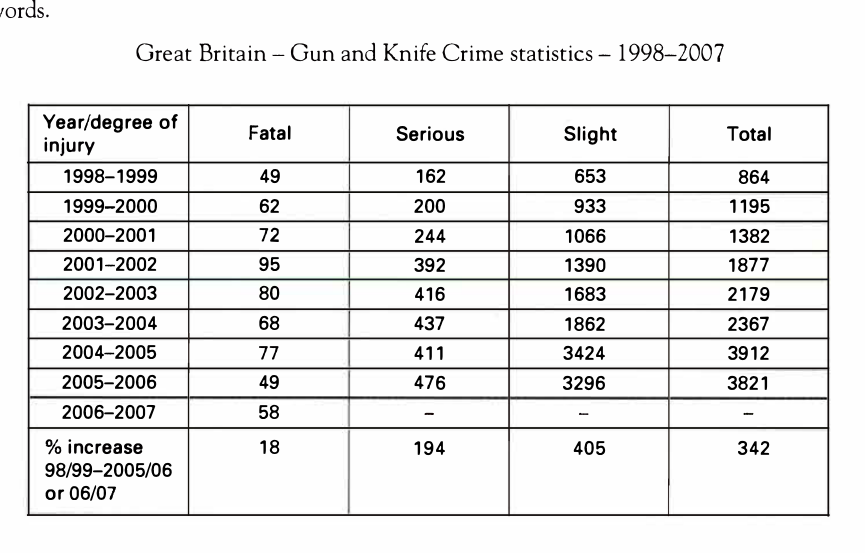
The table shows the number of fatal, serious and slight injuries resulting from gun and knife crime in Great Britain from 1998 to 2007 and the percentage increase for each degree of injury over the period.
Summarise the information by selecting and reporting the main features, and make comparisons where relevant.
Great Britain - Gun and Knife Crime statistics - 1998-2007
Student answer (Band 5.5)
The table comparison among fatal, serious and slight injuries due to gun and knife in Great Britain alongwith percentage increase in crime from 1998 to 2007.
Overall, the total highest number injuries was calculated in the year of [redacted phone] and the lowest injuries occured in the year of [redacted phone]. Similarly, the slight injuries showed the highest proportion and the fatal indicated the lowest percentage.
Looking at the table, 3424 slight injuries happened in the year [redacted phone]. The second position was also taken by slight injuries in [redacted phone] by 3296 cases. In the same year, comparatively 411 cases occured in serious injuries and 77 cases in case of fatal. In addition, 476 cases in terms of serious injuries and 49 cases of fatal. The total highest cases (3912) shown in the year of [redacted phone].
In short, the whole crime are increased in percentage due to gun and knife in Britain. All the injuries are shown in the shape of percentage 18% fatal injuries, 19.4% serious injuries, 40.5% slight injuries and total injuries 34.2% from 1998 to 2007.
AI examiner evaluation
| Criterion | Band |
|---|---|
| Task Achievement / Task Response | 5.0 |
| Coherence and Cohesion | 5.5 |
| Lexical Resource | 5.5 |
| Grammatical Range and Accuracy | 5.0 |
| Overall | 5.5 |
Task Achievement / Task Response: Band 5.0
You identify several relevant features, including the peak total of 3,912 in 2004–05, the low total in 1998–99, and the dominance of slight injuries. However, the report only partially summarises the table: it gives little account of the overall rise across the years and omits the substantial increase in serious injuries. Some figures are also misreported or unclear. For example, 3,296 slight injuries and 476 serious injuries belong to 2005–06, not 2006–07; the table gives no slight or serious figures for 2006–07. The final percentages are expressed incorrectly: 194% and 405% are written as 19.4% and 40.5%. Select the main trends accurately and explain the percentage increases without changing their scale.
Coherence and Cohesion: Band 5.5
The response has a recognisable structure, with an opening, an overview, supporting details and a concluding statement. This gives the reader some organisation, and phrases such as “Overall” and “Looking at the table” help signal movement between sections. However, progression is uneven: the third paragraph jumps between years and injury categories, and “In addition” introduces figures without making clear which year they describe. The conclusion largely repeats the percentage information rather than bringing the main trends together. Group the data more systematically—for example, describe the overall totals first, then compare the injury categories—and use clear references to each year so that connections between figures are easy to follow.
Lexical Resource: Band 5.5
You use some relevant task vocabulary, including “fatal,” “serious,” “slight,” “proportion” and “percentage increase,” so the topic is generally clear. However, the range is limited and several word choices or combinations are unnatural, such as “table comparison,” “the total highest number injuries,” and “the whole crime are increased.” Repetition of “cases” and “injuries” also makes the description less precise. Some expressions obscure the intended comparison, particularly “the second position was also taken by slight injuries.” Use standard data-reporting language and distinguish clearly between injury counts, totals and percentage changes. More accurate collocations would make the report easier to understand and more suitable for an academic summary.
Grammatical Range and Accuracy: Band 5.0
The response includes simple statements and some attempts at longer structures, but grammatical control is inconsistent. Errors occur in agreement and sentence construction, as in “the whole crime are increased,” and in the opening fragment, “The table comparison among…” which does not form a complete sentence. The phrase “the total highest number injuries was calculated” also has problems with articles, word order and the verb used to describe table data. Tense and sentence boundaries are not always handled clearly, which makes some details difficult to interpret. Practise writing complete, direct sentences with accurate subject–verb agreement, articles and plural forms. A wider range of structures will help once these basic patterns are more reliable.
See this exact question answered at other band scores. The same prompt compared across bands.
Browse more IELTS Writing model answers or get your own writing scored by the same AI examiner.