Band 5.0 IELTS Writing Task 1 Model Answer
Overall Band Score: 5.0 · IELTS Momentum Workout · 2026-11-12
IELTS Writing Task 1 question
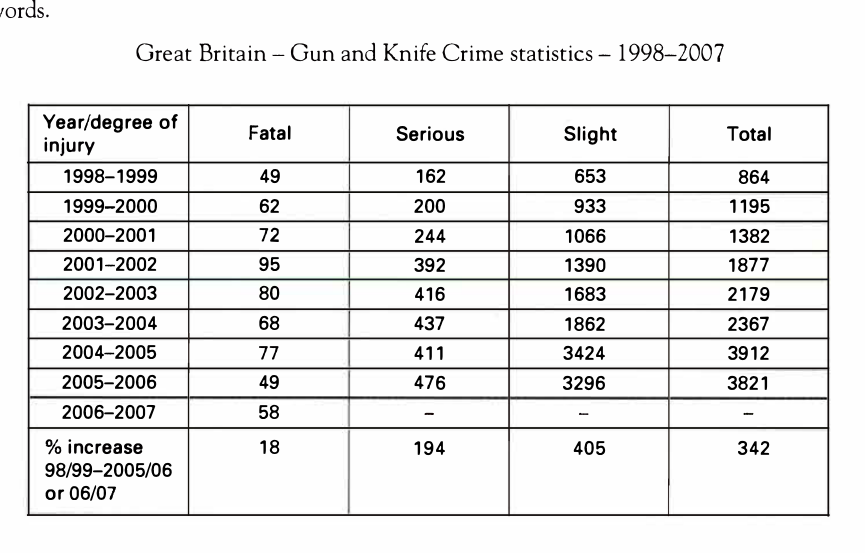
The table shows the number of fatal, serious and slight injuries resulting from gun and knife crime in Great Britain from 1998 to 2007 and the percentage increase for each degree of injury over the period.
Summarise the information by selecting and reporting the main features, and make comparisons where relevant.
Great Britain - Gun and Knife Crime statistics - 1998-2007
Student answer (Band 5.0)
The data table demonstrates the amount of people who sustained different level of injuries from crimes in united kingdom between 1998 and 2007 and the percentage increase for each degree of wound over the period.
Overall, most people suffered from slight injuries. Almost every year, there was increase in number of people who got injured by criminals.
In 1998, people suffered from injuries was at lowest level. A total of 864 people got hurt. 49 were fatally wounded. While, 653 citizens got less life risking injuries. The number of patients increased every year. in 2001, injuries were about double of 1998.
In 2005, there was a massive decline in life risking wounds, as It dropped to 49 people. in 2006 and 2007, the data is not available completely, Only fatal injuries are mentioned. Most increase was recorded in [redacted phone] of about 405 percent. Which is far more than other years.
AI examiner evaluation
| Criterion | Band |
|---|---|
| Task Achievement / Task Response | 4.5 |
| Coherence and Cohesion | 5.5 |
| Lexical Resource | 5.5 |
| Grammatical Range and Accuracy | 5.0 |
| Overall | 5.0 |
Task Achievement / Task Response: Band 4.5
You identify the broad topic and give a basic overview that slight injuries were the most common and the figures generally rose. However, the response reports only a small selection of the table and includes important inaccuracies: the 405% increase applies to slight injuries, not to 2006–2007, and the table gives no complete figures for 2006–2007 beyond the fatal count. The claim that injuries increased every year is also inaccurate, as totals fell from 2004–2005 to 2005–2006. Several key comparisons, including the rise in serious injuries and the overall increase in total cases, are omitted. The response is 141 words, below the 150-word minimum; develop the overview and comparisons with accurate data.
Coherence and Cohesion: Band 5.5
The response has a recognisable sequence: an introduction, an overview, and then details about selected years. This gives the reader some sense of organisation, and time references such as “In 1998” and “In 2005” help locate the information. However, progression is limited because the details are not grouped into clear comparisons, and the final point about the 405% increase is disconnected from the year it describes. Linking words are sometimes awkward or incomplete, as in “While, 653 citizens…” and “Which is far more than other years.” Use complete sentences and organise the body around trends—for example, overall totals and injury categories—so comparisons connect logically rather than appearing as isolated facts.
Lexical Resource: Band 5.5
You use some relevant vocabulary for describing the table, including “percentage increase,” “decline,” “fatal,” and “slight injuries.” This shows a basic ability to discuss changes and injury categories. However, several choices are imprecise or unnatural for an academic data summary: “amount of people” is unsuitable for countable people, “different level of injuries” is awkward, and “life risking wounds” does not accurately describe the categories. “Patients” also suggests medical treatment rather than people recorded in crime statistics. Repeated use of “people,” “injuries,” and “number” limits variety. Aim for precise terms such as “number of victims,” “injury severity,” and “cases,” while retaining the table’s category labels.
Grammatical Range and Accuracy: Band 5.0
The response uses mostly short, simple statements, with a few attempts at more complex structures. Meaning is generally recoverable, but errors occur frequently enough to make some sentences awkward or incomplete. For example, “people suffered from injuries was at lowest level” has faulty sentence structure, while “Almost every year, there was increase” is missing an article. The fragments “While, 653 citizens…” and “Which is far more than other years” should be joined to complete clauses. Capitalisation after full stops is inconsistent (“in 2001,” “as It dropped,” and “in 2006”). Practise accurate sentence patterns for reporting figures, and check articles, verb forms, punctuation, and sentence boundaries.
See this exact question answered at other band scores. The same prompt compared across bands.
Browse more IELTS Writing model answers or get your own writing scored by the same AI examiner.