Band 4.5 IELTS Writing Task 1 Model Answer
Overall Band Score: 4.5 · IELTS Momentum Workout · 2026-11-12
IELTS Writing Task 1 question
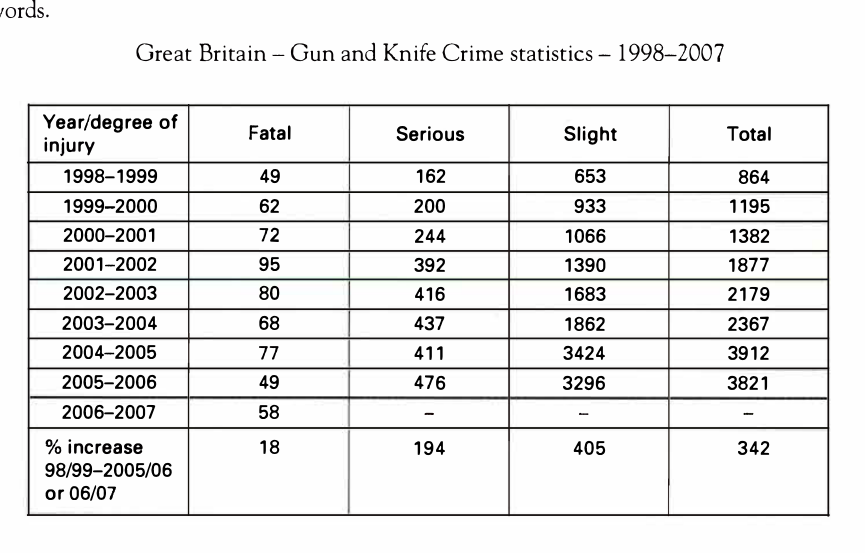
The table shows the number of fatal, serious and slight injuries resulting from gun and knife crime in Great Britain from 1998 to 2007 and the percentage increase for each degree of injury over the period.
Summarise the information by selecting and reporting the main features, and make comparisons where relevant.
Great Britain - Gun and Knife Crime statistics - 1998-2007
Student answer (Band 4.5)
Table illustrates the number of total serious and slight injuries due to gunm and knife crime in great britian from 1998 to 2007 and the proportion rise for each degree of injury over the period
overall,the individual number of degree highest over one year include fatal in [redacted phone] and serious in [redacted phone] and slight in [redacted phone] and the combined injury from one year had highest [redacted phone]
the number of fatal injury remain flactuate over different year and 18
% had found over the year but the numbver of serious injury increased over the year from 1988 to 2007 and recorded as 194%
the number of slight injury had also showed the highest trend over the year and recorded as 405% increase from 1998 to 2007 and this also showed the highest trend among all and in total 342 increased hads occured from 1998 to 2005 from both gun and knife injuries
AI examiner evaluation
| Criterion | Band |
|---|---|
| Task Achievement / Task Response | 4.5 |
| Coherence and Cohesion | 4.5 |
| Lexical Resource | 5.0 |
| Grammatical Range and Accuracy | 4.5 |
| Overall | 4.5 |
Task Achievement / Task Response: Band 4.5
You identify several relevant headline features, including the peak in fatal injuries in 2001–02, the highest serious-injury figure in 2005–06, and the largest total in 2004–05. You also report the percentage increases. However, the overview is unclear and some details are inaccurate: the total peaked at 3,912 in 2004–05, not 2005–06, and slight injuries peaked at 3,424 in 2004–05, rather than being described clearly as a trend. The claim that serious injuries rose from “1988 to 2007” misstates the starting year. The response is also 143 words, below the 150-word minimum; the eight words copied from the prompt are excluded. Develop the main comparisons more accurately and explain the overall pattern.
Coherence and Cohesion: Band 4.5
There is an attempt to organise the response around an overview and then discuss injury categories, and phrases such as “overall” and “the number of” help signal the topic. However, the ideas are compressed into one continuous block rather than separated into clear paragraphs, and the progression is difficult to follow. The opening sentence is incomplete, while the overview combines several peaks without making their relationships clear. Repetition of “the number of” and “over the year” also makes the response feel list-like. Use a short introduction, a distinct overview, and one or two body paragraphs grouped by injury type or trend. Clear sentence boundaries and more precise links between comparisons would make the information easier to follow.
Lexical Resource: Band 5.0
The response uses some task-relevant vocabulary, including “fatal,” “serious,” “slight,” “combined,” and “increase,” so the reader can identify the subject and broad trends. However, the range is limited and several word choices or collocations are inaccurate or repetitive. “Proportion rise” is not a natural way to describe the percentage increase, and “highest trend” does not clearly express a peak or an upward pattern. There are also spelling errors such as “britian,” “flactuate,” and “numbver,” which reduce clarity. Aim for more precise reporting language, such as “the figure peaked at” and “rose by,” and check spelling carefully. This would make the comparisons more exact and easier to understand.
Grammatical Range and Accuracy: Band 4.5
You attempt to communicate several comparisons, but sentence structures are mostly simple or incomplete, and frequent grammatical errors sometimes make the meaning difficult to follow. For example, “Table illustrates” is missing an article, while “the individual number of degree highest over one year include” has an unclear structure and incorrect agreement. The sentence beginning “the number of fatal injury remain” also has problems with number agreement and verb form. Punctuation and capitalisation are inconsistent, with long run-on sequences and missing full stops. Practise building complete sentences with a clear subject and verb, and use past-tense forms consistently when describing the table. Separating each comparison into a sentence will also help you control grammar and punctuation.
See this exact question answered at other band scores. The same prompt compared across bands.
Browse more IELTS Writing model answers or get your own writing scored by the same AI examiner.