Band 5.5 IELTS Writing Task 1 Model Answer
Overall Band Score: 5.5 · IELTS Momentum Workout · 2026-11-13
IELTS Writing Task 1 question
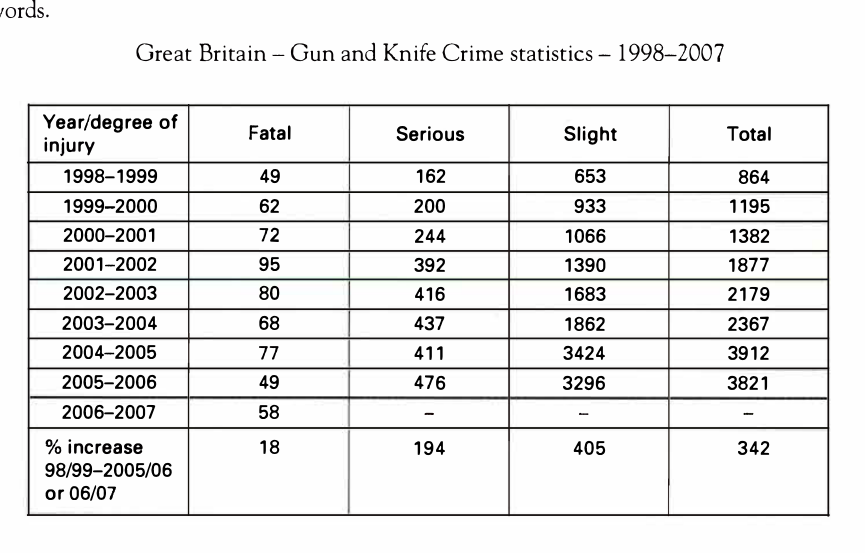
The table shows the number of fatal, serious and slight injuries resulting from gun and knife crime in Great Britain from 1998 to 2007 and the percentage increase for each degree of injury over the period.
Summarise the information by selecting and reporting the main features, and make comparisons where relevant.
Great Britain - Gun and Knife Crime statistics - 1998-2007
Student answer (Band 5.5)
The table presents information about the number of different injuries including fatal, serious, and slight from knife and gun crime in British between 1998 and 2007 and the percentage for each injury throughout the period.
Overall, the Britian experienced highest injury was fatal in between 2001 and 2002 while the serious injury was highest in 2005 to 2006. Meanwhile, slight injury was highest in 2004 to 2005. In addition, in 2006 and 2007 the British experienced only fatal injury from gun and knife. Although, the total injury was highest in 2004 and 2005.
Initially, in 1998 and 1999, the total injury were 864 including slight 653, serious 162 while the cases of fatal were 49. Furthermore, in 1999 and 2000, the total cases were 1195 having fatal 62, serious 200, and slight injury accounted for 933. Although, the total injuries were surged over the time to 3912 in 2005.
Lastly, total 342% cases increased from 1998 to 2007 having 405 of slight injury, 194 from serious and 18% of fatal injury throughout the period.
AI examiner evaluation
| Criterion | Band |
|---|---|
| Task Achievement / Task Response | 5.0 |
| Coherence and Cohesion | 5.5 |
| Lexical Resource | 5.5 |
| Grammatical Range and Accuracy | 5.5 |
| Overall | 5.5 |
Task Achievement / Task Response: Band 5.0
You identify the table’s subject and include several relevant figures, such as the starting total of 864 and the final reported total of 3,912. However, the overview is not consistently accurate: fatal injuries peaked at 95 in 2001–02, but slight injuries peaked at 3,424 in 2004–05 and serious injuries at 476 in 2005–06. The claim that only fatal injuries occurred in 2006–07 is unsupported; the table simply gives no figures for serious, slight or total injuries that year. You also say the total was highest in 2004–05, although 2005–06 is the last year with a total and its figure is lower. To strengthen the response, give a precise overview of the main rises and peaks, and avoid interpreting missing data as zero.
Coherence and Cohesion: Band 5.5
The response has a recognisable structure: an introduction, an overview and paragraphs with figures. This helps the reader identify the topic and some key data. However, progression is limited because the body mainly lists the first two years, then jumps to the total in 2005, without systematically comparing the intervening years or grouping trends. Connectors such as “Although” are used where no contrast follows, and “Lastly” introduces percentage changes without clearly linking them to the earlier account. Organise the body around meaningful patterns—for example, the overall rise in totals and the different peaks in each injury category—and use linking words only when their logical relationship is clear.
Lexical Resource: Band 5.5
You use relevant topic vocabulary, including “fatal,” “serious,” “slight,” “total,” and “percentage,” so the subject is generally clear. There is some attempt at varied phrasing, such as “accounted for” and “surged,” but several word choices or combinations are inaccurate or awkward: “different injuries,” “in British,” “total injury were,” and “342% cases increased.” “Injury” is also repeated frequently where “injuries,” “cases” or “figures” would be more suitable. These issues sometimes make the intended meaning less clear, particularly in the final sentence. Aim for precise data-reporting collocations, such as “the number of injuries,” “in Great Britain,” and “the total rose by 342%.” Check spelling of “Britain” as well.
Grammatical Range and Accuracy: Band 5.5
You attempt both simple and more complex sentences, including clauses beginning with “while” and “Although,” and the reader can understand much of the information. However, errors recur in sentence structure and agreement. For example, “the total injury were 864” has a singular/plural mismatch, while “the Britian experienced highest injury was fatal” lacks a clear grammatical structure. The sentence beginning “Although, the total injuries were surged” combines an unsuitable connector with an incorrect verb form. Articles and prepositions are also often missing or misplaced, as in “in between 2001 and 2002.” Use straightforward, controlled patterns such as “The total number of injuries rose to…” and “Fatal injuries peaked at…” before attempting more complex comparisons.
See this exact question answered at other band scores. The same prompt compared across bands.
Browse more IELTS Writing model answers or get your own writing scored by the same AI examiner.