Band 5.5 IELTS Writing Task 1 Model Answer
Overall Band Score: 5.5 · IELTS Momentum Workout · 2026-11-14
IELTS Writing Task 1 question
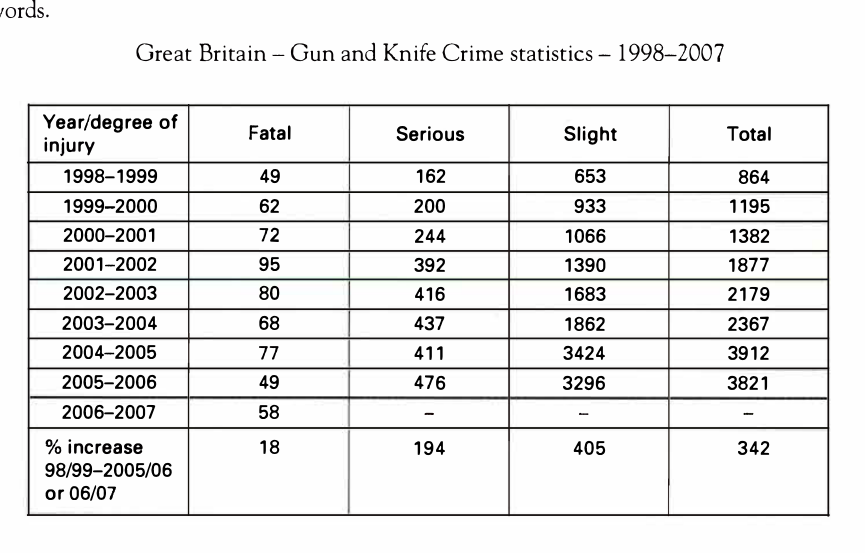
The table shows the number of fatal, serious and slight injuries resulting from gun and knife crime in Great Britain from 1998 to 2007 and the percentage increase for each degree of injury over the period.
Summarise the information by selecting and reporting the main features, and make comparisons where relevant.
Great Britain - Gun and Knife Crime statistics - 1998-2007
Student answer (Band 5.5)
The given table depicts the number of fatal, serious, and slight injuries which happened due to gun and knife crime in the United Kingdom during the period of 1998 to 2007 and the percentage increase of each injury over these years.
Firstly, the fatal injuries from 1998 to 2007 fluctuated over the years. There was an increment in the earlier years but took a dip by 2007 in the number. Subsequently, serious injuries soared high during this period whereas slight injuries took a surge in the number. The percentage increase also showed statistics that illustrated significant increase. The fatal injuries are comparatively less when compared to serious and slight injuries with the latter one being the highest.
Overall, it is clear from all the perspective that gun and knife crimes in the United Kingdom has risen high from 1998 up to date.
AI examiner evaluation
| Criterion | Band |
|---|---|
| Task Achievement / Task Response | 4.5 |
| Coherence and Cohesion | 6.0 |
| Lexical Resource | 5.5 |
| Grammatical Range and Accuracy | 5.5 |
| Overall | 5.5 |
Task Achievement / Task Response: Band 4.5
The response identifies the broad pattern that fatal injuries fluctuated while serious and slight injuries increased, and it notes that slight injuries were the most numerous. However, the account is very general and does not report key figures or make clear comparisons across the years. For example, slight injuries rose sharply to 3,424 in 2004–05, while serious injuries reached 476 in 2005–06; these important details are omitted. The claim that crime rose “up to date” is also unsupported, as the table ends in 2006–07 and gives no total for that final year. The response is 134 words, below the 150-word minimum; eight words copied from the prompt were not counted. Develop the overview with accurate figures and cover the table’s main changes.
Coherence and Cohesion: Band 6.0
The response has a recognisable overall arrangement: it introduces the table, groups the injury categories in the next section, and ends with a summary. Linking expressions such as “Firstly,” “Subsequently,” and “Overall” help signal this progression. However, the middle section moves quickly between trends and the percentage increase without explaining how the points relate, and “the latter one” is not a fully clear reference. The final sentence largely repeats the general idea of an increase rather than drawing together the specific trends. Organise the body around clear comparisons—for example, fatal injuries versus the two more common categories—and use linking phrases to show changes over time rather than simply marking sequence.
Lexical Resource: Band 5.5
The response uses some relevant vocabulary for describing data, including “fluctuated,” “increment,” “soared,” and “percentage increase.” This gives it enough range to communicate the broad trends, although several choices are imprecise or unnatural in this context. “Soared high” and “took a surge in the number” are awkward collocations, while “from all the perspective” does not express the intended summary clearly. “United Kingdom” is also less precise than the table’s “Great Britain.” Use standard data-reporting language and distinguish between a rise in injury counts and a rise in the overall crime rate, which the table does not directly establish. More precise wording would make the comparisons clearer.
Grammatical Range and Accuracy: Band 5.5
There is some variety in sentence construction, including a relative clause in the opening (“injuries which happened…”) and a contrast between categories in the second paragraph. Most sentences remain understandable, but some grammatical choices reduce accuracy. In “the fatal injuries… fluctuated… There was an increment… but took a dip,” the second clause lacks a clear subject; “the number” would need to be stated as what took a dip. The final sentence also has subject–verb disagreement: “gun and knife crimes… has risen” should use “have risen.” The phrase “from 1998 to 2007” is understandable, though the table presents annual periods. Aim for complete clauses and check agreement, while retaining a mix of simple and more complex sentence forms.
See this exact question answered at other band scores. The same prompt compared across bands.
Browse more IELTS Writing model answers or get your own writing scored by the same AI examiner.