Band 5.0 IELTS Writing Task 1 Model Answer
Overall Band Score: 5.0 · IELTS Momentum Workout · 2026-11-14
IELTS Writing Task 1 question
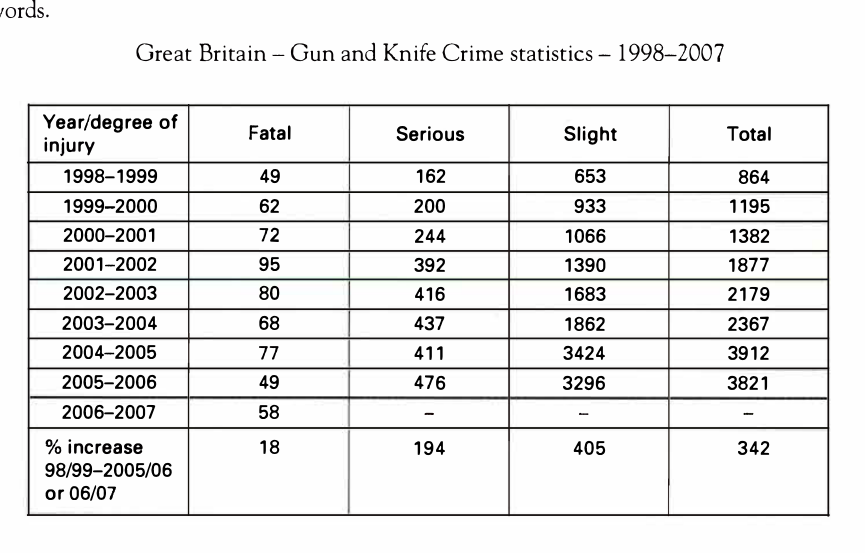
The table shows the number of fatal, serious and slight injuries resulting from gun and knife crime in Great Britain from 1998 to 2007 and the percentage increase for each degree of injury over the period.
Summarise the information by selecting and reporting the main features, and make comparisons where relevant.
Great Britain - Gun and Knife Crime statistics - 1998-2007
Student answer (Band 5.0)
The given table illustrates the information about number of injuries of crime cases from gun and knife in Great Britain from 1998 to 2007.
Overall, this table gives the information about fatal, serious and slight injuries. Highest number of injured patients was in 2006 lowest cases was in 1998.
In [redacted phone] the lowest number of total individuals injured 864, among them 653 was slightly injured. In [redacted phone] there was the second lowest number of injured 1195 total among them 933 was slightly injured. Between [redacted phone] there was 1382 total number 1066 from them was slightly injured. In [redacted phone] there was 1877 same as above highest numbers was involved by slightly involved patients. In upcoming year of [redacted phone] there was 2170 individuals are affected among them highest number of slightly injured ones.
In [redacted phone] there was 2367 harmed ones as above from them highest number of individuals was slightly harmed. Meanwhile, in [redacted phone] and [redacted phone], 3912 which was highest number of harmed above all year and 3821 respectively, the number raise in percentage in all duration was 18% fatal, 194 serious, 405 slight and 342 total.
AI examiner evaluation
| Criterion | Band |
|---|---|
| Task Achievement / Task Response | 4.5 |
| Coherence and Cohesion | 5.0 |
| Lexical Resource | 5.0 |
| Grammatical Range and Accuracy | 5.0 |
| Overall | 5.0 |
Task Achievement / Task Response: Band 4.5
You identify the table’s subject and report several relevant totals, including 864 in 1998–99 and the peak of 3,912 in 2004–05. However, the overview is unclear and partly inaccurate: saying the highest figure was in “2006” does not identify the correct period, and the lowest was in 1998–99. The response mainly lists yearly totals rather than selecting and comparing the main patterns. It also omits the final 2006–07 fatal figure and does not explain that slight injuries were consistently the largest category. Some figures are inaccurate: the 2002–03 total is 2,179, not 2,170, and the percentage increases need percent signs. A clearer overview and more accurate, selective comparisons would strengthen the report.
Coherence and Cohesion: Band 5.0
The response has a basic structure: an introduction, an overview, and a chronological account of the figures. This gives the reader some sense of how the data is being presented. However, progression is limited because most of the body repeats one year after another, often using similar wording such as “among them” and “highest number.” The overview does not clearly guide the reader toward the main trends, and the final sentence combines two totals with percentage changes without a clear relationship between them. Use paragraphs to group the overall pattern and key comparisons, and use linking expressions selectively to show contrast or change rather than relying on a year-by-year list.
Lexical Resource: Band 5.0
You use some relevant vocabulary, including “fatal,” “serious,” “slightly injured,” and “percentage,” so the topic is generally recognisable. However, the range is limited and several expressions are unnatural or imprecise, such as “injured patients,” “harmed ones,” and “highest numbers was involved by slightly involved patients.” These choices make parts of the report difficult to interpret and do not consistently describe crime statistics in an appropriate academic style. Prefer precise terms such as “people injured,” “slight injuries,” and “accounted for the largest number.” Also avoid repeating “individuals” and “number” when a more concise phrase can express the comparison clearly.
Grammatical Range and Accuracy: Band 5.0
You attempt both simple statements and longer sentences, and the reader can understand the general subject and many of the figures. However, complex sentences are often faulty, and errors occur frequently enough to make some relationships unclear. For example, “Highest number of injured patients was in 2006 lowest cases was in 1998” joins two clauses without suitable punctuation and has missing articles. In “there was 1877 same as above highest numbers was involved,” the sentence structure and subject–verb agreement are problematic. Practise forming complete comparisons with a clear subject and verb, and check articles, plurals, agreement, and punctuation. Shorter, accurately controlled sentences would improve clarity before you attempt more complex structures.
See this exact question answered at other band scores. The same prompt compared across bands.
Browse more IELTS Writing model answers or get your own writing scored by the same AI examiner.