Band 5.5 IELTS Writing Task 1 Model Answer
Overall Band Score: 5.5 · IELTS Momentum Workout · 2026-11-14
IELTS Writing Task 1 question
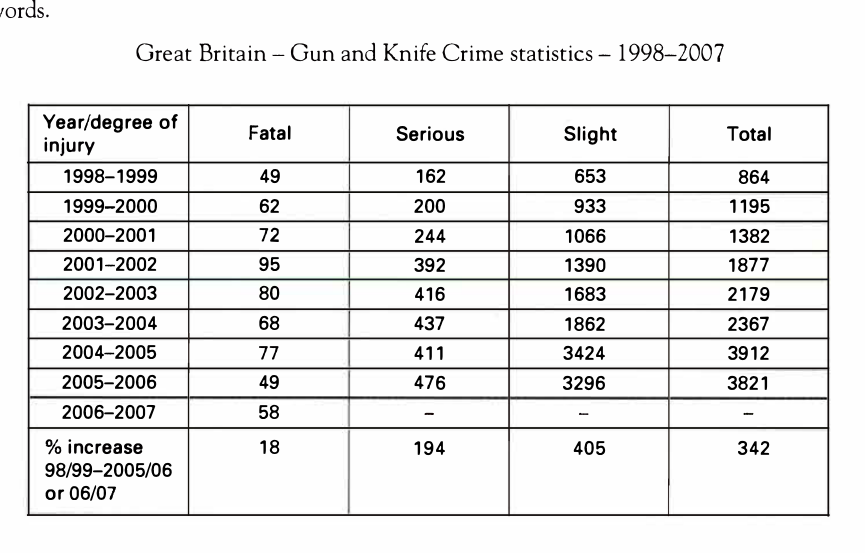
The table shows the number of fatal, serious and slight injuries resulting from gun and knife crime in Great Britain from 1998 to 2007 and the percentage increase for each degree of injury over the period.
Summarise the information by selecting and reporting the main features, and make comparisons where relevant.
Great Britain - Gun and Knife Crime statistics - 1998-2007
Student answer (Band 5.5)
The table presents the number and proportionate rise in deadly, serious and mild injuries caused by gun and knife crime in Great Britain between 1998 to 2007.
Overall, there was an increase in the percentage of people in three injury categories. A greater proportion of people were hurt slightly. A large share of people got seriously hurt while a relatively less portion were dead.
In [redacted phone], 653 cases of slight injury were reported which was the highest number as compared to fatal cases which were only 49 and 162 cases of serious injury.
These trend continued to rise with the category of slight injury being on the top of the list from the beginning of the period till 2006. In 2007 such type of cases were not reported.
AI examiner evaluation
| Criterion | Band |
|---|---|
| Task Achievement / Task Response | 4.0 |
| Coherence and Cohesion | 5.5 |
| Lexical Resource | 6.0 |
| Grammatical Range and Accuracy | 6.0 |
| Overall | 5.5 |
Task Achievement / Task Response: Band 4.0
You identify the broad pattern that slight injuries were the most numerous, and you give some accurate opening figures: 653 slight, 49 fatal and 162 serious cases in 1998–99. However, the overview is imprecise: the table reports numbers of injuries, not proportions of people, and the percentage increases apply to the period rather than describing a yearly rise in all three categories. The claim that slight injuries were not reported in 2006–07 is also unsupported; the table gives dashes for slight, serious and total figures, so these are unavailable, not zero. You omit the substantial overall rise and the key percentage increases. The response is 22 words below the required minimum, which further limits the detail and comparisons provided.
Coherence and Cohesion: Band 5.5
The response has a recognisable structure, with an introductory sentence, an overview and two paragraphs of detail. The progression from the general pattern to the first year’s figures is understandable, and phrases such as “Overall” and “In 1998-1999” help signal the stages. However, the final paragraph repeats the idea that slight injuries were highest without adding much supporting comparison, and the account stops before covering the later figures or the percentage changes. Some references are unclear: “These trend” does not clearly identify which figures are meant, while “such type of cases” is vague. Develop a clearer sequence by grouping the overall trends first, then comparing the main figures across the period.
Lexical Resource: Band 6.0
You use a reasonable range of topic-related vocabulary, including “fatal,” “serious,” “slight,” “proportionate rise” and “reported,” and the meaning is generally clear. There are also attempts to vary wording, such as “mild injuries” and “deadly,” although these are less precise than the table’s labels: “slight” and “fatal.” Some collocations and expressions are awkward, including “a relatively less portion were dead” and “on the top of the list.” The phrase “percentage of people” also misrepresents what the table measures. Aim for precise statistical language, for example “the number of injuries,” “accounted for the largest figure,” and “rose by 405%.” This would make the description more natural and accurate.
Grammatical Range and Accuracy: Band 6.0
You use both simple sentences and more developed structures, including the relative clause “which was the highest number” and the comparison “as compared to fatal cases.” Most of the message remains understandable, but some grammatical errors are noticeable. In “between 1998 to 2007,” use “between 1998 and 2007”; “These trend continued” needs plural agreement (“These trends continued”); and “a relatively less portion” has an incorrect comparative construction. The sentence “A large share of people got seriously hurt while a relatively less portion were dead” also has awkward parallel structure. Practise accurate agreement, articles and comparative forms, and use complete comparisons such as “the figure for slight injuries was much higher than the figures for serious and fatal injuries.”
See this exact question answered at other band scores. The same prompt compared across bands.
Browse more IELTS Writing model answers or get your own writing scored by the same AI examiner.