Band 5.0 IELTS Writing Task 1 Model Answer
Overall Band Score: 5.0 · IELTS Momentum Workout · 2026-11-14
IELTS Writing Task 1 question
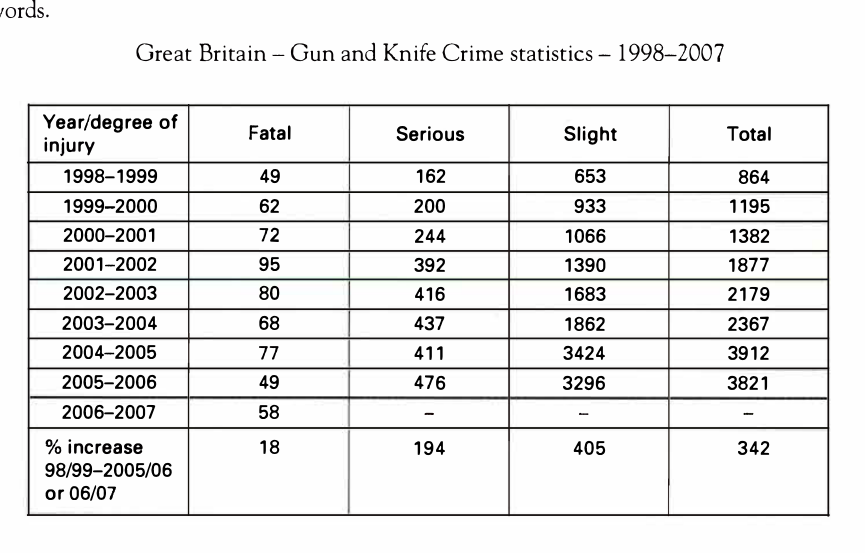
The table shows the number of fatal, serious and slight injuries resulting from gun and knife crime in Great Britain from 1998 to 2007 and the percentage increase for each degree of injury over the period.
Summarise the information by selecting and reporting the main features, and make comparisons where relevant.
Great Britain - Gun and Knife Crime statistics - 1998-2007
Student answer (Band 5.0)
The table illustrates the increasing percentage of fatal, serious and slight injuries resulting from gun and knife crime statistics in Great Britain from 1998 to 2007.
Overall, Fatal injuries have been occurs very low in the period of [redacted phone] and [redacted phone] than compared to others. While slight cases was increased by 2005 - 2006, it has high crime percentage by comparing overall.
Firstly, Fatal injuries have been increased slightly from 1998 to 2002 whereas 49 in [redacted phone], it becomes 62 in [redacted phone] , again it increases 10 in 2000 - 2001 and it should reach to 95 in [redacted phone]. While fatal injuries start reducing from 2003 and it becomes 58 in [redacted phone].
Secondly, serious injured cases were increased gradually and suddenly it falls but in [redacted phone], then serious crimes 476. Furthermore, slightly injured crimes are sharply increases and it changes from 653 to 3296 with high crimes by 2007. Moreover, more cases are occur in [redacted phone] with including Fatal, Serious and Slight.
AI examiner evaluation
| Criterion | Band |
|---|---|
| Task Achievement / Task Response | 5.0 |
| Coherence and Cohesion | 5.5 |
| Lexical Resource | 5.0 |
| Grammatical Range and Accuracy | 5.0 |
| Overall | 5.0 |
Task Achievement / Task Response: Band 5.0
You identify the broad pattern that slight injuries were the most numerous and mention changes in all three injury categories. However, the overview is unclear and partly inaccurate: fatal injuries were not consistently “very low” in 1998–99 and 2005–06 compared with every other year, and slight injuries peaked at 3,424 in 2004–05 before falling to 3,296 in 2005–06. The response also says serious injuries “falls” in 2005–06, although they rose to 476, the highest recorded figure. Several details are reported, but the total figures and the overall increases are not clearly summarised. To strengthen the response, give a precise overview of the main trends and compare the categories using accurate figures.
Coherence and Cohesion: Band 5.5
The response has a basic structure: an introduction, an overview, and two paragraphs beginning with “Firstly” and “Secondly.” These markers help the reader recognise the shift between injury categories. However, the progression within paragraphs is sometimes difficult to follow, particularly where several trends are joined in long or incomplete sentences. For example, “While fatal injuries start reducing from 2003 and it becomes 58” does not clearly connect the time period to the figure, and the final sentence introduces the 2004–05 peak without explaining how it relates to the preceding comparison. Use clearer topic sentences and organise each category’s figures in chronological order. More precise linking and reference would make the comparisons easier to follow.
Lexical Resource: Band 5.0
You use relevant task vocabulary, including “fatal injuries,” “serious,” “slight,” “increased,” and “reducing,” so the reader can identify the categories being discussed. However, the range is limited and some word choices or combinations are inaccurate, which sometimes makes the intended meaning unclear. For instance, “increasing percentage” misdescribes a table of injury counts and percentage increases, while “serious injured cases” and “slightly injured crimes” are not natural expressions. Repeated use of “increases” and “crimes” also reduces precision. Choose terms that distinguish the number of injuries from the percentage change, such as “the number of cases” and “rose by.” More accurate collocations would make the report clearer and more formal.
Grammatical Range and Accuracy: Band 5.0
You attempt both simple and more complex sentences, including clauses introduced by “whereas,” “while,” and “although.” However, these attempts often contain errors in verb forms, agreement, and sentence construction, so meaning is not always easy to follow. Examples include “Fatal injuries have been occurs,” “slight cases was increased,” and “more cases are occur.” The sentence beginning “whereas 49 in 1998-1999” is also incomplete, and “it becomes 58” has an unclear reference. Practise forming accurate past-tense comparisons: for example, “Fatal injuries rose from 49 in 1998–99 to 95 in 2001–02, then fell.” Building reliable simple sentences before adding subordinate clauses will improve control.
See this exact question answered at other band scores. The same prompt compared across bands.
Browse more IELTS Writing model answers or get your own writing scored by the same AI examiner.