Band 5.5 IELTS Writing Task 1 Model Answer
Overall Band Score: 5.5 · IELTS Momentum Workout · 2026-11-14
IELTS Writing Task 1 question
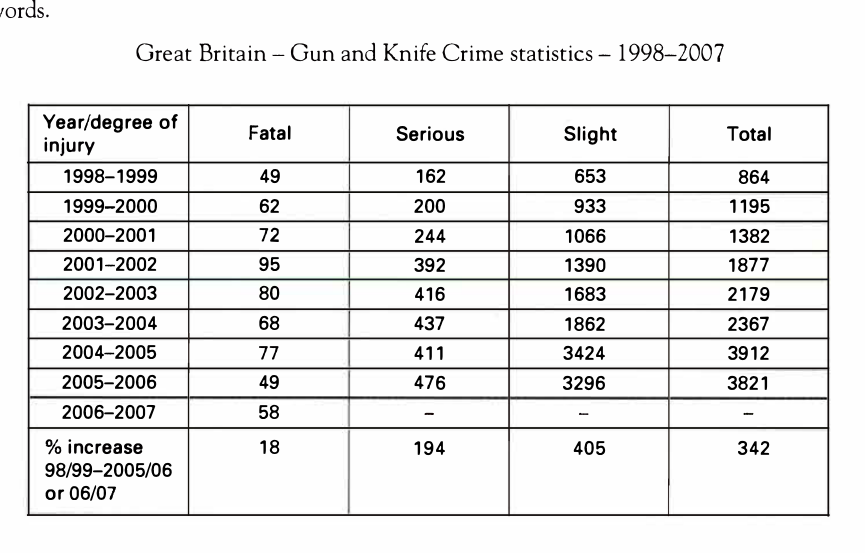
The table shows the number of fatal, serious and slight injuries resulting from gun and knife crime in Great Britain from 1998 to 2007 and the percentage increase for each degree of injury over the period.
Summarise the information by selecting and reporting the main features, and make comparisons where relevant.
Great Britain - Gun and Knife Crime statistics - 1998-2007
Student answer (Band 5.5)
The table illustrates, fatal, serious and slight injuries from gun and knife crimes in the Grate Britain from the year 1998 to 2007 along with the percentage of each degree of harm over the time.
Overall, an increase is been seen in all types of crimes. Most crime performed among these years is in between 2006 to 2007 whereas the least in between 1998 to 1999. In both cases the most contribution is done by crimes which did slight injuries and least by the crimes were of fatal injuries.
In the year 1998 to 1999 crimes with fatal injuries were at their minimum level with 49 which increased drastically in the year 2001 to 2002 with 95 which decreased till the year 2006 to 2007 and got to 15 with an overall increase percentage as 18%. The crimes which caused serious injuries were 162 in year 1999 which increased and reached at 476 in 2006 with an increase percentage as 194%.
Whereas the crimes which created slight injuries were 654 at its initial stage which increased drastically at reached at 3821 in the year 2006 with a increase percent as 405%.
AI examiner evaluation
| Criterion | Band |
|---|---|
| Task Achievement / Task Response | 5.5 |
| Coherence and Cohesion | 6.0 |
| Lexical Resource | 5.5 |
| Grammatical Range and Accuracy | 5.0 |
| Overall | 5.5 |
Task Achievement / Task Response: Band 5.5
You identify the broad pattern that injury figures rose overall and note that slight injuries made up the largest category, which gives the response a relevant overview. However, some key details are inaccurate or unclear: the highest total was 3,912 in 2004–05, not 2006–07, for which the table gives no total; fatal injuries fell to 49 in 2005–06, not 15 in 2006–07; and the slight-injury figure in 2005–06 was 3,296, not 3,821. The response also omits the total column and does not clearly compare the categories across the period. To develop the report, select accurate peak and end-period figures and explain the overall changes more precisely.
Coherence and Cohesion: Band 6.0
The response has a recognisable structure: an introduction, an overview, and paragraphs describing the injury categories. This makes the information broadly easy to follow, and transitions such as “Whereas” signal a shift in focus. However, the progression is weakened by unclear references and some mechanical linking. For example, “Most crime performed among these years” does not clearly identify whether you mean incidents, injuries, or the total, while “In both cases” has an uncertain reference. The final paragraph also presents slight injuries without connecting their trend to the other categories or the total. Use clearer topic sentences and group related comparisons together; ensure each linking phrase refers unambiguously to the data just mentioned.
Lexical Resource: Band 5.5
You use relevant terms such as “fatal,” “serious,” “slight,” “increased,” and “percentage,” so the reader can generally understand the subject and direction of change. There are also attempts to vary wording with phrases such as “minimum level” and “increased drastically.” However, several choices are inaccurate or unnatural for describing a table: “crimes performed” and “crimes which created slight injuries” are awkward, and “contribution” is not the clearest way to describe the largest injury category. “Grate Britain” is also misspelled. Aim for precise collocations such as “the number of injuries,” “accounted for the largest share,” and “rose substantially.” This would make the report more natural and reduce ambiguity without requiring more elaborate vocabulary.
Grammatical Range and Accuracy: Band 5.0
You attempt both simple statements and longer sentences, including clauses linked with “which,” and the overall meaning is usually recoverable. However, control is inconsistent, and several sentence patterns contain errors. Examples include “an increase is been seen,” where the verb form is faulty, and “which increased drastically at reached at 95,” where the clause structure and verb pattern break down. There are also problems with articles and number agreement in phrases such as “a increase percent” and “slight injuries were 654 at its initial stage.” Some sentences join several changes together, making the timeline difficult to follow. Practise accurate past-tense reporting and build comparisons in shorter, complete sentences before adding subordinate clauses.
See this exact question answered at other band scores. The same prompt compared across bands.
Browse more IELTS Writing model answers or get your own writing scored by the same AI examiner.