Band 6.0 IELTS Writing Task 1 Model Answer
Overall Band Score: 6.0 · IELTS Momentum Workout · 2026-11-15
IELTS Writing Task 1 question
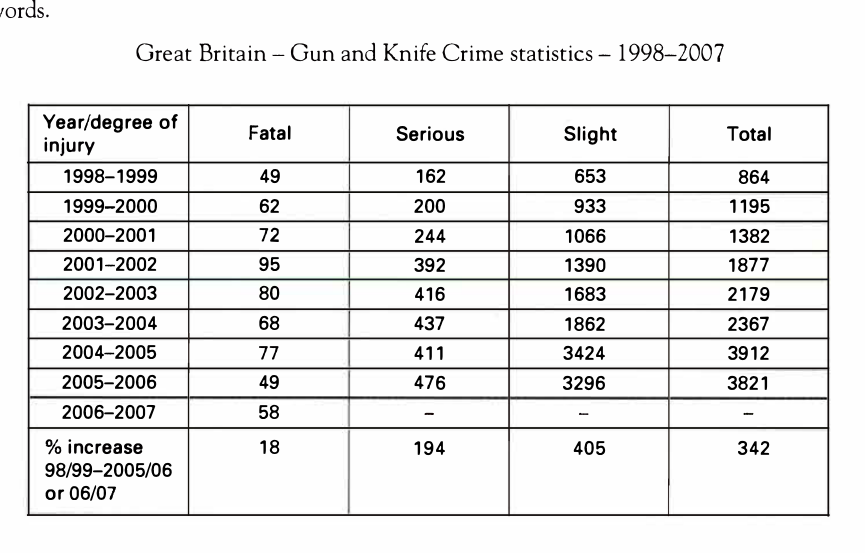
The table shows the number of fatal, serious and slight injuries resulting from gun and knife crime in Great Britain from 1998 to 2007 and the percentage increase for each degree of injury over the period.
Summarise the information by selecting and reporting the main features, and make comparisons where relevant.
Great Britain - Gun and Knife Crime statistics - 1998-2007
Student answer (Band 6.0)
The table illustrates the number of fatal, serious and slight injuries resulting from gun and knife crime in Great Britain from 1998 to 2007 and the percentage increase for each degree of injury over the period.
Overall, it is clear that all the categories increased over the period. The highest increase was in the slight injuries category, whereas the lowest increase was shown by fatal injuries.
To begin with, in [redacted phone], there were 49 fatal injuries. The figure increased to 72 by [redacted phone] and reached the peak of 95 in [redacted phone] before falling to 80 in [redacted phone]. A decline is seen in the figure by [redacted phone] and reached to 58 showing an increase of 18% overall. However, in [redacted phone], there were 162 serious injuries and the count increased to 437 injuries in [redacted phone] before dropping to 411 in [redacted phone]. In contrast, the figure of injuries increased to 476 by [redacted phone]. In general, serious injuries rose by 194%.
Turning to remaining data, slight injuries accounted for 653 in [redacted phone] and rose sharply to 1390 in [redacted phone] and reached the highest of 3296 by [redacted phone] showing an increase of 405%. Overall, the figure of total injuries climbed from 864 in [redacted phone] to 3821 by [redacted phone] showing an increase of 342%.
AI examiner evaluation
| Criterion | Band |
|---|---|
| Task Achievement / Task Response | 6.0 |
| Coherence and Cohesion | 6.0 |
| Lexical Resource | 6.0 |
| Grammatical Range and Accuracy | 5.5 |
| Overall | 6.0 |
Task Achievement / Task Response: Band 6.0
You identify the main overall pattern and make relevant comparisons, including the sharpest percentage rise in slight injuries (405%) and the smallest in fatal injuries (18%). You also select useful figures for fatal and serious injuries and report the total rising from 864 to 3,821. However, the overview that “all the categories increased” is too broad: fatal injuries fluctuate and finish at 58, while the table gives no final-year figures for serious, slight or total injuries. The statement that slight injuries reached 3,296 “by 2005–2006” is accurate, but the earlier rise to 1,862 and the jump to 3,424 in 2004–2005 are omitted. Clarify the period covered by the percentage row and distinguish trends from endpoint comparisons.
Coherence and Cohesion: Band 6.0
The response has a clear four-part structure: introduction, overview, and two body paragraphs grouped by injury type. Sequencing is generally easy to follow, and phrases such as “To begin with” and “Turning to remaining data” signal transitions. However, some linking is mechanical or imprecise. “However” does not clearly express the relationship between the fatal and serious figures, while “In contrast” introduces a rise in serious injuries without a clear opposing point. The overview also says all categories increased, then the body describes fluctuations, which weakens the progression of the account. Group related comparisons more consistently and use references such as “this figure” only when the category is unmistakable.
Lexical Resource: Band 6.0
You use an adequate range of task-related vocabulary, including “fatal injuries,” “decline,” “peak,” “rose sharply,” and “accounted for.” These choices make the main trends understandable, and there is some variation in how increases are described. At times, however, wording is repetitive or imprecise: “figure” and “increased” recur frequently, and “reached the highest of 3296” is not a natural collocation. “Showing an increase of 18% overall” also risks suggesting a general trend rather than reporting the table’s percentage comparison. Use more precise alternatives such as “stood at,” “climbed to,” or “recorded a rise of,” and vary the language without obscuring which injury category is being discussed.
Grammatical Range and Accuracy: Band 5.5
You use a mix of simple and complex sentence forms, including time clauses and participle phrases, and most of the meaning remains clear. Some grammatical errors persist, particularly in sentence construction and verb patterns. For example, “A decline is seen in the figure by 2006-2007 and reached to 58” shifts awkwardly from passive to active and has an incorrect verb pattern; “reached to” should be “reached.” In “reached the highest of 3296,” the structure is also faulty. The sentence beginning “However, in 1998-1999” joins two category descriptions in a way that is difficult to manage. Aim for complete, parallel clauses and check tense consistency when describing past data.
See this exact question answered at other band scores. The same prompt compared across bands.
Browse more IELTS Writing model answers or get your own writing scored by the same AI examiner.