Band 5.0 IELTS Writing Task 1 Model Answer
Overall Band Score: 5.0 · IELTS Momentum Workout · 2026-11-15
IELTS Writing Task 1 question
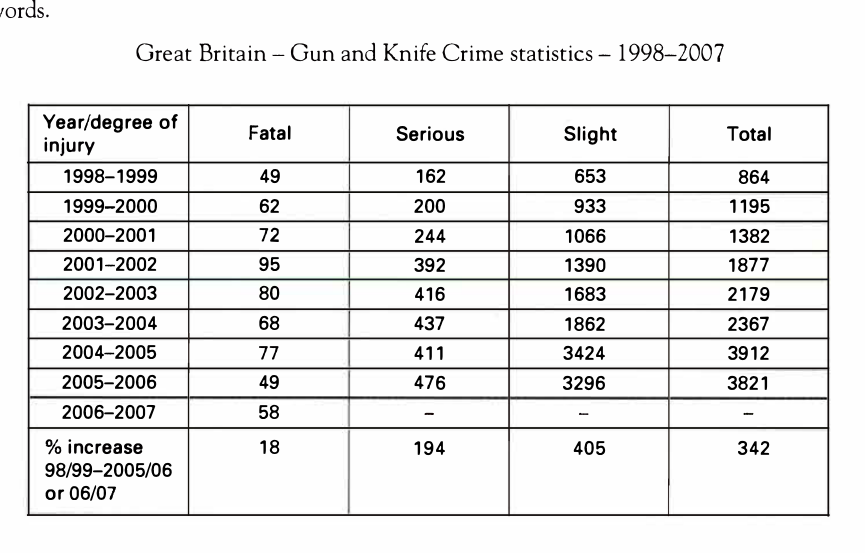
The table shows the number of fatal, serious and slight injuries resulting from gun and knife crime in Great Britain from 1998 to 2007 and the percentage increase for each degree of injury over the period.
Summarise the information by selecting and reporting the main features, and make comparisons where relevant.
Great Britain - Gun and Knife Crime statistics - 1998-2007
Student answer (Band 5.0)
The table illustrate the number of fatal, serious and slight injuries resulting from gun and knife crime in Great Britain from 1998 to 2007 and the percentage increase for each degree of injury over the period.
Overall, the number of injuries increased significantly during this period.slight injuries were highest in number while, fatal injuries were the lowest.
In [redacted phone] there were 49 injuries of fatal.162 injuries of serious and 653 injuries of slight very high from other two.However, in [redacted phone] in this year injuries were growing rapidly but with low record. then in [redacted phone] they make a new record of having at least 3424 in slight and the other were like serious were 411 and fatal on 77.
So, great britain gun and knife crime statistics from 1998 to 2007 has been ended with increase of fatal with 18. serious like 194 and the last one was slight highest from all of them.
AI examiner evaluation
| Criterion | Band |
|---|---|
| Task Achievement / Task Response | 4.5 |
| Coherence and Cohesion | 5.0 |
| Lexical Resource | 5.0 |
| Grammatical Range and Accuracy | 4.5 |
| Overall | 5.0 |
Task Achievement / Task Response: Band 4.5
You identify the subject and give a basic overview that slight injuries were the most numerous and fatal injuries the fewest. You also select some figures, including the 1998–99 values and the slight-injury peak in 2004–05. However, the account is only partial: it does not describe the overall progression across the years, and the claim that injuries rose significantly is not qualified by the later fall in total cases from 3,912 to 3,821. The final percentage increases are mentioned incompletely, with no clear comparison of all four categories. The response is 120 words, below the required 150, which limits the opportunity to summarise and support the main features.
Coherence and Cohesion: Band 5.0
The response has a recognisable structure: an introduction, an overview, a paragraph with selected figures, and a brief concluding statement. This gives the reader some sense of organisation. However, progression between ideas is weak, and the body does not clearly group or compare the data. For example, “However, in 1999-2000” does not introduce a clear contrast, while “So” begins a conclusion that largely repeats the percentage information without explaining it. Several sentences run together or are separated by full stops where the ideas need clearer links. To improve, organise the body chronologically or by injury severity, and use linking phrases to show trends and comparisons accurately.
Lexical Resource: Band 5.0
You use relevant topic vocabulary such as “fatal,” “serious,” “slight,” “percentage increase,” and “record,” so the reader can identify the subject and some key features. However, the range is limited and several word combinations are unnatural or imprecise, including “injuries of fatal,” “they make a new record,” and “has been ended with increase.” Repetition of “injuries” and “increase” also makes the account less precise. Choose standard data-reporting expressions such as “fatal injuries,” “reached a peak,” and “rose by,” and distinguish clearly between the number of cases and the percentage increase. This would make the comparisons easier to understand.
Grammatical Range and Accuracy: Band 4.5
You attempt an overview and some longer sentences, but sentence structures are mostly simple, and errors are frequent enough to make parts of the response difficult to follow. Examples include the subject–verb disagreement in “The table illustrate,” the incomplete sentence “slight injuries were highest in number while, fatal injuries were the lowest,” and the faulty construction “in 1999-2000 in this year injuries were growing rapidly.” Punctuation also causes problems: several figures are joined by full stops without spaces, and sentence boundaries are unclear. Practise forming complete sentences with accurate subjects and verbs, and use commas and full stops to separate ideas. A wider range of controlled sentence patterns would help present trends more clearly.
See this exact question answered at other band scores. The same prompt compared across bands.
Browse more IELTS Writing model answers or get your own writing scored by the same AI examiner.