Band 6.0 IELTS Writing Task 1 Model Answer
Overall Band Score: 6.0 · IELTS Momentum Workout · 2026-11-16
IELTS Writing Task 1 question
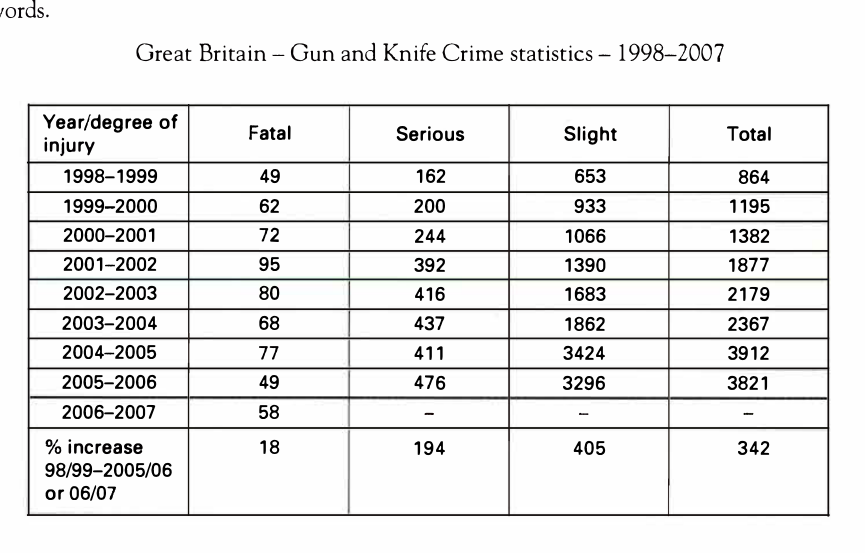
The table shows the number of fatal, serious and slight injuries resulting from gun and knife crime in Great Britain from 1998 to 2007 and the percentage increase for each degree of injury over the period.
Summarise the information by selecting and reporting the main features, and make comparisons where relevant.
Great Britain - Gun and Knife Crime statistics - 1998-2007
Student answer (Band 6.0)
The table provides data on the number of injuries such as fatal, serious and minor resulting from gun and knife also the percentage rise for each degree of injury in UK over the period of 9 years from 1998 to 2007.
Overall, the number surged rapidly from 2004 to 2006 where all degrees of injuries increased. Most people was the victim of slight injuries. from [redacted phone], almost 4000 people were the victims of injuries which is the highest among all the years.
it is quite evident that all the injuries and crime increased over the period. From [redacted phone], slight injuries were the highest among all other injuries with mere 653, fatal and serious injuries accounted for 49 and 162 respectively, which make the total of 864. 2001 to 2003, there was a rise in slight injuries which harmed almost 1390 individuals and serious injuries were accounted for 392 and 95 people faced fatal injuries. These crimes surged from 2004 to 2006, more than 3000 people were the victims of slight injurious and serious injuries were accounted for more than 400. People with fatal injuries declined over this period. From [redacted phone], 58 individuals faced fatal injurious in result of crime.
Looking at other details, percentage of slight injuries rose up with 405%. Whereas, serious and fatal injuries went up to 194% and 18% respectively.
AI examiner evaluation
| Criterion | Band |
|---|---|
| Task Achievement / Task Response | 6.0 |
| Coherence and Cohesion | 6.0 |
| Lexical Resource | 6.0 |
| Grammatical Range and Accuracy | 5.5 |
| Overall | 6.0 |
Task Achievement / Task Response: Band 6.0
You identify the table’s subject and include a clear overview: slight injuries were the most common, and the total peaked in 2004–05 at nearly 4,000. You also report the percentage increases, including 405% for slight and 18% for fatal injuries. However, some details are inaccurate or unclear. The 2001–03 figures are combined in a way that makes it sound as though 1,390 slight injuries occurred across that period; this value belongs to 2001–02, while 2002–03 recorded 1,683. The claim that all injury categories increased is also too broad, since fatal injuries fluctuated and fell from 95 to 49 before ending at 58. Distinguish the main trends more precisely and explain the missing final-year figures.
Coherence and Cohesion: Band 6.0
The response has a recognisable structure, moving from an introduction and overview to selected figures and percentage changes. Paragraphing helps separate these functions, and phrases such as “Overall” and “Looking at other details” signal shifts. However, progression within the main detail paragraph is not always clear: the account jumps from 1998–99 to “2001 to 2003,” then to 2004–06, without consistently distinguishing individual years or stages. Some linking is mechanical, particularly “Whereas” at the start of a sentence, and the lowercase “it” after the overview disrupts presentation. Group the figures into clear early and later periods, and use comparisons to connect them rather than listing them in sequence.
Lexical Resource: Band 6.0
You use an adequate range of task-related vocabulary, including “surged,” “declined,” “accounted for,” and “percentage,” and the meaning is generally understandable. There are also attempts at more formal reporting language. However, several choices are inaccurate or repetitive: “minor” does not match the table’s label “slight,” “slight injurious” is not a natural phrase, and “people faced fatal injuries” is awkward. Repeated references to people as “victims” also make the description less precise, since the table records injuries rather than victims. Choose standard collocations such as “the number of people sustaining slight injuries” and use “fatal injuries” consistently. More precise vocabulary would make comparisons clearer.
Grammatical Range and Accuracy: Band 5.5
You attempt both simple and more complex sentences, including the opening sentence with “such as” and the comparison beginning “From 1998–1999.” Most of the message remains understandable, but some grammatical errors recur. For example, “Most people was” has subject–verb disagreement, while “which make the total” should use a past-tense verb to match the figures. The sentence beginning “2001 to 2003” lacks a clear subject, and “Whereas” is used as a fragment rather than joining two clauses. Capitalisation after full stops is also inconsistent. Practise complete sentence structures, agreement, and consistent past-tense reporting; these corrections would improve accuracy without requiring more complicated sentences.
See this exact question answered at other band scores. The same prompt compared across bands.
Browse more IELTS Writing model answers or get your own writing scored by the same AI examiner.