Band 5.0 IELTS Writing Task 1 Model Answer
Overall Band Score: 5.0 · IELTS Momentum Workout · 2026-11-16
IELTS Writing Task 1 question
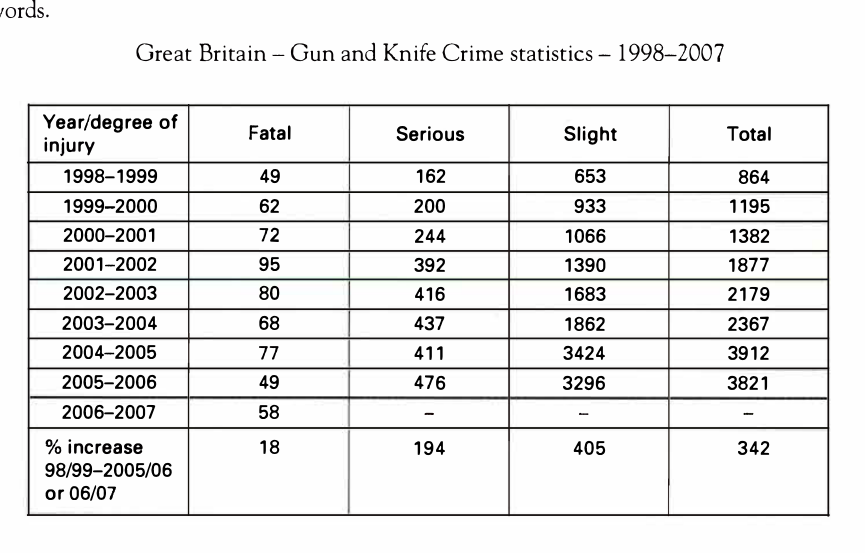
The table shows the number of fatal, serious and slight injuries resulting from gun and knife crime in Great Britain from 1998 to 2007 and the percentage increase for each degree of injury over the period.
Summarise the information by selecting and reporting the main features, and make comparisons where relevant.
Great Britain - Gun and Knife Crime statistics - 1998-2007
Student answer (Band 5.0)
The table illustrates the injuries in great britain with gun and knife between 1998 to 2007
Overall, the slight injuries have increased in every period of time. While, the serious lead the second rank in injuries and a short rise in every year. Moreover fatal injury among the lowest in this table.
In 1998 to 1999 the fatal injury are 49% or 162% are serious and 653% are slight injury and the total was 864%. Followed by 1999 to 2000 62% are fatal, 200% are serious, 933% are slight and the total was 1195%. In next one year the fatal injury are 72% and the serious are 244% and the slight injury are 1066% total was 1382%. While in 2001 to 2002 95% are fatal and 392% are serious and 1390% are slight and the total was 1877%.
Furthermore in 2003 to 2007 the fatal injury are goes down into 68% to 58%. While the serious injury are increased 437 to 476% in among year but last year he did'nt right. While the slight injury experience significant increased 1862 to 3296%. The total was 3821 at the end
AI examiner evaluation
| Criterion | Band |
|---|---|
| Task Achievement / Task Response | 5.0 |
| Coherence and Cohesion | 5.5 |
| Lexical Resource | 5.0 |
| Grammatical Range and Accuracy | 5.0 |
| Overall | 5.0 |
Task Achievement / Task Response: Band 5.0
You identify the broad pattern that slight injuries were the most numerous and that fatal injuries were comparatively low, and you include several figures from the table. However, the overview is incomplete: it says slight injuries rose in every period, although they fell from 3,424 to 3,296 in 2005–06. The report also gives figures as percentages, even though the table presents counts, and the claim that serious injuries rose every year overlooks the fall from 437 to 411. Coverage of the later years is limited, and the missing serious and slight figures for 2006–07 are not clearly distinguished from unavailable data. Select the main trends accurately and compare the overall increase in total injuries with the fluctuations in fatal cases.
Coherence and Cohesion: Band 5.5
The response has a basic structure: an opening, an overview, and paragraphs describing earlier and later figures. Time markers such as “In 1998 to 1999,” “Furthermore,” and “at the end” help the reader follow the chronology. However, progression is weakened by listing many figures one year at a time rather than grouping related trends, and some links are unclear or mechanical. For example, “While, the serious lead the second rank” does not connect smoothly to the preceding overview, while “but last year he did'nt right” leaves the intended reference uncertain. Organise the body around meaningful comparisons—such as the overall rise, the peak and subsequent dip in slight injuries, and the changing fatal figures—and use clear references between sentences.
Lexical Resource: Band 5.0
You use some relevant vocabulary for describing data, including “increased,” “significant,” “total,” and “fatal injury,” so the topic is generally recognisable. However, the range is limited and several word choices or collocations make the meaning awkward: “the serious lead the second rank,” “short rise,” and “experience significant increased.” Repeated use of “injury” and “are” also reduces precision, and the repeated percent signs incorrectly suggest that the values are percentages rather than counts. Use standard data-reporting expressions and vary terms such as “number,” “figure,” and “case.” Check spelling and word forms as well, including “Great Britain” and “increased,” so the reader can interpret the comparisons more easily.
Grammatical Range and Accuracy: Band 5.0
The response mainly uses simple statements and attempts a few linked or complex sentences, for example, “While the serious injury are increased 437 to 476% in among year.” These attempts show some effort to connect comparisons, but frequent errors in verb forms, agreement, articles, and sentence construction make several statements difficult to follow. Examples include “the fatal injury are 49,” “the fatal injury are goes down,” and “the total was 864%,” where the sentence patterns do not reliably express the intended data. Punctuation and sentence boundaries are also inconsistent, particularly in the long sequences of figures. Practise accurate comparative structures such as “Fatal injuries fell from X to Y, whereas serious injuries rose,” and check subject–verb agreement and tense in each sentence.
See this exact question answered at other band scores. The same prompt compared across bands.
Browse more IELTS Writing model answers or get your own writing scored by the same AI examiner.