Band 5.0 IELTS Writing Task 1 Model Answer
Overall Band Score: 5.0 · IELTS Momentum Workout · 2026-11-16
IELTS Writing Task 1 question
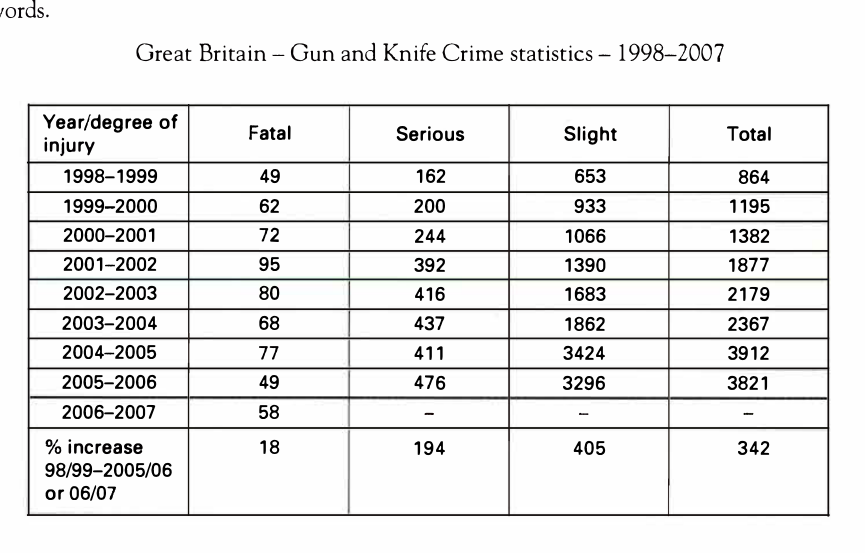
The table shows the number of fatal, serious and slight injuries resulting from gun and knife crime in Great Britain from 1998 to 2007 and the percentage increase for each degree of injury over the period.
Summarise the information by selecting and reporting the main features, and make comparisons where relevant.
Great Britain - Gun and Knife Crime statistics - 1998-2007
Student answer (Band 5.0)
The table illustrates the number of fatal, serious and slight injuries resulting from gun and knife crime in Great Britain over a period of 9 years starting from 1998.
Overall it can be seen that, the number of injuries was gradually increasing until [redacted phone] and the highest number of injuries was also recorded that year .
According to the table we can see that the total the number of injuries in between 1998 to 1999 was 864,among them 49 was fatal cases,162 case and 665 were slight ninjury cases.In the following year we can see the total number increased to 1195.Just like that the number of injuries kept dramatically increasing till [redacted phone].In that year the number fatal injuries were 49,the number of serious injuries were counted 476 and there were 3426 sliht injuries.The total number of injuries was accounted for 3926.Finally the percantage of increase of total injuries were almost 342.The fatal injuries increased 18%,regarding serious injuries it increased 405% and the slight injuries were recorded for 405% of increase
AI examiner evaluation
| Criterion | Band |
|---|---|
| Task Achievement / Task Response | 5.0 |
| Coherence and Cohesion | 5.5 |
| Lexical Resource | 5.0 |
| Grammatical Range and Accuracy | 5.0 |
| Overall | 5.0 |
Task Achievement / Task Response: Band 5.0
You identify the broad pattern of rising injury totals and include an overview, which gives the response a relevant foundation. However, the account only partially reports the table’s main features, and several figures are inaccurate: slight injuries in 1998–99 were 653, not 665; in 2005–06 they were 3,296, not 3,426; and the total was 3,821, not 3,926. The percentage increases are also misassigned: serious injuries rose by 194%, while slight injuries rose by 405%. The overview’s claim that the total peaked in 2005–06 overlooks the lower total in 2004–05 and the missing total for 2006–07. Select a few accurate comparisons and distinguish clearly between the injury categories.
Coherence and Cohesion: Band 5.5
The response has a recognisable sequence: an introduction, an overall statement, and then details moving from the first year to the final complete year. Phrases such as “Overall” and “In the following year” help signal this progression. However, most information is compressed into one long detail paragraph, so the comparisons between categories and the percentage changes are difficult to follow. Repeated openings such as “we can see” and “the number of injuries” make the linking feel mechanical, while “Just like that” does not clearly express the relationship between the figures. Use separate paragraphs for the overview and selected details, and group related figures so the reader can compare trends more easily.
Lexical Resource: Band 5.0
You use relevant task vocabulary, including “fatal,” “serious,” “slight,” “total,” and “increased,” so the topic is generally understandable. However, the range is limited and several choices or spelling errors reduce precision: “sliht,” “percantage,” and “ninury” are distracting, while “the total number of injuries was accounted for 3926” is an awkward expression. Repeating “number of injuries” and “we can see” also limits variety. Aim for accurate collocations and concise reporting language, such as “the total stood at” or “the figure rose to.” Check spelling carefully, especially for key category labels and percentage terminology, because these words carry the central information in a table summary.
Grammatical Range and Accuracy: Band 5.0
You attempt a few longer structures, including “Overall it can be seen that…” and “In the following year…,” but most sentences rely on simple patterns, and errors are frequent enough to make some details harder to interpret. Examples include “the total the number,” “49 was fatal cases,” and “the number fatal injuries were 49,” where articles, agreement, or sentence structure are faulty. Commas are also missing after introductory phrases and between figures, creating run-on sections such as the description of 1998–99. Practise building clear sentences with a subject and verb—for example, “There were 49 fatal injuries”—and use consistent past-tense reporting. More accurate sentence control would make the data easier to understand.
See this exact question answered at other band scores. The same prompt compared across bands.
Browse more IELTS Writing model answers or get your own writing scored by the same AI examiner.