Band 5.0 IELTS Writing Task 1 Model Answer
Overall Band Score: 5.0 · IELTS Momentum Workout · 2026-11-16
IELTS Writing Task 1 question
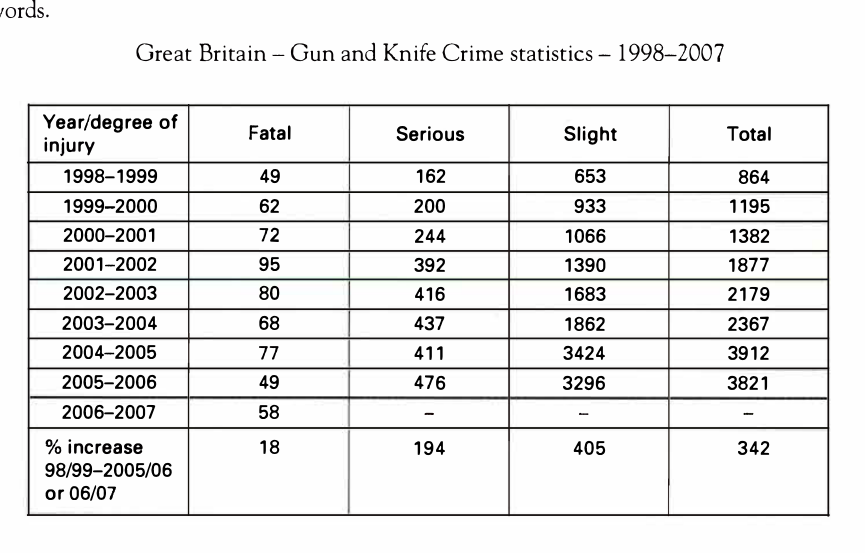
The table shows the number of fatal, serious and slight injuries resulting from gun and knife crime in Great Britain from 1998 to 2007 and the percentage increase for each degree of injury over the period.
Summarise the information by selecting and reporting the main features, and make comparisons where relevant.
Great Britain - Gun and Knife Crime statistics - 1998-2007
Student answer (Band 5.0)
The table below illustrates the number of fatal, serious and slight inguries resulting from gun and knife crime in Great Britain from 1998 to 2007 and the percentage increase for each degree of injury over the period.
Overall, this report shows the comparison between different types of injuries as the result from the different kinds of weapons from 1998 to 2007 in Britain. The highset number of injury was slight injury was about 3424 in 2004 to 2005 and it increased was accord to 405% during time and reached maximum point. Moreover, the lowest number of injury is fatal injury and it also increased was about 18% during period. In addition, the second largest amount of injury is serious injury as the result of weapons was about 476 in 2005 to 2006 and it increased as well as about 194% during period.Furthermore the total injuries from 1998 to 1999 was abp
AI examiner evaluation
| Criterion | Band |
|---|---|
| Task Achievement / Task Response | 4.5 |
| Coherence and Cohesion | 4.5 |
| Lexical Resource | 5.0 |
| Grammatical Range and Accuracy | 5.0 |
| Overall | 5.0 |
Task Achievement / Task Response: Band 4.5
You identify the table’s subject and mention several relevant features, including the peak in slight injuries (3,424 in 2004–05) and the percentage increases. However, the overview is unclear and some comparisons are inaccurate: serious injuries reached 476 in 2005–06, but this was not the second-largest injury category; slight injuries were much more numerous. The claim that fatal injuries were the lowest category is broadly correct, but the response does not clearly summarise the overall trend or the total figures. It also ends mid-sentence (“the total injuries … was abp”), leaving the task incomplete. The response is 126 words, below the required 150, so it cannot develop the key features sufficiently. Select the main trends accurately and complete the summary.
Coherence and Cohesion: Band 4.5
There is an attempt to organise the response with an opening, an overview paragraph, and linking expressions such as “Moreover,” “In addition,” and “Furthermore.” These help signal that another point is coming. However, the ideas do not progress clearly: the overview repeats the task description, then moves between slight, fatal, and serious injuries without a consistent comparison. Several connectors are used mechanically, and the final sentence is cut off, so the reader cannot follow the point about total injuries. Use a clear sequence—introduction, overview, then grouped details—and connect comparisons directly, for example by contrasting the much higher slight-injury figures with the lower fatal figures.
Lexical Resource: Band 5.0
The response uses some relevant vocabulary, including “percentage increase,” “fatal injury,” and “serious injury,” so the topic is generally recognisable. However, the range is limited and several word choices or collocations are inaccurate or repetitive, such as “the result from the different kinds of weapons” and “reached maximum point.” There are also noticeable spelling errors, including “inguries,” “highset,” and “abp,” which reduce clarity and polish. Aim for precise table-description language, such as “the number of cases,” “rose to a peak,” and “accounted for an increase of.” Avoid repeating “injury” where a clear reference such as “this figure” would work.
Grammatical Range and Accuracy: Band 5.0
You attempt both simple and longer sentences, and the opening sentence communicates the table’s subject. However, complex sentences are often faulty, as in “The highset number of injury was slight injury was about 3424 … and it increased was accord to 405%.” The repeated “was” constructions make relationships between the figures and trends difficult to understand. There are also problems with articles, number agreement, and sentence boundaries; for example, “the lowest number of injury is fatal injury” needs clearer plural phrasing and consistent past tense. The final sentence is incomplete. Practise building accurate comparison sentences with a clear subject and verb, such as “Slight injuries peaked at 3,424 in 2004–05, an increase of 405%.”
See this exact question answered at other band scores. The same prompt compared across bands.
Browse more IELTS Writing model answers or get your own writing scored by the same AI examiner.