Band 5.5 IELTS Writing Task 1 Model Answer
Overall Band Score: 5.5 · IELTS Momentum Workout · 2026-11-16
IELTS Writing Task 1 question
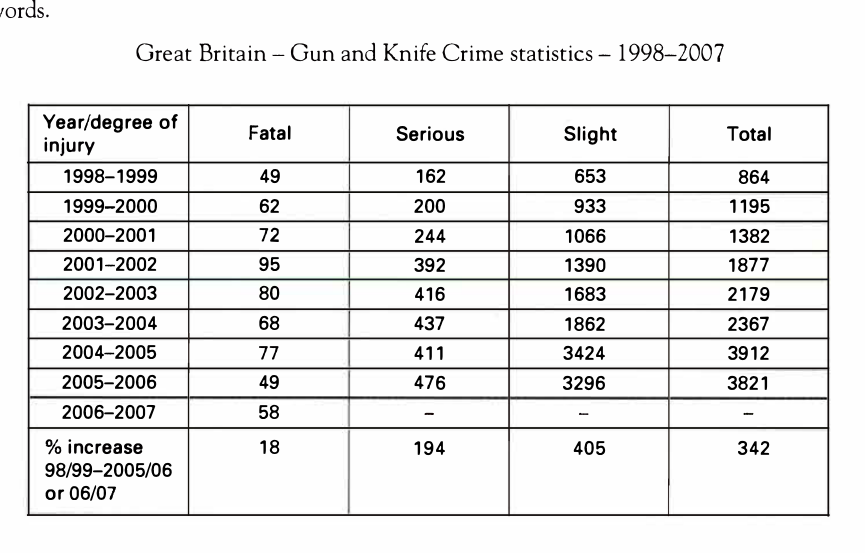
The table shows the number of fatal, serious and slight injuries resulting from gun and knife crime in Great Britain from 1998 to 2007 and the percentage increase for each degree of injury over the period.
Summarise the information by selecting and reporting the main features, and make comparisons where relevant.
Great Britain - Gun and Knife Crime statistics - 1998-2007
Student answer (Band 5.5)
The table below illustrates the three types of injuries fatal, serious and slight attacked, by the gun and knife crime from 1998 to 2007 in Great Britain. While the percentage of these attacks increased over the years.
Overall, slight injuries accounts the largest proportion of increase in crime statistics, while the serious injuries records the second highest. The least percentage of increase was fatal injuries.
Firstly, the number of slight injuries was 653 in 1998, from there significantly increased up to 3296 attacks in 2006 and there is 405% increased from 1998 to 2007. While the serious injuries had 162 in 1998 and ended up with 476 wounds in 2006 with rose of 194% by 2007.
Respectively the fatal injuries registered the least injuries in 1998 with 49 wounds and 58 in 2007, only 18% increased slightly injuries in crimes. The total number of injuries registered by gun and knife in 1998 was 864 and it rose to 3821 by 2006, in contrast total 342% of injuries increased by 2007.
AI examiner evaluation
| Criterion | Band |
|---|---|
| Task Achievement / Task Response | 6.0 |
| Coherence and Cohesion | 6.0 |
| Lexical Resource | 5.5 |
| Grammatical Range and Accuracy | 5.0 |
| Overall | 5.5 |
Task Achievement / Task Response: Band 6.0
You identify the main pattern that slight injuries were the largest category and fatal injuries the smallest in percentage growth, and you include figures for all three injury types and the total. However, several details are inaccurate or unclear: the 405% rise applies to slight injuries through 2005–06, not 2007, and the serious-injury figure of 476 is also for 2005–06; the table gives no later figures for these categories. The total rose from 864 to 3,821, but 342% is the reported increase, not the total number of injuries. Your overview is relevant, though it would be stronger if it also noted the sharp rise in the total and the peak in slight injuries in 2004–05.
Coherence and Cohesion: Band 6.0
The response has a recognisable structure: an introduction, an overview, and two paragraphs presenting figures. This gives the reader a coherent overall route through the information. However, some links are mechanical or confusing. For example, “While the percentage…” is a sentence fragment, and “Respectively” does not clearly connect the fatal-injury figures to the preceding comparison. The repeated use of “While” also creates awkward transitions. Grouping the injury categories more clearly and using direct comparisons would improve progression—for example, contrast the much larger increase in slight injuries with the smaller rise in fatal cases. Ensure each paragraph develops one clear comparison rather than moving abruptly between figures.
Lexical Resource: Band 5.5
You use relevant vocabulary such as “percentage,” “increased,” “registered,” and “total,” so the topic is generally clear. There is also some attempt to vary wording with “rose” and “ended up.” However, several choices are inaccurate or unnatural for describing a statistical table: injuries are not “attacked,” “wounds” is an imprecise substitute for injury cases, and “accounts the largest proportion of increase” is an awkward collocation. “Slightly injuries” also appears where you mean fatal injuries. Use precise terms consistently, such as “number of cases,” “injury category,” and “percentage increase.” This would make the comparisons more exact and reduce ambiguity without requiring more elaborate vocabulary.
Grammatical Range and Accuracy: Band 5.0
You attempt both simple and more complex forms, including comparisons and clauses beginning with “while,” but control is uneven. Agreement errors occur in “slight injuries accounts” and “serious injuries records”; these plural subjects require plural verb forms. The opening sentence is also difficult to parse, and “While the percentage of these attacks increased over the years” is a dependent clause presented as a complete sentence. Some sentence boundaries and punctuation make relationships between ideas unclear. Aim for complete, direct sentences, and check subject–verb agreement and clause structure. For example, combine the opening overview into a full sentence and avoid starting a standalone sentence with “While” unless it is joined to a main clause.
See this exact question answered at other band scores. The same prompt compared across bands.
Browse more IELTS Writing model answers or get your own writing scored by the same AI examiner.