Band 5.5 IELTS Writing Task 1 Model Answer
Overall Band Score: 5.5 · IELTS Momentum Workout · 2026-11-16
IELTS Writing Task 1 question
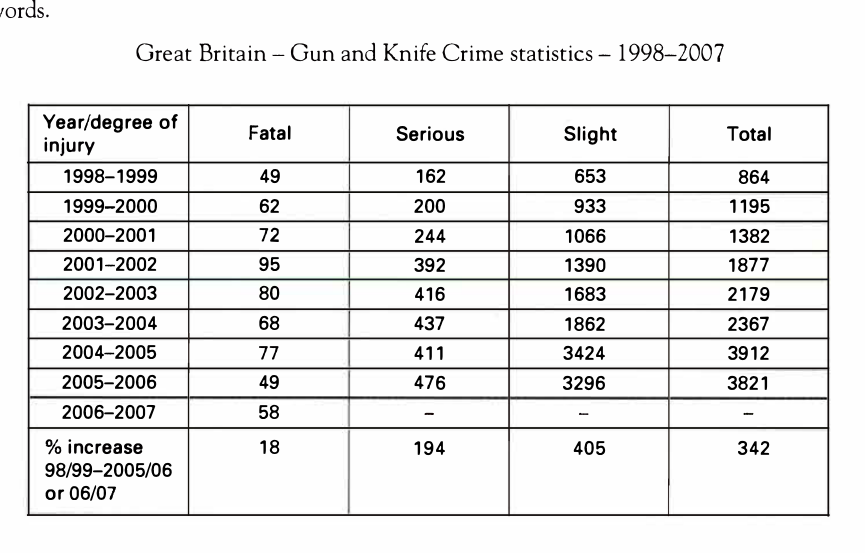
The table shows the number of fatal, serious and slight injuries resulting from gun and knife crime in Great Britain from 1998 to 2007 and the percentage increase for each degree of injury over the period.
Summarise the information by selecting and reporting the main features, and make comparisons where relevant.
Great Britain - Gun and Knife Crime statistics - 1998-2007
Student answer (Band 5.5)
The table illustrates the number of injuries that are fatal, serious and slight, resulting from gun and knife crimes in the Great Britain from 1998 to 2007.
Overall, we can see the highest number of injuries are slight injuries and lowest percentage of injuries are fatal.
The highest number of injuries are slight.In contrast, fatal injuries are the lowest.Serious injuries also have a clear increasing pattern resulting in total of 194% increase in total.Fatal injuries started at 49 in 1988-99 that later increased to 95 in 2001-02 recording highest till 2007 that was only 49.Slight injuries also summed up to a total increase of 405%.
The total increase in percentage that the table shows from gun and knife crime is 342%.An increasing pattern can be noticed in all injuries where the fatal remained lowest and the slight injuries remained highest keeping serious injuries in between them.The total injuries at starting was only 864 which increased to 3821 in 2006-07.This increment shows the percentage of increase in crimes from gun and knife overtime.
AI examiner evaluation
| Criterion | Band |
|---|---|
| Task Achievement / Task Response | 5.5 |
| Coherence and Cohesion | 5.0 |
| Lexical Resource | 5.5 |
| Grammatical Range and Accuracy | 5.5 |
| Overall | 5.5 |
Task Achievement / Task Response: Band 5.5
You identify the main categories and several relevant features: slight injuries were the most numerous, fatal injuries the fewest, and the table reports increases of 194%, 405% and 342% for serious, slight and total injuries. However, the overview is incomplete and some details are inaccurate or unclear. For example, fatal injuries peaked at 95 in 2001–02, but the response says this was the highest “till 2007,” despite the table ending that series at 58 in 2006–07. The starting year is also given as “1988-99” rather than 1998–99, and the final total is labelled 2006–07 although 3,821 belongs to 2005–06. Distinguish the overall rise from the later fluctuations and report the table’s periods precisely.
Coherence and Cohesion: Band 5.0
The response has a basic paragraph structure, with an introduction, an overview and further details, and it uses simple linking expressions such as “Overall” and “In contrast.” However, progression is limited because several points are repeated: the claim that slight injuries were highest and fatal injuries lowest appears more than once, while the figures and trends are not grouped into a clear sequence. The sentence beginning “Serious injuries also have a clear increasing pattern” shifts abruptly to the percentage increase, and the final paragraph repeats the total increase before returning to the overall trend. Organise the report into a concise overview followed by paragraphs comparing the injury categories and total figures, using references such as “this figure” only when their meaning is clear.
Lexical Resource: Band 5.5
You use relevant task vocabulary, including “fatal,” “serious,” “slight,” “increasing pattern” and “percentage increase,” so the reader can generally understand the subject. However, the range is limited and some expressions are repetitive or imprecise. “The highest number of injuries are slight injuries” is repeated, and “summed up to a total increase” is an awkward way to describe the percentage change. “This increment shows the percentage of increase in crimes” also overstates what the table directly reports, which is injuries resulting from crime. Use more precise reporting language and vary terms such as “number,” “increase” and “injuries.” Check labels carefully too: “1988-99” is a data-label error, not a vocabulary choice.
Grammatical Range and Accuracy: Band 5.5
You attempt both simple and more extended sentences, including “An increasing pattern can be noticed in all injuries where the fatal remained lowest.” However, control is uneven, and errors in agreement, articles, tense and sentence boundaries are noticeable. For instance, “The highest number of injuries are” should use a singular verb, while “in the Great Britain” has an unnecessary article. “The total injuries at starting was only 864” has agreement and phrasing problems, and “fatal injuries started at 49 … that later increased” does not form a clear relative clause. There is also missing spacing after the full stop in “slight.In contrast.” Build accuracy by checking subject–verb agreement and articles, and use shorter, clearly structured comparisons alongside your longer sentences.
See this exact question answered at other band scores. The same prompt compared across bands.
Browse more IELTS Writing model answers or get your own writing scored by the same AI examiner.