Band 6.5 IELTS Writing Task 1 Model Answer
Overall Band Score: 6.5 · IELTS Momentum Workout · 2026-11-17
IELTS Writing Task 1 question
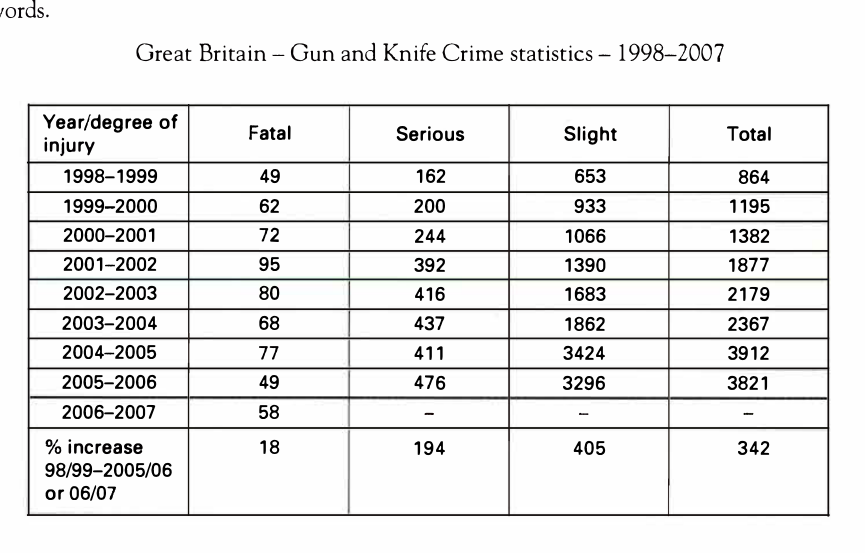
The table shows the number of fatal, serious and slight injuries resulting from gun and knife crime in Great Britain from 1998 to 2007 and the percentage increase for each degree of injury over the period.
Summarise the information by selecting and reporting the main features, and make comparisons where relevant.
Great Britain - Gun and Knife Crime statistics - 1998-2007
Student answer (Band 6.5)
The table represents how many incidents of fatal , seious and minor injuries occured owing to the gun and knife crime in the Great Britain between 1998 and 2007. It also illustrates how each degree of harm increased by percentage point over the given period.
Overall, total number of injuries showed an increase until [redacted phone]. From the begining to the end, fatal cases were the lowest in number whereas slight injuries were the highest. In [redacted phone], the highest number of fatal cases were recorded while the number of slight harm gradually climbed over the time and peaked at [redacted phone].The number of serious cases also increased considerably.
With regard to fatal injuries, the figure fluctuated considerably, recording the highest (95) in [redacted phone] while the lowest (49) in [redacted phone] and [redacted phone]. Serious incidents also showed an unstable trend, being the highest(476) in [redacted phone] and the lowest (162) in [redacted phone].
Turning to the slight harm, it was the more frequent over the years. 3424 cases of slight injuries were enlisted in [redacted phone] while only 653 in [redacted phone], almost six fold increase. Similarly, the number of total cases also showed a rise until [redacted phone] hitting 3912 , then falling down to 3821 in [redacted phone].
However, if we consider the percentage increase, fatal cases increased by 18% point throughout the given period while serious and slight cases climbed by 194 and 405 percentage point respectively..
AI examiner evaluation
| Criterion | Band |
|---|---|
| Task Achievement / Task Response | 6.5 |
| Coherence and Cohesion | 6.5 |
| Lexical Resource | 6.0 |
| Grammatical Range and Accuracy | 6.0 |
| Overall | 6.5 |
Task Achievement / Task Response: Band 6.5
You give a clear overview of the main pattern: total injuries rose before falling slightly, fatal injuries were the least numerous, and slight injuries were the most common. The key figures for the fatal and serious categories are accurately identified, and the comparison of slight injuries from 653 to 3,424 is useful. This covers the task well, though some features are less fully reported: the overview could make the sharp rise in slight injuries and the overall percentage increases more prominent. Also, the table provides no serious, slight or total figures for 2006–2007, so “from the beginning to the end” is imprecise; specify that the comparison ends in 2005–2006 for those categories. The percentage increases are reported, but the total increase of 342% is omitted.
Coherence and Cohesion: Band 6.5
The response is arranged in a sensible sequence: an introduction, an overview, and then paragraphs covering injury categories and totals. Linking phrases such as “With regard to,” “Turning to,” and “However” help signal shifts in focus, and the reader can follow the comparisons. This is a coherent overall structure, although some connections are mechanical or unclear. For example, “From the beginning to the end” is ambiguous because the final year has missing data for several categories, and the final paragraph’s “However” does not express a clear contrast with the preceding information. The discussion also moves between categories and totals without always making the relationship explicit. Use more precise references to the years and connect the percentage figures directly to the trends already described.
Lexical Resource: Band 6.0
You use an adequate range of vocabulary for describing data, including “fluctuated,” “peaked,” “considerably,” and “almost six fold increase.” These choices help communicate changes and comparisons, and the meaning is generally clear. However, some word choices and collocations are inaccurate or unnatural, such as “percentage point” for a percentage increase, “enlisted” for recorded, and “slight harm” for slight injuries. “Fatal cases” is understandable, but “fatal injuries” is more precise and consistent with the table. There are also spelling errors, including “seious,” “occured,” and “begining.” Aim for accurate, consistent terminology and check spelling; this would make the report sound more natural and precise without requiring more elaborate vocabulary.
Grammatical Range and Accuracy: Band 6.0
You use a mix of simple and complex sentence forms, including subordinate clauses such as “while the lowest (49)…” and the conditional framing “if we consider the percentage increase.” Most sentences communicate the intended comparisons, but some grammatical and punctuation errors remain. For example, “total number of injuries showed an increase” needs an article (“the total number”), and “the highest number of fatal cases were recorded” has a subject–verb agreement problem because “number” is singular. In “3424 cases … while only 653,” the second clause lacks a verb, and several spaces before commas or full stops are incorrect. Review articles, agreement, and complete clause structure, and proofread punctuation. Greater accuracy across these patterns would strengthen an otherwise understandable range.
See this exact question answered at other band scores. The same prompt compared across bands.
Browse more IELTS Writing model answers or get your own writing scored by the same AI examiner.