Band 4.0 IELTS Writing Task 1 Model Answer
Overall Band Score: 4.0 · IELTS Momentum Workout · 2026-11-17
IELTS Writing Task 1 question
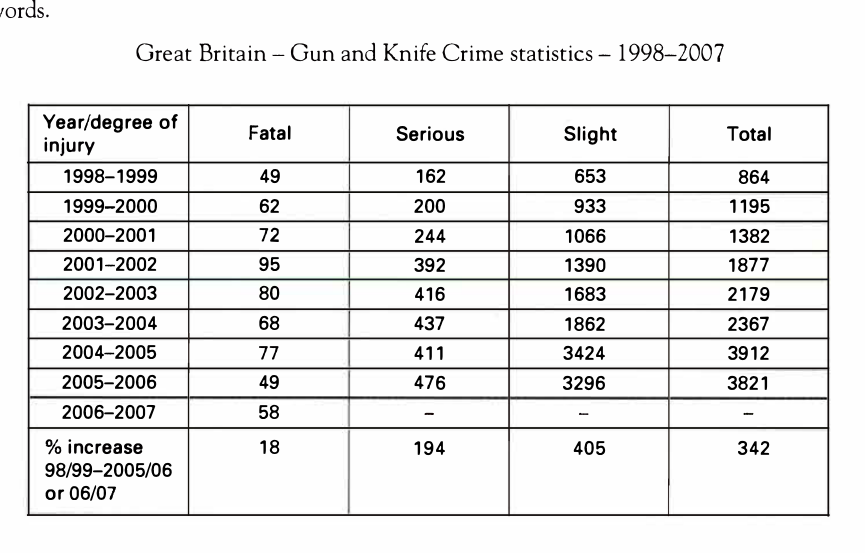
The table shows the number of fatal, serious and slight injuries resulting from gun and knife crime in Great Britain from 1998 to 2007 and the percentage increase for each degree of injury over the period.
Summarise the information by selecting and reporting the main features, and make comparisons where relevant.
Great Britain - Gun and Knife Crime statistics - 1998-2007
Student answer (Band 4.0)
This table illustrate the percentage of people injuries (fatal , serious, slight injuries) by the gun and knife crime from 1998 to 2007 in Great Britain.
Overall, the slight injuries are higher then the serious and fatal and between 2006 and 2007 only fatal injuries are happen.
In the following years the fatal injuries are less in numbers as compare to serious and sight injuries. in 1998 the number of crimes are less then the 2006 thats why the number of injuries in 1998 are much lower then 2006. in 2007 only
AI examiner evaluation
| Criterion | Band |
|---|---|
| Task Achievement / Task Response | 3.0 |
| Coherence and Cohesion | 4.0 |
| Lexical Resource | 4.5 |
| Grammatical Range and Accuracy | 4.5 |
| Overall | 4.0 |
Task Achievement / Task Response: Band 3.0
The response identifies one valid overall feature: slight injuries were the largest category, and it notices that the final year has figures only for fatal injuries. However, the overview is incomplete and the account contains little accurate, specific reporting of the table. The statement that “between 2006 and 2007 only fatal injuries are happen” should refer to 2006–2007, where fatal injuries are recorded but the other entries are unavailable; it does not establish that no other injuries occurred. The comparison between 1998 and 2006 is vague and does not report the figures or the substantial rise in totals. The response is also well below the required 150 words, leaving the task minimally addressed. Select key trends and support them with accurate data.
Coherence and Cohesion: Band 4.0
There is a basic attempt to organise the response with an opening sentence, an overview beginning “Overall,” and a further paragraph. This gives the reader some indication of the intended structure. However, the progression is weak: the final paragraph repeats the comparison that injuries were lower in 1998, then ends abruptly with “in 2007 only,” leaving the idea unfinished. Connections between claims are also unclear, particularly in “in 1998 the number of crimes are less then the 2006 thats why…,” where the cause-and-effect link is unsupported by the table. Use separate paragraphs for the overview and key comparisons, and connect each point clearly without repeating it.
Lexical Resource: Band 4.5
The response uses a small set of relevant terms, including “fatal,” “serious,” and “slight injuries,” so the topic is generally recognisable. However, vocabulary is repetitive and several word choices or forms make the meaning imprecise: “percentage of people injuries” misdescribes a table of injury counts and percentage increases, while “the number of crimes” is not what the figures show. “Sight injuries” also appears to be a misspelling of “slight injuries.” Improve precision by using terms such as “number of injuries,” “injury category,” and “recorded cases.” Avoid repeating “number” and “injuries” without adding specific comparisons or trend language.
Grammatical Range and Accuracy: Band 4.5
The response attempts both simple statements and a longer cause-and-effect sentence, but control is inconsistent and the range remains limited. Errors include subject–verb agreement in “This table illustrate,” incorrect comparison structure in “higher then,” and the verb construction “injuries are happen.” The sentence beginning “in 1998 the number of crimes are less…” also has tense and agreement problems, and the final phrase “in 2007 only” is incomplete. Capitalisation and punctuation are inconsistent, including lowercase sentence openings and missing punctuation at the end. Practise accurate present-tense descriptions of tables and complete sentences, for example, “The table shows that slight injuries were the most numerous category.”
See this exact question answered at other band scores. The same prompt compared across bands.
Browse more IELTS Writing model answers or get your own writing scored by the same AI examiner.