Band 6.0 IELTS Writing Task 1 Model Answer
Overall Band Score: 6.0 · IELTS Momentum Workout · 2026-11-17
IELTS Writing Task 1 question
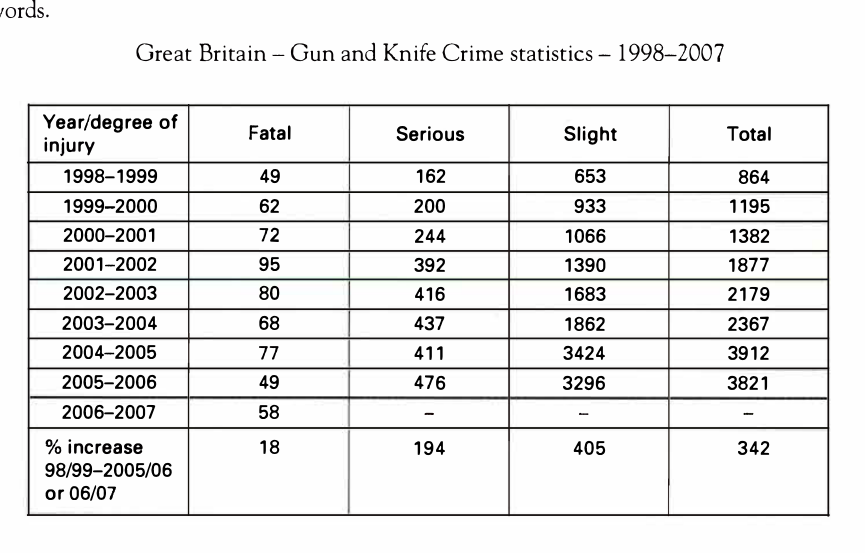
The table shows the number of fatal, serious and slight injuries resulting from gun and knife crime in Great Britain from 1998 to 2007 and the percentage increase for each degree of injury over the period.
Summarise the information by selecting and reporting the main features, and make comparisons where relevant.
Great Britain - Gun and Knife Crime statistics - 1998-2007
Student answer (Band 6.0)
The table illustrates the percentage of three types of injuries occured because of gun and knife crime in Great Britain between 1998 and 2007.
The number of fatal injuries almost doubled from 49 to 95 in 2001, then decreased to 49 again in 2005 and in 2006, the number rose to 58. The number of people who suffered from serious injuries experienced a significant growth, rising from 162 to 476 over the period.
The proportion of reported slight injuries is the highest throughout these years to 405%, as the numbers increased gradually from 653 to 3424 in 2005, then fell to 3296 in 2006. the number of total injuries increased from 864 fo 3821 over the period of 10 years.
Overall, the percentage of fatal, serious, and slight injuries increased over the period, while the slight injuries remained the highest among all of them.
AI examiner evaluation
| Criterion | Band |
|---|---|
| Task Achievement / Task Response | 5.5 |
| Coherence and Cohesion | 6.5 |
| Lexical Resource | 6.0 |
| Grammatical Range and Accuracy | 5.5 |
| Overall | 6.0 |
Task Achievement / Task Response: Band 5.5
You identify several relevant patterns, including the rise in serious injuries from 162 to 476 and the sharp increase in slight injuries before their fall to 3,296. However, the opening calls the figures percentages, although the table reports numbers of injuries, and the overview repeats this confusion by saying all injury percentages increased. The 405% figure is the increase for slight injuries, not their proportion or a yearly value. Some comparisons are also imprecise: fatal injuries peaked at 95 in 2001–02, rather than simply “in 2001,” and the total rose to 3,821 in 2005–06. The response is six words below the required minimum. Develop the overview around the overall rise, the dominance of slight injuries, and the contrasting fatal-injury pattern, using the table’s periods accurately.
Coherence and Cohesion: Band 6.5
The response has a clear overall arrangement: it introduces the table, groups details into paragraphs, and ends with an overview. The sequence from fatal to serious, slight, and total injuries is generally easy to follow, and linking expressions such as “then” and “while” help show changes and contrast. This coherent organisation meets the lower-band expectations and shows some ability to guide the reader. However, the overview comes after the detailed figures, and its repetition of the claim that all percentages increased does not provide a clear synthesis. The transition from slight injuries to total injuries within the same paragraph is also abrupt. Put the main overview immediately after the introduction and use clearer grouping or transitions to distinguish injury categories from the total.
Lexical Resource: Band 6.0
You use an adequate range of task-related vocabulary, including “increased gradually,” “significant growth,” “decreased,” and “rose,” so the main trends are usually understandable. There is also some variation in how you describe change. However, several choices are inaccurate or awkward: “percentage” and “proportion” confuse rates with counts, while “suffered from serious injuries” is less suitable for a table summary than a concise description of the figures. “To 405%” does not clearly express the table’s reported percentage increase. The spelling error “occured” and the typo “fo” also reduce accuracy. Choose precise terms such as “number,” “figure,” and “percentage increase,” and check spelling and collocations before submitting.
Grammatical Range and Accuracy: Band 5.5
You use both simple and more developed sentence forms, including the contrast in “then decreased … and in 2006, the number rose,” and most of the message remains understandable. However, some grammatical errors and punctuation slips are noticeable. In “The proportion … is the highest … to 405%,” the sentence structure does not clearly connect the comparison with the increase; the lowercase “the” after the preceding full stop is also incorrect. The phrase “increased from 864 fo 3821” contains a typing error, and “between 1998 and 2007” is less precise than the table’s year-period labels. Improve control by checking sentence boundaries, capitalisation, and the grammatical links between figures and trend descriptions. More consistently accurate complex sentences would strengthen the response.
See this exact question answered at other band scores. The same prompt compared across bands.
Browse more IELTS Writing model answers or get your own writing scored by the same AI examiner.