Band 5.0 IELTS Writing Task 1 Model Answer
Overall Band Score: 5.0 · IELTS Momentum Workout · 2026-11-17
IELTS Writing Task 1 question
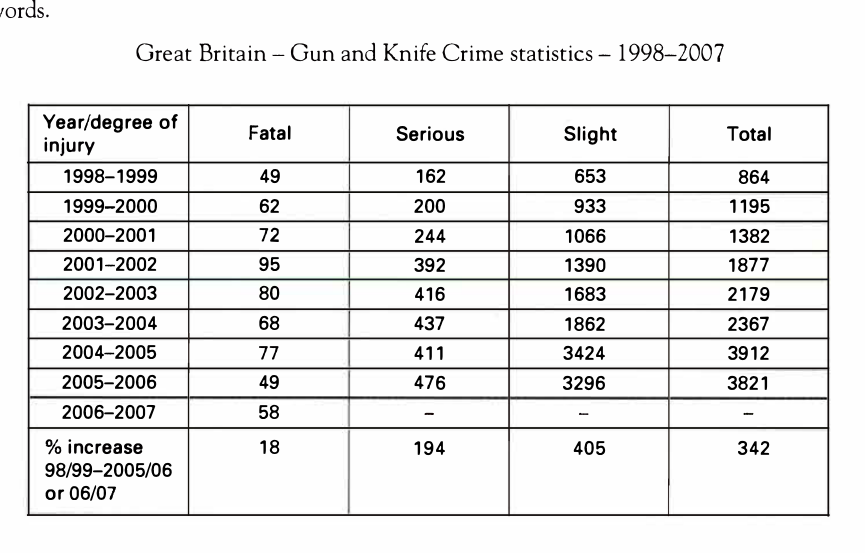
The table shows the number of fatal, serious and slight injuries resulting from gun and knife crime in Great Britain from 1998 to 2007 and the percentage increase for each degree of injury over the period.
Summarise the information by selecting and reporting the main features, and make comparisons where relevant.
Great Britain - Gun and Knife Crime statistics - 1998-2007
Student answer (Band 5.0)
The table shows the number of injuries in Great Britain from 1998 to 2007.
Overall injuries were fatal, serious and slight injuries in the result of gun and knife crimes in GREAT BRITAIN.
In the begening fatal injuries were slowly increased from 1998 to 2000 with number of 49 to 95. After 2000 these gun and knife crimes were decreasing from 2003 to 2007 from 95 number to 58 and total percentage increase by 18 fatal injuries.
serious injuries were 162 in the start of 1998 to 1999 and gradually these were increasing with 476 number from 2000 to 2007. There were ttotal 194 number of serious injuries that had increased with percentage.
Slight injuries were also small in bigening but these were greater than fatal and serious injuries. these were from number of 653 to 3296 from 1998 to 2007. And 405 had great percentage.
Total injuries were 864 to 3821 from 1998 to n
AI examiner evaluation
| Criterion | Band |
|---|---|
| Task Achievement / Task Response | 4.5 |
| Coherence and Cohesion | 5.5 |
| Lexical Resource | 5.0 |
| Grammatical Range and Accuracy | 5.0 |
| Overall | 5.0 |
Task Achievement / Task Response: Band 4.5
You identify the three injury categories and report several relevant figures, including the rise in slight injuries from 653 to 3,296 and the overall increase from 864 to 3,821. However, the response only partially summarises the table: it lacks a clear overview of the main pattern, and some figures or periods are inaccurate. Fatal injuries rose from 49 to a peak of 95 in 2001–02, not by 2000, before falling and fluctuating to 58 in 2006–07. Serious injuries reached 476 in 2005–06, but this is not a figure “from 2000 to 2007.” The percentage increases are also described unclearly. The final sentence is unfinished, leaving the total trend incomplete. Select the main comparisons accurately and explain them clearly.
Coherence and Cohesion: Band 5.5
The response has a basic sequence: an introduction, comments on fatal, serious and slight injuries, and a final reference to totals. This category-by-category organisation helps the reader follow the subject. However, progression is limited because there is no distinct, informative overview, and the paragraphs mostly repeat the same pattern of stating a figure and then a change. Linking and reference are sometimes unclear, as in “After 2000 these gun and knife crimes were decreasing,” where it is not clear whether “these” refers to fatal injuries or crime overall. The final sentence also stops abruptly. Use a clear overview after the introduction, group related comparisons, and connect each figure to its time period.
Lexical Resource: Band 5.0
You use some relevant task vocabulary, including “fatal,” “serious,” “slight,” “gradually” and “percentage increase,” so the reader can recognise the categories being discussed. However, the range is limited and several phrases are imprecise or awkward, such as “in the result of gun and knife crimes,” “with number of 49 to 95,” and “had great percentage.” These choices make some comparisons difficult to interpret. There are also spelling errors, including “begening,” “bigening” and “ttotal.” Aim for accurate collocations for describing data, such as “rose from … to …,” “accounted for the largest number,” and “increased by … percent.”
Grammatical Range and Accuracy: Band 5.0
You attempt both simple statements and longer sentences, for example, “Slight injuries were also small in bigening but these were greater than fatal and serious injuries.” However, the range is limited, and errors recur in sentence construction, tense and articles. “In the begening fatal injuries were slowly increased” uses an incorrect verb pattern; write “fatal injuries increased slowly.” In “serious injuries were 162 in the start of 1998 to 1999,” the article and preposition pattern are faulty. Some sentences also lack a complete or clear structure, particularly the final fragment, “Total injuries were 864 to 3821 from 1998 to n.” Practise complete comparison sentences and consistent past-tense reporting.
See this exact question answered at other band scores. The same prompt compared across bands.
Browse more IELTS Writing model answers or get your own writing scored by the same AI examiner.