Band 4.5 IELTS Writing Task 1 Model Answer
Overall Band Score: 4.5 · IELTS Momentum Workout · 2026-11-17
IELTS Writing Task 1 question
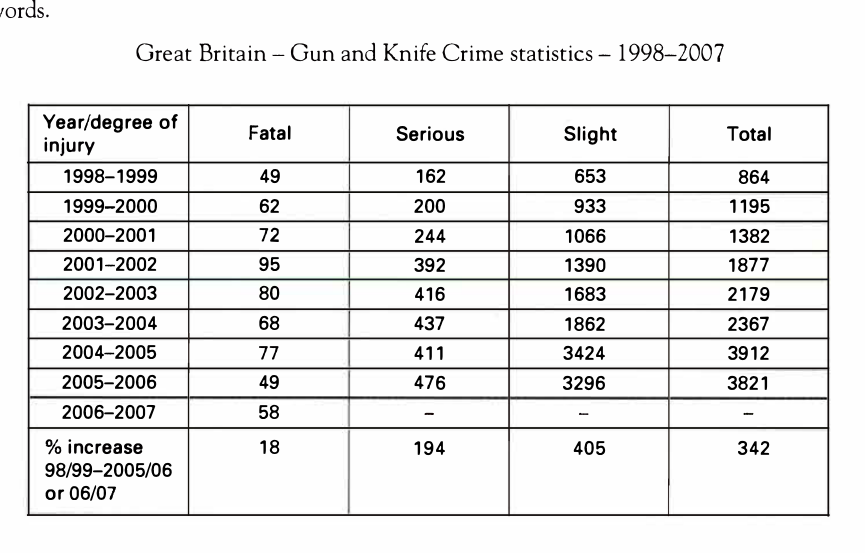
The table shows the number of fatal, serious and slight injuries resulting from gun and knife crime in Great Britain from 1998 to 2007 and the percentage increase for each degree of injury over the period.
Summarise the information by selecting and reporting the main features, and make comparisons where relevant.
Great Britain - Gun and Knife Crime statistics - 1998-2007
Student answer (Band 4.5)
The table illustrates no. of fatal, serious, and minor injuries due to gun and knife crime in London, scotland , from 1998 to 2007. And with the passage of time ratio of each injury increased.
Overall, it can be seen that that in 1999 year their was fatal and minor injuries at lowest level, but with passage of time, fatal, serious and minor injuries also increases.
in [redacted phone] mortal rate was at lowest level with just only 49, serious 162,while minor injuries was just 653. When it was combine total 864 injuries was reported in UK,scotland.
IN year [redacted phone], their was as marked increase in fatal, while serious were in 2005 to 2006, with minor injuries were in 2005 to 2006 year with 3424
AI examiner evaluation
| Criterion | Band |
|---|---|
| Task Achievement / Task Response | 4.0 |
| Coherence and Cohesion | 4.5 |
| Lexical Resource | 5.0 |
| Grammatical Range and Accuracy | 4.5 |
| Overall | 4.5 |
Task Achievement / Task Response: Band 4.0
You identify the table’s subject and give a basic overview that injury figures generally rose, then include some figures from 1998–99 and later years. However, the response only minimally covers the data: it incorrectly locates the crime in “London, scotland” rather than describing Great Britain, and the claim that 1999 had the lowest fatal and minor figures is inaccurate because the table begins in 1998–99. The overview also misses the major pattern that slight injuries rose sharply and that total injuries peaked in 2004–05 before falling. Your final comparison is incomplete and does not clearly report the relevant values. The response is 26 words below the required minimum, which further limits the detail and comparisons you can provide. Select the main trends accurately and support them with a few well-chosen figures.
Coherence and Cohesion: Band 4.5
There is a basic attempt to organise the response with an opening, an overview, and a paragraph containing figures. This gives the reader some sense of the intended structure. However, progression is weak: the overview repeats the idea of increases, while the final paragraph jumps between years and injury categories without explaining how the figures relate. Connectors such as “Overall” and “When it was combine” are used, but the latter does not clearly link the total to the preceding figures. The response also ends abruptly after mentioning slight injuries in 2005–06. Use separate, purposeful paragraphs for the overview and key comparisons, and group related trends together so the reader can follow the changes across the period.
Lexical Resource: Band 5.0
You use some relevant vocabulary, including “fatal,” “serious,” “minor injuries,” “ratio,” and “marked increase,” so the topic is generally recognisable. However, the range is limited and several choices are inaccurate or informal for describing a table. “Mortal rate” does not accurately describe the number of fatal injuries, and “ratio” is not the right term for the figures shown. The repeated use of “injuries” and “increased” also makes the description less precise. There are spelling and word-form problems, including “scotland” and “combine,” which reduce clarity. Aim for accurate data-reporting terms such as “number,” “figure,” “rose,” and “accounted for,” and use “slight injuries,” the table’s category, consistently.
Grammatical Range and Accuracy: Band 4.5
The response attempts a few longer structures, such as “Overall, it can be seen that…” and “When it was combine…,” but most sentences rely on simple patterns, and errors frequently affect accuracy. Examples include “their was” instead of “there were,” “fatal, serious and minor injuries also increases” instead of a correctly agreed past-tense verb, and “in 1998-1999 mortal rate was” without an article. Sentence boundaries and punctuation are also unreliable: the opening uses a fragment beginning “And,” and the final sentence is incomplete. These problems sometimes make relationships between figures difficult to understand. Practise complete sentences with consistent past-tense reporting, correct subject–verb agreement, and clear punctuation before adding more complex clauses.
See this exact question answered at other band scores. The same prompt compared across bands.
Browse more IELTS Writing model answers or get your own writing scored by the same AI examiner.