Band 6.0 IELTS Writing Task 1 Model Answer
Overall Band Score: 6.0 · IELTS Momentum Workout · 2026-11-19
IELTS Writing Task 1 question
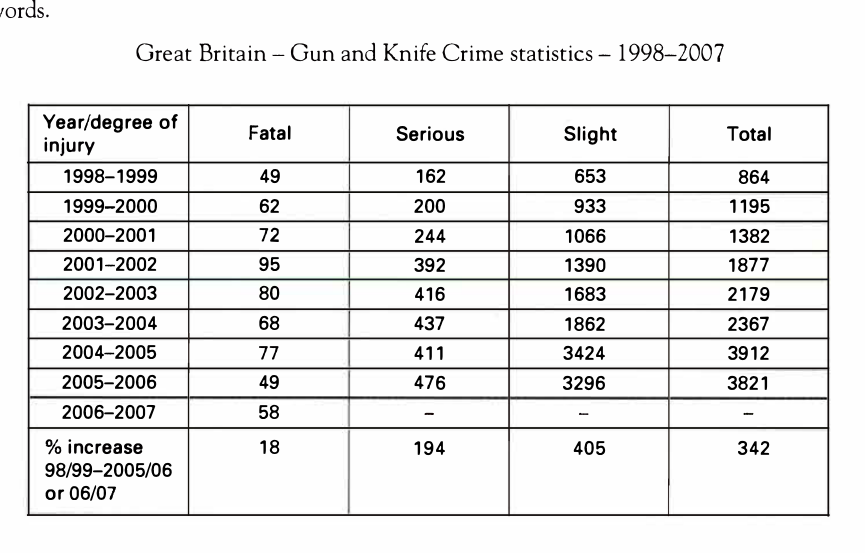
The table shows the number of fatal, serious and slight injuries resulting from gun and knife crime in Great Britain from 1998 to 2007 and the percentage increase for each degree of injury over the period.
Summarise the information by selecting and reporting the main features, and make comparisons where relevant.
Great Britain - Gun and Knife Crime statistics - 1998-2007
Student answer (Band 6.0)
The table demonstrates the consequences of the gun and knife crime in Great Britain over 19 years and the increased percentage of fatal, serious and slight injuries.
Overall, the slight injuries were by far accounted for largest share not only among others but also in total percentage, while serious cases placed in second on the list. However, the number of fatal cases were lower respectively.
From 1998 to 2007, the number of slightly injured cases were at its peak and rose drastically from 653 to 3296, at 405%.Whereas, the serious cases reported over 19 years increased gradually from 162 to 476 which was 194%. Nevertheless, the fatal cases were much lower in comparison with other two, from 49 to 58 by the end of 2007, at 58%.
However, the total of all these three crime rate in [redacted phone] was 864, which increased to 2179 by 2003 and 3821 by the end of 2007. The percentage of all these crime from 1998 to 2007 was 342%.
AI examiner evaluation
| Criterion | Band |
|---|---|
| Task Achievement / Task Response | 6.0 |
| Coherence and Cohesion | 6.0 |
| Lexical Resource | 6.0 |
| Grammatical Range and Accuracy | 5.5 |
| Overall | 6.0 |
Task Achievement / Task Response: Band 6.0
You identify the main pattern that slight injuries were the largest category and fatal injuries the smallest, and you include relevant figures for all three categories and the total. However, some details are inaccurate or unclear: the table covers 1998–1999 to 2006–2007, not “over 19 years”; the 405% increase applies to slight injuries through 2005–2006, while the figures 653 and 3,296 are also from those endpoints, not 2007. Similarly, the total of 3,821 is for 2005–2006, and the final year has no total. The overview’s reference to “total percentage” is unclear. A more precise overview and careful distinction between the final available year and the percentage-comparison period would make the report more complete and accurate.
Coherence and Cohesion: Band 6.0
The response has a clear overall arrangement: an introduction, an overview, a paragraph comparing injury categories, and a final paragraph on totals. This gives the reader a recognisable progression through the information. Some linking is effective, such as “Overall” to signal the summary and “However” to introduce the total figures. At times, though, connectors are mechanical or do not express the relationship clearly: “Whereas” begins a sentence fragment, and “Nevertheless” does not establish a clear contrast before the fatal-injury figures. References such as “these three crime rate” are also unclear. Grouping the category comparisons more explicitly and using connectors only where their logical function is clear would strengthen cohesion.
Lexical Resource: Band 6.0
You use a reasonable range of task-related vocabulary, including “slight injuries,” “serious cases,” “fatal cases,” “increased gradually,” and “rose drastically.” These choices make the broad comparisons understandable. However, some expressions are imprecise or awkward for describing a table: “the consequences of the gun and knife crime,” “accounted for largest share,” and “the percentage of all these crime” do not communicate the intended statistical relationships naturally. “At its peak” is also not a precise description of a rise across the period. Aim for accurate collocations such as “the number of injuries,” “the largest category,” and “the overall total,” and use “percentage increase” when referring to the table’s final row.
Grammatical Range and Accuracy: Band 5.5
You attempt both simple and more complex sentence forms, including comparisons and clauses introduced by “while” and “which.” The main ideas remain understandable, but some grammatical errors recur. For example, “the number of fatal cases were” has subject–verb disagreement, and “the number of slightly injured cases were at its peak” combines agreement and pronoun problems. “Whereas, the serious cases…” is a fragment because “whereas” needs to connect the clause to another one. There are also issues with articles and number, as in “the largest share” and “these three crime rate.” Review agreement with singular subjects such as “the number,” and check that subordinate clauses are attached to complete sentences. More consistently accurate complex sentences would improve control.
See this exact question answered at other band scores. The same prompt compared across bands.
Browse more IELTS Writing model answers or get your own writing scored by the same AI examiner.