Band 6.0 IELTS Writing Task 1 Model Answer
Overall Band Score: 6.0 · IELTS Momentum Workout · 2026-11-19
IELTS Writing Task 1 question
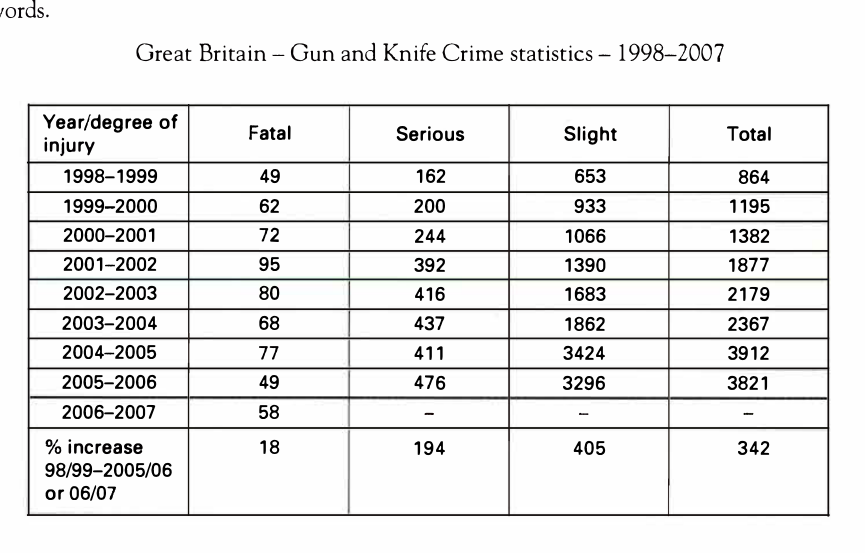
The table shows the number of fatal, serious and slight injuries resulting from gun and knife crime in Great Britain from 1998 to 2007 and the percentage increase for each degree of injury over the period.
Summarise the information by selecting and reporting the main features, and make comparisons where relevant.
Great Britain - Gun and Knife Crime statistics - 1998-2007
Student answer (Band 6.0)
The table illustrates the severity of several types of injuries (fatal, serious, and slight) and the increase in their percentage caused by gun and knife crimes in the UK from the year 1998 to 2007.
Overall, a significant rise has been observed in the number of the total injured people over the period of 10 years. Fortunately, mild ijuries were on top while severe injuries were fewer but kept on increasing approximately every year.
The amount of fatal injured people by these crimes was 49 during the year [redacted phone] but it was almost doubled (95) by the year 2002 then starting falling and reached to 58 by the end of 2007.The overall rise in this type was 18%. Similarly, serious level affected people were also increased 194% starting from 162 in 1998 to 476 at the end of 2006.
Moreover, the number of minute ijured people was high every year then the other two and the affedcted people were approximately 5 time more (3296) in year 2006 than the people (653) in the year 1998 which is 405% rise in this particular crime. The telly of total people affected by both crime was increased significantly from 864 to 3821 which is 342% increase overall,
AI examiner evaluation
| Criterion | Band |
|---|---|
| Task Achievement / Task Response | 6.0 |
| Coherence and Cohesion | 6.0 |
| Lexical Resource | 5.5 |
| Grammatical Range and Accuracy | 5.5 |
| Overall | 6.0 |
Task Achievement / Task Response: Band 6.0
You identify the main overall pattern: total injuries rose substantially, slight injuries were the most numerous, and the percentage increases were greatest for slight and total injuries. You also include useful comparisons, such as fatal injuries rising from 49 to a peak of 95 before falling, and serious injuries increasing from 162 to 476. However, some details are inaccurate or unclear: the slight-injury figure of 3,296 is for 2005–06, not 2006–07, and the table gives no final-year figures for serious, slight or total injuries. The claim that severe injuries increased “approximately every year” is also too broad, since fatal figures fluctuate and serious injuries fall from 416 to 411 in 2004–05. A more precise overview and clearer treatment of the table’s final-year data would strengthen the report.
Coherence and Cohesion: Band 6.0
The response has a recognisable structure: an introduction and overview are followed by paragraphs comparing injury categories. Linking expressions such as “Overall,” “Similarly” and “Moreover” help signal the direction of the report. However, the progression within the body is sometimes difficult to follow because several figures and comparisons are packed into long sentences, and the final sentence ends with a comma rather than a clear conclusion. References such as “this type” and “both crime” are not always precise, so readers may need to infer which category or crimes are meant. Grouping the figures more systematically—for example, discussing the overall trend first, then comparing the three injury levels—would make the organisation clearer and cohesion less dependent on basic linking words.
Lexical Resource: Band 5.5
You use a relevant range of vocabulary, including “severity,” “significant rise,” “overall rise” and “percentage,” which helps communicate the main trends. There are also attempts to vary descriptions of the categories, such as “mild” and “severe.” However, several choices are inaccurate or unnatural for statistical reporting: “fatal injured people,” “minute injured people,” “the tally of total people,” and “the increase … caused by” do not express the intended meanings precisely. Spelling errors such as “ijuries,” “affedcted” and “telly” also reduce accuracy. Aim for consistent, standard terms such as “fatal injuries,” “slight injuries,” “number of people injured” and “percentage increase.” This would make the vocabulary more precise and natural without requiring more complex wording.
Grammatical Range and Accuracy: Band 5.5
You attempt a mixture of simple and more complex sentences, including contrast and time clauses, as in “but it was almost doubled … then starting falling.” The overall meaning is generally understandable, but some grammatical errors affect clarity. For example, “it was almost doubled” has an awkward passive construction, while “then starting falling” lacks a correctly formed verb; “it then began to fall” would be clearer. There are also problems with articles, number and sentence boundaries, as in “both crime was increased” and the run-on final sentence ending in a comma. Punctuation is inconsistent, particularly where full stops are missing after year references. More accurate verb forms and clearer sentence boundaries would improve control while preserving your attempts at complex structures.
See this exact question answered at other band scores. The same prompt compared across bands.
Browse more IELTS Writing model answers or get your own writing scored by the same AI examiner.