Band 5.5 IELTS Writing Task 1 Model Answer
Overall Band Score: 5.5 · IELTS Momentum Workout · 2026-11-19
IELTS Writing Task 1 question
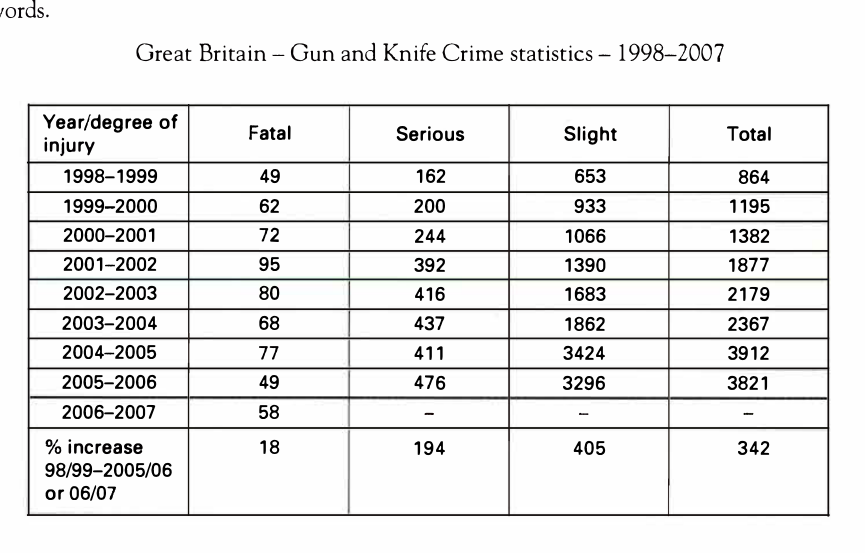
The table shows the number of fatal, serious and slight injuries resulting from gun and knife crime in Great Britain from 1998 to 2007 and the percentage increase for each degree of injury over the period.
Summarise the information by selecting and reporting the main features, and make comparisons where relevant.
Great Britain - Gun and Knife Crime statistics - 1998-2007
Student answer (Band 5.5)
The given chart depicts the different types of injury resulting from either gun or knife between the year 1998 and 2007.
Overall, the total number of cases reported every year has been increased then the previous year except in year 2005 - 2006 where the total reported cases is less than the previous year. Further in the year [redacted phone] there is no data has been provided.
The injury has been catergorised into three types that is fatal, serious and slight. Out of the three slight injury has been the most reported every year. whereas fatal ranked the least reported one.
The slight injury ranked the highest for the increased in the percent change between the 1998 to 2006 with the 405 cases. However, fatal type of injury ranked the lowest in the percent change between the year 1998 to 2007 with only 18 cases. The serious category of injury reports 194 cases for increase in percent change between the year 1998 to 2006.
AI examiner evaluation
| Criterion | Band |
|---|---|
| Task Achievement / Task Response | 5.5 |
| Coherence and Cohesion | 6.0 |
| Lexical Resource | 5.5 |
| Grammatical Range and Accuracy | 5.0 |
| Overall | 5.5 |
Task Achievement / Task Response: Band 5.5
You identify the main categories and correctly note that slight injuries were the most numerous, fatal injuries the least numerous, and that the total fell from 2004–05 to 2005–06. You also report the percentage increases for the three injury types accurately. However, the overview is incomplete: totals generally rose, but the response does not describe the substantial rise to 3,912 in 2004–05 or the subsequent decline. It also calls the percentage changes “cases,” and does not report the total increase of 342%. The statement that no data was provided for 2006–07 needs qualification, since a fatal figure of 58 is shown while the other entries are blank. Selecting and comparing these key features more fully would make the summary more complete.
Coherence and Cohesion: Band 6.0
The response has a clear overall arrangement: an introduction, an overview, and a paragraph about injury categories and percentage changes. This makes the main points reasonably easy to locate. However, progression within the overview is limited, and some information is repeated rather than developed through comparisons. For example, the response separately states that slight injuries were highest and fatal injuries lowest, then discusses their percentage increases without clearly linking the annual figures to those changes. The connector “Further” does not express the relationship intended, and “whereas” begins a sentence fragment after a full stop. Grouping the annual trend and the percentage-change comparisons more systematically, with accurate linking phrases, would improve cohesion.
Lexical Resource: Band 5.5
You use relevant task vocabulary such as “fatal,” “serious,” “slight,” “percent change,” and “reported,” so the reader can understand the subject and categories. However, several word choices and collocations are imprecise or repetitive. “The injury has been catergorised” is awkward, and “ranked the highest for the increased” does not express the comparison naturally. Referring to percentage increases as “cases” also confuses a rate of change with a count. There is a noticeable spelling error in “catergorised,” and repeated use of “reported” and “injury” limits variety. More precise terms such as “accounted for,” “rose,” and “percentage increase” would help convey the data clearly and accurately.
Grammatical Range and Accuracy: Band 5.0
The response includes some longer sentence attempts, including the overview beginning “Overall,” and the comparison introduced by “However,” but control is inconsistent. Errors include “has been increased” where a simple past form is needed, “the total reported cases is,” and “there is no data has been provided,” which combines incompatible structures. The sentence “whereas fatal ranked the least reported one” is also incomplete after the preceding full stop. Articles and number agreement are sometimes missing or inaccurate, as in “the year 1998” and “the serious category … reports.” These errors can make relationships between ideas difficult to follow. Practise accurate past-tense reporting and build complex comparisons from complete clauses, checking agreement and sentence boundaries.
See this exact question answered at other band scores. The same prompt compared across bands.
Browse more IELTS Writing model answers or get your own writing scored by the same AI examiner.