Band 5.0 IELTS Writing Task 1 Model Answer
Overall Band Score: 5.0 · IELTS Momentum Workout · 2026-11-20
IELTS Writing Task 1 question
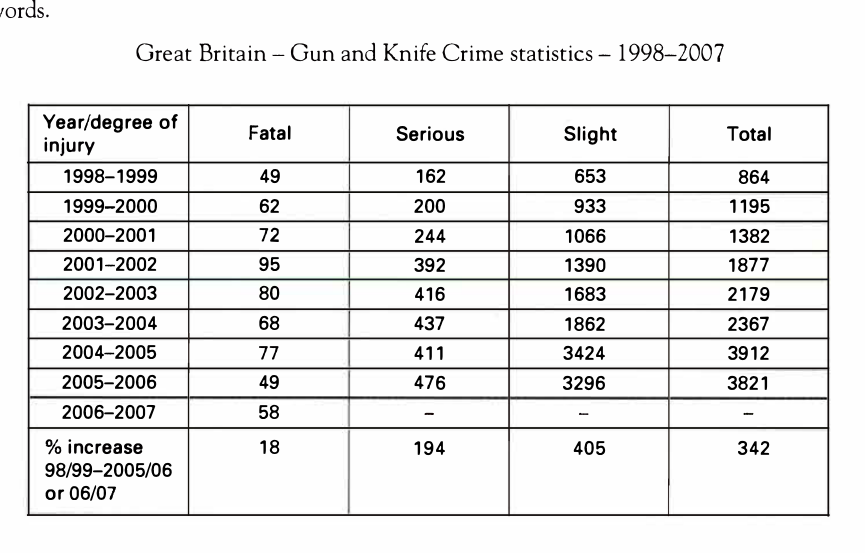
The table shows the number of fatal, serious and slight injuries resulting from gun and knife crime in Great Britain from 1998 to 2007 and the percentage increase for each degree of injury over the period.
Summarise the information by selecting and reporting the main features, and make comparisons where relevant.
Great Britain - Gun and Knife Crime statistics - 1998-2007
Student answer (Band 5.0)
The table presents the number of fatal, serious and slight injuried from weapon crime in great britain ftom 1998 to 2007 and show increase for each degree of injury over time.
Great Britain - Gun and Knife Crime statistic result from 1998 to 2007 illustrate,Each and every yera total number of year/degree of injury is only rising year by year and aslo serious and slight follow the same trent,but fatal degree of injury seen to be flucuted.
In year [redacted phone] fatal 49,serious 162 slight 653 total 864 which is the lowest of time,[redacted phone] fatal 63 serious 200 slight 933 total 1195 ,[redacted phone] had total 1385 following same patten of icreas in all aspects,
after [redacted phone] table shows fatal injury stard flucuate however total number of injury is still rising,in [redacted phone] for first time serious injury seems to drecrease to 411 and fatal had 77,meanwhile [redacted phone] has report of fatal of 58 other are not given
AI examiner evaluation
| Criterion | Band |
|---|---|
| Task Achievement / Task Response | 4.5 |
| Coherence and Cohesion | 5.0 |
| Lexical Resource | 5.0 |
| Grammatical Range and Accuracy | 5.0 |
| Overall | 5.0 |
Task Achievement / Task Response: Band 4.5
You identify the broad pattern that totals and slight injuries generally rose, while fatal injuries fluctuated, and you note that figures for 2006–07 are incomplete. However, the response only partially reports the table’s main features: it gives no clear overview of the overall scale of the increases, omits the substantial rise in serious injuries, and does not mention the percentage increases. Some figures are inaccurate: 1999–2000 fatalities were 62, not 63, and the 2000–01 total was 1,382, not 1,385. The claim that totals rise every year is also incorrect, since the total fell from 3,912 to 3,821 in 2005–06. Select the key trends and compare them accurately rather than listing isolated years.
Coherence and Cohesion: Band 5.0
There is a basic sequence from an introduction to general trends and then selected yearly figures, and phrases such as “however” and “meanwhile” show an attempt to connect contrasting information. Nevertheless, the response is presented as one continuous block, and the progression is difficult to follow: the overview is mixed with detailed figures, then the account jumps between years without a clear organising principle. Several long sentences run figures together, making comparisons hard to locate. Use separate paragraphs for an overview and the main details, and group the data by trend—for example, rising injury categories versus fluctuating fatalities. Clearer sentence boundaries and more precise links would make the information easier to follow.
Lexical Resource: Band 5.0
The response uses some relevant vocabulary, including “fatal,” “serious,” “slight,” “total,” “increase,” and “fluctuate,” so the reader can recognise the subject and intended trends. However, the range is limited and several spelling and word-form errors make the writing less clear, such as “injuried,” “flucuated,” “icreas,” and “patten.” Some expressions are also unnatural or imprecise: “total number of year/degree of injury” does not clearly describe the figures, and “weapon crime” is less specific than the table’s gun and knife crime. Aim for accurate collocations such as “number of injuries,” “fatal injuries fluctuated,” and “the total rose,” and check spelling carefully.
Grammatical Range and Accuracy: Band 5.0
You attempt both simple statements and longer sentences with contrast, as in “fatal degree of injury seen to be flucuted” and “however total number of injury is still rising.” However, control is inconsistent, and errors frequently make relationships between ideas difficult to understand. Examples include missing or incorrect verb forms in “fatal degree of injury seen,” “total number … is only rising,” and “2000-2001 had total,” as well as agreement and article problems in “each and every yera total number … is.” Punctuation is also weak: commas join long sequences of figures without clear sentence boundaries. Practise complete subject–verb sentences and use full stops to separate comparisons; then check tense and agreement in each sentence.
See this exact question answered at other band scores. The same prompt compared across bands.
Browse more IELTS Writing model answers or get your own writing scored by the same AI examiner.