Band 5.5 IELTS Writing Task 1 Model Answer
Overall Band Score: 5.5 · IELTS Momentum Workout · 2026-11-20
IELTS Writing Task 1 question
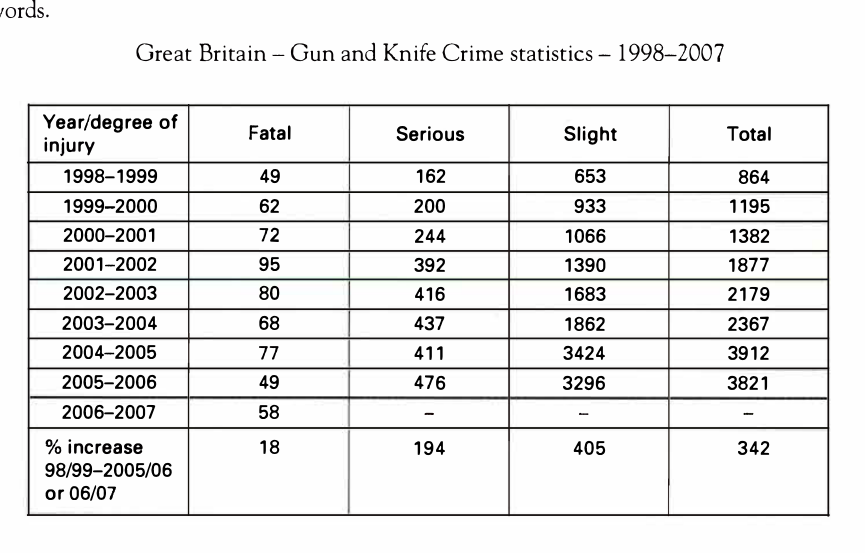
The table shows the number of fatal, serious and slight injuries resulting from gun and knife crime in Great Britain from 1998 to 2007 and the percentage increase for each degree of injury over the period.
Summarise the information by selecting and reporting the main features, and make comparisons where relevant.
Great Britain - Gun and Knife Crime statistics - 1998-2007
Student answer (Band 5.5)
The table illustrates the amount of 3 different injuries happened due to gun and knife crime in Great Britain between 1998 and 2007 with the percentage rise in each type of injury over the period.
overall, the ratio of crime from gun and knife increased throughout the whole period of time. The degree of injuries which includes fatal, serious, and slight rose every year excluding fatal injury from the year 2002.
since 1998 to 2002, fatal injury went to it's peak value of 95 then dropped back throughout the time to it's lowest number of 58. However, serious injuries hiked from the year 1998 till 2007 starting with the lowest value of 162 to the peak number of 476 making it the second most injury occurred due to crime.
The large amount of injuries occurred as slight injury from 1998 the number of injuries were 653 which increased every year by huge amount and ending up at 3296 in the year 2007.
AI examiner evaluation
| Criterion | Band |
|---|---|
| Task Achievement / Task Response | 5.5 |
| Coherence and Cohesion | 6.0 |
| Lexical Resource | 5.5 |
| Grammatical Range and Accuracy | 5.5 |
| Overall | 5.5 |
Task Achievement / Task Response: Band 5.5
You identify the main categories and report several relevant figures, including the fatal-injury peak of 95 and the rise in slight injuries from 653 to 3,296. However, the overview is not fully accurate: injuries did not rise every year, as fatal figures fluctuated and slight injuries fell from 3,424 to 3,296 in the final year with data. The claim that serious injuries rose “till 2007” is also unsupported because the table gives no serious-injury figure for 2006–07; 476 is the 2005–06 value. The percentage increases are omitted, despite being a key feature, and the total figures are not discussed. More precise coverage of these features would make the summary more complete and better grounded.
Coherence and Cohesion: Band 6.0
The response has a recognisable sequence: an introduction, an overview, and then details about fatal, serious, and slight injuries. This gives the reader a basic route through the information, and transitions such as “However” help signal contrast. However, the overview and detail paragraphs do not always connect clearly: the claim that all categories rose every year conflicts with the later account of fatal injuries falling, and the final-year references are ambiguous. The response also groups each injury type separately without comparing their scale or linking the percentage increases to the trends. Use clearer paragraphing and references, and organise the body around the main comparisons—for example, the much larger rise in slight injuries versus the smaller increase in fatal cases.
Lexical Resource: Band 5.5
You use relevant topic vocabulary such as “fatal,” “serious,” “slight,” “peak,” and “increased,” so the reader can generally understand the categories and trends. There is also some attempt at varied wording, including “hiked” and “dropped back.” However, several choices are informal or imprecise for an academic report: “hiked” and “huge amount” are less suitable than neutral trend language, while “amount of injuries” is not a natural collocation. “Ratio of crime” does not accurately describe the number of injuries, and “injuries happened due to” is awkward. Aim for precise terms such as “number,” “figure,” “rose,” and “declined,” and use “percentage increase” when reporting the table’s final row.
Grammatical Range and Accuracy: Band 5.5
You attempt both simple and more extended sentences, including a contrast introduced by “However” and a clause beginning “which includes.” The main meaning is usually recoverable, but some sentence structures and grammatical forms are inaccurate. For example, “The degree of injuries which includes” has a mismatch between the plural noun and verb, while “fatal injury went to it's peak value” has an incorrect possessive form and awkward construction. The sentence beginning “The large amount of injuries occurred as slight injury” is also difficult to follow because its clauses are not clearly joined. Capitalise “Overall” and use consistent, accurate past-tense reporting. More controlled sentence boundaries and agreement would improve clarity while retaining a mix of structures.
See this exact question answered at other band scores. The same prompt compared across bands.
Browse more IELTS Writing model answers or get your own writing scored by the same AI examiner.