Band 5.0 IELTS Writing Task 1 Model Answer
Overall Band Score: 5.0 · IELTS Momentum Workout · 2026-11-20
IELTS Writing Task 1 question
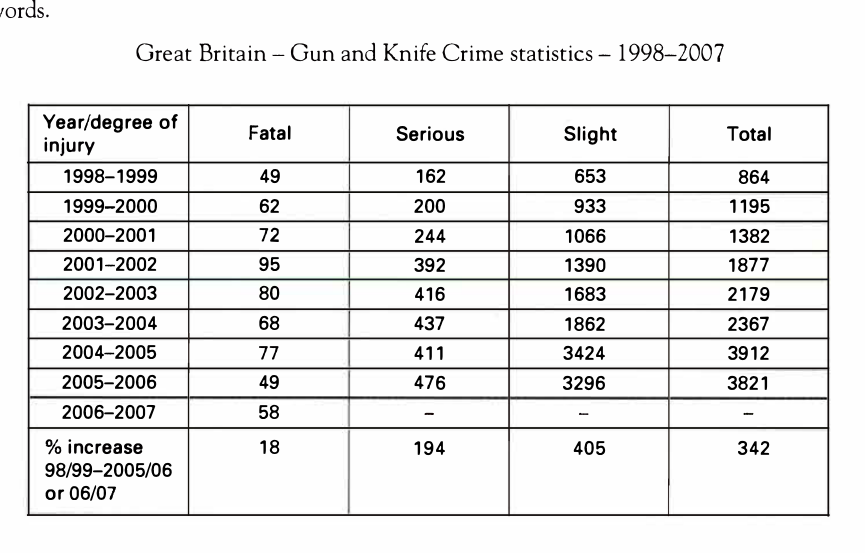
The table shows the number of fatal, serious and slight injuries resulting from gun and knife crime in Great Britain from 1998 to 2007 and the percentage increase for each degree of injury over the period.
Summarise the information by selecting and reporting the main features, and make comparisons where relevant.
Great Britain - Gun and Knife Crime statistics - 1998-2007
Student answer (Band 5.0)
THE GIVEN BAR CHART SHOWS STATISTICS OF GREAT BRITAIN - GUN AND KNIFE IN [redacted phone]. OVER THE YEARS RISK OF INJRUIES WERE INCREASED.
THIS CHART DIVIDED STATISTIC IN FIVE COLUMNS WHICH IS YEAR OF INJURY,FATAL,SERIOUS,SLIGHT AND TOTAL OF ALL THREE CATEGORY.
IN YEAR 1998 TO 1999, CASE OF SLIGHT INJURY WERE FAR MORE HIGHER THAN SERIOUS AND FATAL WHICH WAS 653. MOREOVER, NEXT YEAR CASES WERE SIGNIFICANT HIGHER THAN PRIVIOUS YEAR IN ALL THREE CATEGORY WHICH WAS IN TOTAL 1195.FOR INSTANCE EVERY YEAR CASE OF INJURY WERE HIGHER THAN PRIVIOUS YEAR.
FURTHERMORE, IN YEAR BETWEEN 2000 TO 2007 CASES OF INJURIES WERE RAPIDLY INCREASE IN ALL THREE CATEGORY FOR FATAL CASES OF INJURY WERE PEAK ON YEAR 2002 WHEREAS IN 2006 CASES WERE SIGNIFICANT LOWER THAN OTHER YEARS.MOREOVER, SERIOUS CASES WERE RAPIDLY INCRESE EACH YEAR, IN YEAR 2003 IT HAD CROSS 400 AND IN YEAR 2006 IT WAS 476 HIGHER THAN ANY OTHER YEARS. HOWEVER,AT THE AND OF YEAR 2006 TOTAL INJURY CASES WERE 3821 WHICH WAS LOWER THAN PRIVIOUS YEAR. MOREOVER IN 2007,FATAL CASES WERE 58 WHEREAS OTHER THREE CATEGORY SHOWS NONE.
AI examiner evaluation
| Criterion | Band |
|---|---|
| Task Achievement / Task Response | 4.5 |
| Coherence and Cohesion | 5.0 |
| Lexical Resource | 5.0 |
| Grammatical Range and Accuracy | 5.0 |
| Overall | 5.0 |
Task Achievement / Task Response: Band 4.5
You identify the broad pattern of rising injury figures and include several relevant details, such as the 653 slight injuries in 1998–99, the serious-injury peak of 476 in 2005–06, and the total falling from 3,912 to 3,821. However, the overview is vague and some claims are inaccurate or incomplete. The figures did not rise every year: fatal injuries peaked at 95 in 2001–02, then fluctuated, while slight injuries rose sharply to 3,424 in 2004–05 before declining. The statement that other categories showed “none” in 2006–07 is misleading; the table gives dashes, not zero values. Select the main trends accurately and compare the categories more clearly, including the overall percentage increases.
Coherence and Cohesion: Band 5.0
The response has a basic paragraph structure: an introduction, a description of the table, and two paragraphs of figures and trends. Linking expressions such as “Furthermore,” “Moreover,” and “However” show an attempt to connect ideas. However, progression is not always clear, and the repeated use of these connectors can feel mechanical. The discussion moves between years, injury categories, and totals without a consistent order, while “every year” conflicts with the later description of falling figures. Organise the report around an overview followed by clear comparisons—for example, first describe the overall rise and the sharp increase in slight injuries, then cover the fluctuations in fatal and serious cases. This would make relationships between details easier to follow.
Lexical Resource: Band 5.0
You use some task-relevant vocabulary, including “fatal,” “serious,” “slight,” “peak,” and “total,” so the reader can identify the categories being discussed. However, the range is limited and several word choices or collocations are inaccurate, such as “risk of injuries,” “cases were rapidly increase,” and “cross 400.” Repetition of “cases” and “injury” also makes the report less precise. Spelling errors, including “INJRUIES,” “privious,” and “increse,” are noticeable and reduce clarity. Use standard statistical language consistently, such as “the number of injuries,” “rose,” “reached,” and “declined,” and check spelling before submitting. This would make your comparisons more natural and exact.
Grammatical Range and Accuracy: Band 5.0
You attempt both simple statements and longer sentences with contrast, for example, “Fatal cases … were peak … whereas…” This shows some effort to vary sentence structure, but complex sentences are often faulty and errors occur frequently. Examples include “risk of injuries were increased,” “cases … were rapidly increase,” and “in 2007, fatal cases were 58 whereas other three category shows none.” These contain problems with verb forms, agreement, articles, and sentence construction. Punctuation is also inconsistent, particularly around commas and full stops. Practise building accurate sentences with a clear subject and verb, such as “Fatal injuries peaked at 95 in 2001–02, then fell.” Use past-tense verbs throughout when describing the historical data.
See this exact question answered at other band scores. The same prompt compared across bands.
Browse more IELTS Writing model answers or get your own writing scored by the same AI examiner.