Band 6.0 IELTS Writing Task 1 Model Answer
Overall Band Score: 6.0 · IELTS Momentum Workout · 2026-11-21
IELTS Writing Task 1 question
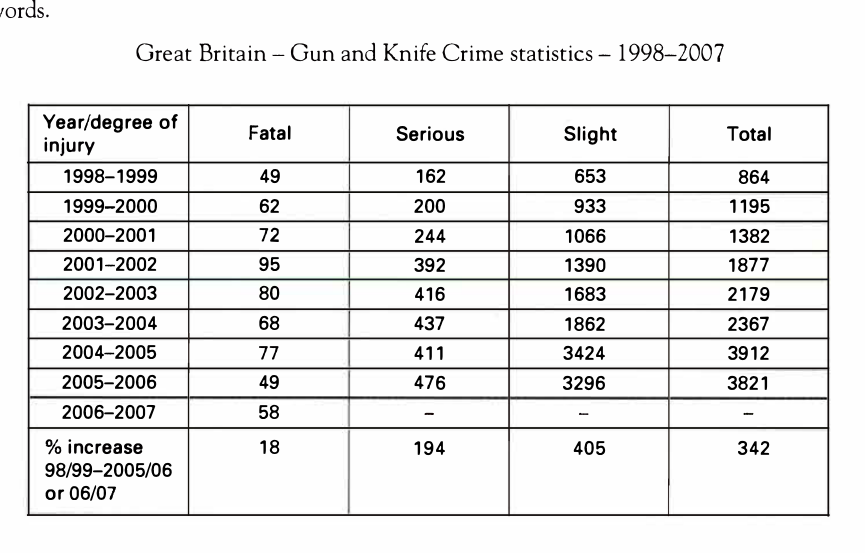
The table shows the number of fatal, serious and slight injuries resulting from gun and knife crime in Great Britain from 1998 to 2007 and the percentage increase for each degree of injury over the period.
Summarise the information by selecting and reporting the main features, and make comparisons where relevant.
Great Britain - Gun and Knife Crime statistics - 1998-2007
Student answer (Band 6.0)
The data illustrates the number of different injuries as a result of gun and and knife crime in Great Britain between 1998 and 2007 and the proportion rise for each category over the decade.
Overall, the highest number of injuries caused by gun and knife were slight injuries. In contrast, life threatening injuries accounted for the lowest figure. Over the decade, the highest percentage of increase was shown in minor injuries.
In [redacted phone], 49 individuals were deadly ingured, the figure increased to 162 who had major wounds, while slight injuries accounted for 653. In [redacted phone], the figure for fatal inguries reached at its peak of 95, critical injuries accounted for 392, whereas the number for small ingures became 1390. The injuries for people who were severe injured reached at its peak of 476 in 2006 and 2007, while marginal injuries peaked at 3424 injuries in 2005 and 2006.
Regarding percentage, deadly injuries increase by 18% over the period, major injuries rose by 194% and minor inguries accounted for the highest figure of 405%. The total figure for all injuries at the start was 864 and at the end of period became 3821. Over the decade injuries increased by 342%.
AI examiner evaluation
| Criterion | Band |
|---|---|
| Task Achievement / Task Response | 6.0 |
| Coherence and Cohesion | 6.5 |
| Lexical Resource | 5.5 |
| Grammatical Range and Accuracy | 5.5 |
| Overall | 6.0 |
Task Achievement / Task Response: Band 6.0
You identify the main pattern that slight injuries were the most numerous and fatal injuries the least, and you report the percentage increases, including the 405% rise in slight injuries. These are relevant features and give the response a clear overview. However, some details are inaccurate or unclear: 162 in 1998–99 refers to serious injuries, not “major wounds” as a separate category, and the 476 serious injuries occurred in 2005–06, not “2006 and 2007.” The slight-injury peak was 3,424 in 2004–05, rather than 2005–06. The final total is 3,821 for 2005–06; no total is provided for 2006–07. More precise reporting of the categories and dates would make the coverage more complete.
Coherence and Cohesion: Band 6.5
The response has a clear overall arrangement: an introduction and overview are followed by figures for selected years and then percentage changes. The paragraphing helps the reader distinguish the broad trends from the details, and linking expressions such as “In contrast,” “whereas,” and “Regarding percentage” show an effort to connect information. This is already a coherent progression, but some connections are not fully clear. For example, “the figure increased to 162 who had major wounds” makes the relationship between the number and injury category difficult to follow, while the shift from 2001–02 to 2006–07 leaves intermediate trends unexplained. Use more direct comparisons and consistent category labels to make the progression smoother and cohesion less dependent on formulaic transitions.
Lexical Resource: Band 5.5
You use a reasonable range of vocabulary to describe the data, including “accounted for,” “reached its peak,” and “percentage of increase.” However, several attempted alternatives for the injury categories are inaccurate or unnatural: “deadly ingured,” “critical injuries,” “small ingures,” and “marginal injuries.” These substitutions make it harder to tell which table category you mean, and spelling errors such as “ingured” and “ingures” are noticeable. In IELTS data reporting, accurate repetition of the labels “fatal,” “serious,” and “slight” is preferable to varied but imprecise synonyms. More reliable collocations, such as “the number of fatal injuries rose,” would also improve clarity and control.
Grammatical Range and Accuracy: Band 5.5
You attempt both simple and more complex sentence forms, including contrasts with “whereas” and “while,” and most of the intended comparisons can be understood. Some grammatical errors remain, particularly in sentence construction and verb patterns. For example, “the figure increased to 162 who had major wounds” incorrectly attaches “who had” to a figure, and “reached at its peak” uses an unnecessary preposition. In “the highest percentage of increase was shown,” the passive construction is awkward, while “deadly injuries increase by 18%” shifts into the present tense despite describing past data. Aim for consistent past-tense reporting and simpler, well-formed structures, such as “Serious injuries rose to 476 in 2005–06.”
See this exact question answered at other band scores. The same prompt compared across bands.
Browse more IELTS Writing model answers or get your own writing scored by the same AI examiner.