Band 4.5 IELTS Writing Task 1 Model Answer
Overall Band Score: 4.5 · IELTS Momentum Workout · 2026-11-21
IELTS Writing Task 1 question
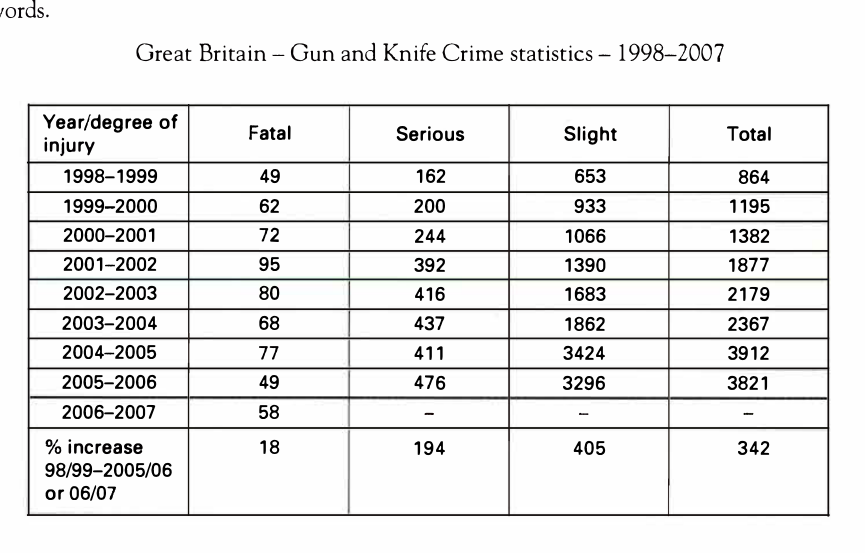
The table shows the number of fatal, serious and slight injuries resulting from gun and knife crime in Great Britain from 1998 to 2007 and the percentage increase for each degree of injury over the period.
Summarise the information by selecting and reporting the main features, and make comparisons where relevant.
Great Britain - Gun and Knife Crime statistics - 1998-2007
Student answer (Band 4.5)
The table shows the number of fatal and serious and slight injuries from gun and knife crime in great britain in 1998 to 2007 period of time and the persentage increase for each degree of injury.
Shown in the tabel that the crimes are going up what makes the fatal injuries goes up as well to the year of 2002 to about 95 fatal injuries than starting to go down by years to 58 with a increasing percentage ofa 18% beside that the serious and the slight injeries crimes they go up each year to hit 476 injuries and 194% increasing percentage on the serious and about 3296 injuries and 405% of increasing on the slight injuries makes it a round 342% of increasing in total over the years of [redacted phone]
To conclude, the crimes in Great Gritain over the years of 1998 ot 2007 has a remarcabel change to the good , witch makes the crimes go down specialy the crimes with fatal injuries
AI examiner evaluation
| Criterion | Band |
|---|---|
| Task Achievement / Task Response | 4.0 |
| Coherence and Cohesion | 5.0 |
| Lexical Resource | 5.0 |
| Grammatical Range and Accuracy | 4.5 |
| Overall | 4.5 |
Task Achievement / Task Response: Band 4.0
You identify the table’s subject and report several relevant figures, including the peak of 95 fatal injuries and the final fatal figure of 58. However, the response only minimally summarises the data: it gives no clear overview of the main pattern across the period and does not explain that slight injuries were consistently the largest category. Some claims are inaccurate or unclear: serious injuries did not rise every year, falling from 437 to 411 before reaching 476, and the table’s percentage increases refer to 1998–99 to 2005–06 or 2006–07, not simply the whole period as stated. The conclusion that crime changed “to the good” is not supported by the figures. Select key trends accurately and distinguish injury counts from percentage changes.
Coherence and Cohesion: Band 5.0
There is a basic attempt to organise the response: an opening identifies the table, a central paragraph reports figures, and a final sentence gives a conclusion. This provides some paragraphing and a recognisable sequence. However, progression within the main paragraph is difficult to follow because several categories and figures are joined in one long, loosely connected sentence. Phrases such as “beside that” and “makes it a round” do not clearly show how the information relates, and the conclusion introduces an unsupported interpretation rather than summarising the main features. Use separate sentences or paragraphs for the overall pattern and the injury categories, with clear links such as “by contrast” or “overall.”
Lexical Resource: Band 5.0
The response uses some task-relevant vocabulary, including “fatal,” “serious,” “slight injuries,” “percentage increase,” and “over the years.” This is enough to communicate the general subject, but the range is limited and several choices are inaccurate or awkward, sometimes making the meaning difficult to follow. For example, “the crimes are going up what makes the fatal injuries goes up” confuses crime totals with injury counts, while “a increasing percentage ofa 18%” is not a natural expression. Spelling errors such as “tabel,” “persentage,” “injeries,” and “remarcabel” are also noticeable. Aim for precise reporting language, such as “the number of injuries rose” and “an increase of 18%.”
Grammatical Range and Accuracy: Band 4.5
You attempt to combine ideas using clauses and time expressions, for example, “than starting to go down by years,” but sentence structures are often incomplete or inaccurately formed. The main reporting sentence lacks a clear grammatical framework, and forms such as “the fatal injuries goes up” show subject–verb disagreement. Other examples include “the serious and the slight injuries crimes they go up” and “the crimes … has a remarkable change,” where sentence structure and agreement make the message hard to interpret. Punctuation is also insufficient, particularly in the long central sentence. Build shorter, complete sentences first, checking subject–verb agreement and verb forms; then add a few controlled complex sentences to show comparisons over time.
See this exact question answered at other band scores. The same prompt compared across bands.
Browse more IELTS Writing model answers or get your own writing scored by the same AI examiner.