Band 5.5 IELTS Writing Task 1 Model Answer
Overall Band Score: 5.5 · IELTS Momentum Workout · 2026-11-22
IELTS Writing Task 1 question
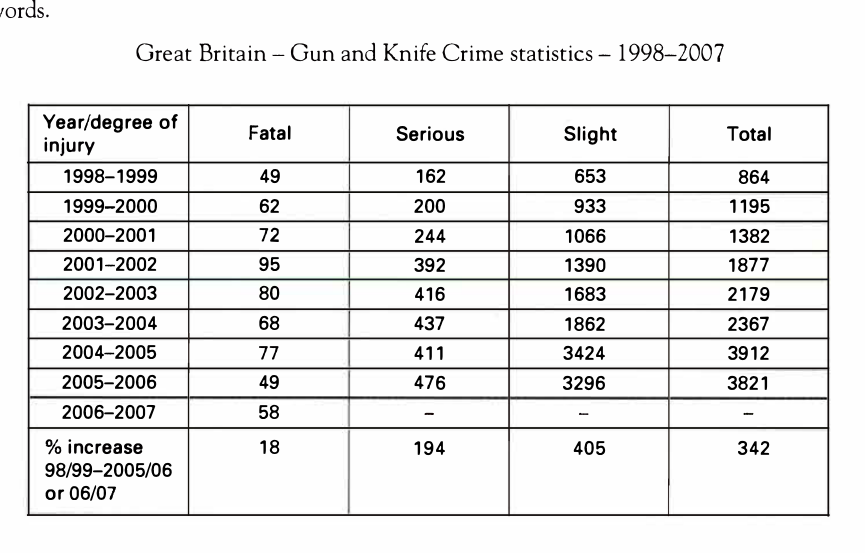
The table shows the number of fatal, serious and slight injuries resulting from gun and knife crime in Great Britain from 1998 to 2007 and the percentage increase for each degree of injury over the period.
Summarise the information by selecting and reporting the main features, and make comparisons where relevant.
Great Britain - Gun and Knife Crime statistics - 1998-2007
Student answer (Band 5.5)
The Table illustrates the number of injuries resulting from gun and knife crimes in great britian from 1998 to 2007. The types of injuries discussed are fatal, serious, and slight.
Overall, The number of damages increased as more years passed. During period of [redacted phone] the total number of abuses were 864, moving further to [redacted phone] the number of crimes went up to 3821 which was a massive addition.There was a total spike of 342% in each violation throught the passing years.
At start, there were total 864 crimes from [redacted phone] making it the lowest damage rate year, on the other hand, from 2006 to 2007 the number of injuries were 3821 making it the highest injury rate year. Some values are missing for year [redacted phone]. The 18% rise in the fatal offense was the lowest change, and 405% surge in the slight felony was the highest shift .The percentage of increase were 18%, 194%, 405%, and 342% for fatal, serious, slight and, all combined violations respectivily.
AI examiner evaluation
| Criterion | Band |
|---|---|
| Task Achievement / Task Response | 5.5 |
| Coherence and Cohesion | 5.5 |
| Lexical Resource | 5.0 |
| Grammatical Range and Accuracy | 5.5 |
| Overall | 5.5 |
Task Achievement / Task Response: Band 5.5
You identify the three injury categories and give an overview of the broad rise in totals, supported by the figures of 864 and 3,821. You also correctly report the percentage increases for fatal, serious, slight and total cases. However, the account is only partly accurate: 3,821 is the total for 2005–2006, not 2006–2007; the latter has only a fatal figure, 58, with the other entries missing. The claim that the total rose by 342% is also misleading because 342% refers to the increase in the combined total from 1998–1999 to 2005–2006, not an increase in every category. Develop the overview around the dominant rise in slight injuries and distinguish the final year’s incomplete data.
Coherence and Cohesion: Band 5.5
The response has a recognisable sequence: an introduction, an overall statement and then details about the totals and percentage changes. This gives the reader some structure, and phrases such as “At start” and “on the other hand” attempt to connect points. However, the progression is not consistently clear because the same total figures and overall rise are repeated, while the final paragraph shifts between years, missing data and percentage changes without a clear grouping. “On the other hand” does not express a meaningful contrast between the two years presented. Organise the body by first comparing the overall totals and then summarising the injury categories and their percentage increases; use linking expressions only where the relationship between ideas is clear.
Lexical Resource: Band 5.0
You use some relevant terms, including “fatal,” “serious,” “slight,” “percentage,” and “surge,” and the reader can generally understand the intended comparisons. However, vocabulary is often imprecise or repetitive. “Damages,” “abuses,” “crimes,” “violations,” and “felony” are not suitable substitutes for injury counts, and “total spike” does not clearly describe the reported percentage increase. There are also spelling and form errors, including “great britian” and “respectivily.” Choose neutral statistical language and repeat accurate terms such as “injuries,” “cases,” and “total” rather than using varied but misleading synonyms. This would make the description clearer and more appropriate to an academic report.
Grammatical Range and Accuracy: Band 5.5
You attempt a mixture of simple statements and longer sentences, and most of the main comparisons remain understandable. However, errors in sentence construction, agreement, articles and punctuation are noticeable. For example, “During period of 1998-1999 the total number of abuses were 864” needs an article and singular agreement (“During the period …, the total number … was 864”). The sentence beginning “At start” also combines several comparisons with a comma splice, making the relationships harder to follow. Capitalisation is inconsistent in “Overall, The number,” and spacing around punctuation is sometimes faulty. Use shorter, complete sentences for the data comparisons, check subject–verb agreement, and punctuate introductory phrases and clauses carefully.
See this exact question answered at other band scores. The same prompt compared across bands.
Browse more IELTS Writing model answers or get your own writing scored by the same AI examiner.