Band 5.0 IELTS Writing Task 1 Model Answer
Overall Band Score: 5.0 · IELTS Momentum Workout · 2026-11-22
IELTS Writing Task 1 question
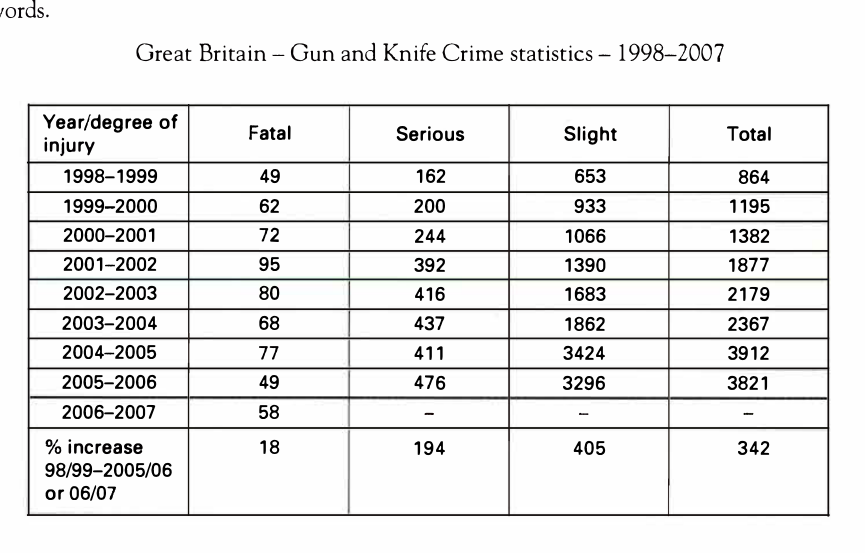
The table shows the number of fatal, serious and slight injuries resulting from gun and knife crime in Great Britain from 1998 to 2007 and the percentage increase for each degree of injury over the period.
Summarise the information by selecting and reporting the main features, and make comparisons where relevant.
Great Britain - Gun and Knife Crime statistics - 1998-2007
Student answer (Band 5.0)
The table shows information about gun and knife crime statistics for Great Britain from 1998 to 2007. In year [redacted phone] most fatal injuries happen then other years, and less happened in [redacted phone] and also in [redacted phone]. Most serious injuries happened in [redacted phone] and fewer in [redacted phone]. Slight injuries mostly happened in [redacted phone], and fewer in [redacted phone].
Overall, fatal injuries are lower in each year. and rate is increased as serious and than slight. In [redacted phone], only fatal injuries occurred, and no other injuries occurred. If we are looking for total number of injuries most injuries happend in [redacted phone], and fewer in [redacted phone]. Here at the end of table as per given information about percentage of increasing injouries in year of 1998-99, 2005-06, 2006-07, fatal injouries increses by 18 percent, serious injouries increase by 194 perscent and slight injouries increse by 405 percent. Overall, it is 342 percentage of all the injouries.
AI examiner evaluation
| Criterion | Band |
|---|---|
| Task Achievement / Task Response | 5.0 |
| Coherence and Cohesion | 5.0 |
| Lexical Resource | 5.0 |
| Grammatical Range and Accuracy | 5.0 |
| Overall | 5.0 |
Task Achievement / Task Response: Band 5.0
You identify several relevant extremes: fatal injuries peak at 95 in 2001–2002 and are lowest at 49 in both 1998–1999 and 2005–2006; serious injuries peak in 2005–2006, and slight injuries peak in 2004–2005. You also report the percentage increases. However, the overview is unclear and includes a major misreading: the table does not say that only fatal injuries occurred in 2006–2007; it gives no serious, slight or total figures for that year. The claim that fatal injuries are lower “in each year” is also too vague to summarise their fluctuating pattern. Develop a clearer overview of the overall rise in recorded injuries and distinguish missing data from zero values.
Coherence and Cohesion: Band 5.0
The response has some organisation: it begins with a description of the table, groups several injury categories together, and then discusses totals and percentage increases. However, the progression is not consistently clear. The overview begins with “Overall” but then shifts between yearly patterns, the final year and percentage changes without a clear hierarchy. Repeated use of “most” and “fewer” makes the comparisons feel like a list, while phrases such as “Here at the end of table” do not clearly connect the information. Use a more deliberate structure: introduce the main trends in an overview, then compare the injury categories and totals in separate, logically ordered paragraphs. Clearer linking and reference to the relevant years would help readers follow the comparisons.
Lexical Resource: Band 5.0
You use enough topic vocabulary to communicate the subject, including “fatal injuries,” “serious injuries,” “slight injuries,” “total number” and “percentage.” However, the range is limited and several word choices or collocations are inaccurate or repetitive. For example, “injuries happen” and “injuries occurred” are less suitable for describing figures in a table; “injuries were recorded” is more natural. “Rate is increased” does not accurately express a change in counts, and “percentage of increasing injuries” is awkward. Spelling errors such as “happend,” “injouries,” “increses” and “perscent” are noticeable and can distract the reader. Aim for precise reporting verbs and check spelling carefully, especially for key terms repeated throughout the response.
Grammatical Range and Accuracy: Band 5.0
The response relies mainly on simple sentence patterns, with limited control when attempting longer or more complex statements. Errors occur frequently, although the general topic remains understandable. For example, “In year 2001-2002 most fatal injuries happen” is missing an article and uses an unsuitable tense; “Overall, fatal injuries are lower in each year. and rate is increased” has faulty sentence punctuation and an unclear grammatical structure. The sentence beginning “If we are looking for total number” also has article and agreement problems. Practise forming accurate comparisons in the past tense, such as “The number of fatal injuries peaked in 2001–2002, while the lowest figures were recorded in…” Vary sentence structures only after the basic verb forms, articles and punctuation are secure.
See this exact question answered at other band scores. The same prompt compared across bands.
Browse more IELTS Writing model answers or get your own writing scored by the same AI examiner.