Band 5.0 IELTS Writing Task 1 Model Answer
Overall Band Score: 5.0 · IELTS Momentum Workout · 2026-11-22
IELTS Writing Task 1 question
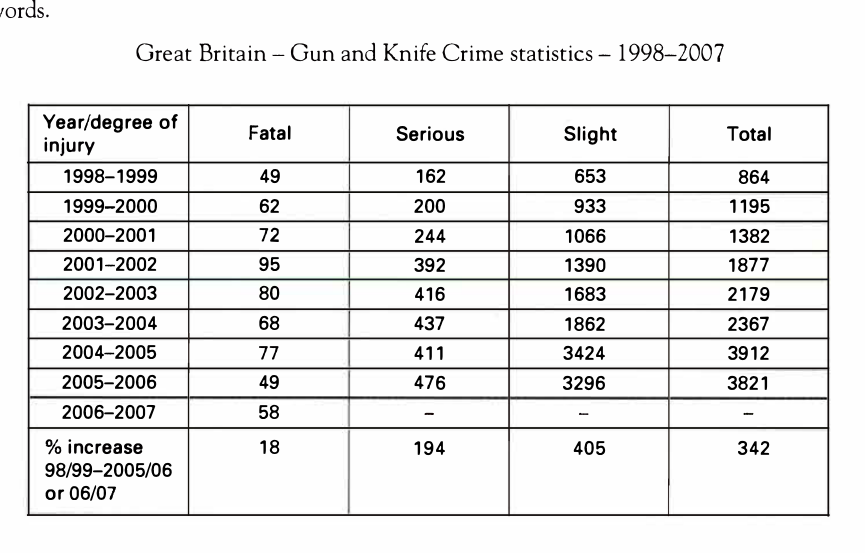
The table shows the number of fatal, serious and slight injuries resulting from gun and knife crime in Great Britain from 1998 to 2007 and the percentage increase for each degree of injury over the period.
Summarise the information by selecting and reporting the main features, and make comparisons where relevant.
Great Britain - Gun and Knife Crime statistics - 1998-2007
Student answer (Band 5.0)
The table shows the percentage changes in different kinds of injuries caused by gun and knife crime in Great Britain during the period of 1998 to 2007.
From the period of 2004 to 2005, the highest record of number of injuries in total was recorded around 3,912. In which slightly injury cases were more as compared with fatal and serious injuries. In all the years, slight injuries have the highest increase of percentage whcih gradually increased with 405%. Whereas, number of seriously injured people from street crimes were second and its percentage increased with 194%. A slightly increase was observed in fatal injury cases and just 18% increase happened in all the periods. A massive drop of almost zero number was reported in serious and slight injury cases by 2006 and 2007.
Overall, the table shows that the crime and injury cases increased till 2006 and slighty injured people were highest among all the other cases. In 2007 there a sudden drop which made recored almost none cases except for fatal.
AI examiner evaluation
| Criterion | Band |
|---|---|
| Task Achievement / Task Response | 5.0 |
| Coherence and Cohesion | 5.0 |
| Lexical Resource | 5.5 |
| Grammatical Range and Accuracy | 5.0 |
| Overall | 5.0 |
Task Achievement / Task Response: Band 5.0
You identify relevant features, including the peak total of 3,912 in 2004–05 and the much larger percentage rises for slight and serious injuries than for fatal injuries. However, the account only partially summarises the table: it gives little coverage of the earlier year-by-year pattern, and the overview is not fully accurate. The figures show that slight injuries rose sharply to 3,424 in 2004–05 and then fell slightly to 3,296, while serious injuries reached 476 in 2005–06; the table does not show these categories dropping to almost zero in 2006–07. That year contains dashes for those figures, not zero values. Select a few key stages and describe them precisely, distinguishing missing data from a recorded decline.
Coherence and Cohesion: Band 5.0
The response has a basic structure, beginning with an introduction and then presenting details followed by an overall statement. Some comparisons are also signalled with “Whereas” and “Overall.” However, the progression is not consistently clear: the first body paragraph moves between the 2004–05 total, percentage increases, and the final-year figures without a clear sequence. The overview repeats the claim that slight injuries were highest, while “In which” creates an incomplete connection to the preceding sentence. Organise the report into a clear overview and a body that follows the timeline or compares injury categories, and use linking expressions only where the relationship between ideas is clear.
Lexical Resource: Band 5.5
You use some relevant vocabulary for describing data, such as “percentage,” “total,” “increase,” and “drop,” and the reader can generally understand the intended comparisons. However, the range is limited and several choices are imprecise or awkward for a statistical report. “Highest record of number of injuries” is an unnatural way to describe the peak total, while “slightly injury cases” and “seriously injured people” do not consistently name the categories shown in the table. There are also spelling errors, including “whcih” and “recored.” Use concise, accurate terms such as “slight injuries,” “serious injuries,” “fatalities,” and “the total peaked at” to make comparisons clearer and more formal.
Grammatical Range and Accuracy: Band 5.0
The response attempts some longer structures, including comparisons introduced by “Whereas,” but control is uneven and the range of sentence patterns is limited. Several sentences contain faulty construction: “In which slightly injury cases were more” is a fragment, and “In 2007 there a sudden drop” is missing a verb. The phrase “A slightly increase was observed” also has an incorrect article-adjective form, and “the crime and injury cases increased” does not clearly express the intended trend. These errors sometimes make relationships between ideas difficult to follow. Build a reliable base with complete subject–verb sentences, then add complex clauses only when their grammar is secure.
See this exact question answered at other band scores. The same prompt compared across bands.
Browse more IELTS Writing model answers or get your own writing scored by the same AI examiner.