Band 5.5 IELTS Writing Task 1 Model Answer
Overall Band Score: 5.5 · IELTS Momentum Workout · 2026-11-23
IELTS Writing Task 1 question
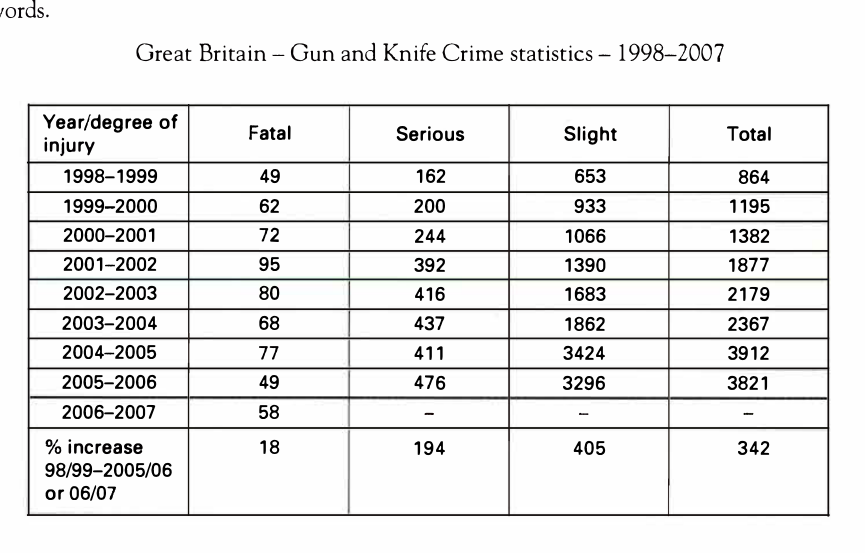
The table shows the number of fatal, serious and slight injuries resulting from gun and knife crime in Great Britain from 1998 to 2007 and the percentage increase for each degree of injury over the period.
Summarise the information by selecting and reporting the main features, and make comparisons where relevant.
Great Britain - Gun and Knife Crime statistics - 1998-2007
Student answer (Band 5.5)
The table details the gun and knife crime injuries categorized as fatal, serious and slight that occurred in Great Britain between 1998 and 2007, also shows the increase rate of each injury.
Overall, the data reveal the total injury cases trend upward. Minor (slight) injury cases shows a significant higher numbers as compared to fatal and serious cases over the entire period.
In [redacted phone], the data shows higher slight injury cases (653) as comapred to fatal (49) and serious (162), leading to a total of 864. Fatal shows a fluctuation trend, from 1998 to 2005, it spiked and after that it comes to its initial value tand then goes up and its increase rate is 18% over the entire period.
In contrast, serious and slight injuries increase rate are 194% and 405% respectively. and total increase rate is 342%.
AI examiner evaluation
| Criterion | Band |
|---|---|
| Task Achievement / Task Response | 5.0 |
| Coherence and Cohesion | 5.5 |
| Lexical Resource | 5.5 |
| Grammatical Range and Accuracy | 5.0 |
| Overall | 5.5 |
Task Achievement / Task Response: Band 5.0
You identify the table’s subject and give a relevant overview that totals generally rose and slight injuries were much more numerous than the other categories. However, the response addresses the data only partially: it describes just the first year in detail and gives percentage increases without comparing the main changes across the period. The fatal-injury account is also inaccurate: cases rose to 95 in 2001–02, then fluctuated, reaching 49 in 2005–06 and 58 in 2006–07; they did not return to their initial value before rising. The opening year is incorrectly written as 1990–1999. The response is 139 words, below the required 150. Add key comparisons and accurate figures, especially the sharp rise in slight injuries and the peak in serious injuries.
Coherence and Cohesion: Band 5.5
The response has a basic, recognisable structure: an introduction, an overview, and two paragraphs of detail. This helps the reader identify the topic and the broad trend. However, progression is limited because most of the figures are not developed, and the final paragraph moves abruptly from injury increases to the total percentage increase. Linking is also sometimes awkward: “In contrast” does not clearly signal a contrast between the serious and slight increases, while the sentence beginning “Fatal shows a fluctuation trend” contains several stages joined together without clear separation. Organise the details by category or by period, and use links that show the precise relationship between comparisons. Clearer sentence boundaries and a fuller sequence of key trends would make the report easier to follow.
Lexical Resource: Band 5.5
You use relevant task vocabulary, including “fatal,” “serious,” “slight,” “fluctuation,” and “increase rate,” so the reader can generally understand the categories being discussed. There is some variety in describing change, but several word choices and collocations are inaccurate or unnatural, such as “significant higher numbers,” “Fatal shows a fluctuation trend,” and “its initial value tand then goes up.” The spelling error “comapred” is also noticeable. These issues make parts of the report less clear and show that vocabulary control is not yet consistent. Aim for precise, conventional phrases such as “a considerably higher number,” “the number of fatal injuries fluctuated,” and “returned to its starting level.” Check spelling and use “percentage increase” rather than “increase rate” where appropriate.
Grammatical Range and Accuracy: Band 5.0
You attempt both simple and more complex sentences, including a relative clause in the opening and a comparison in the overview. However, errors are frequent enough to affect clarity. For example, “Minor (slight) injury cases shows” has subject–verb disagreement, and “the data reveal … cases shows” shifts between plural and singular forms. The sentence “Fatal shows a fluctuation trend, from 1998 to 2005, it spiked…” joins clauses with faulty punctuation and has unclear tense control. The final paragraph also begins a new sentence with lowercase “and.” Use complete, clearly punctuated sentences, maintain consistent past tense for the historical figures, and check agreement and plural forms. More accurate control of these basic patterns would make your comparisons easier to understand.
See this exact question answered at other band scores. The same prompt compared across bands.
Browse more IELTS Writing model answers or get your own writing scored by the same AI examiner.