Band 6.5 IELTS Writing Task 1 Model Answer
Overall Band Score: 6.5 · IELTS Momentum Workout · 2026-11-23
IELTS Writing Task 1 question
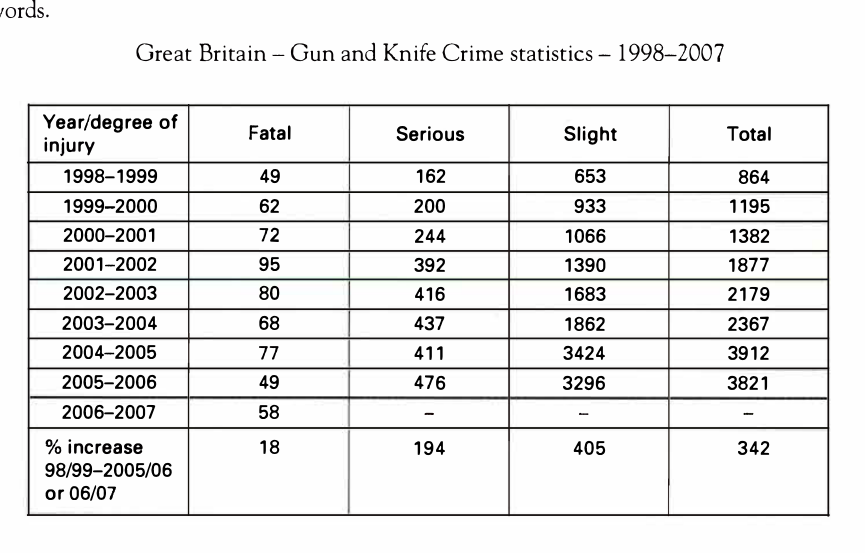
The table shows the number of fatal, serious and slight injuries resulting from gun and knife crime in Great Britain from 1998 to 2007 and the percentage increase for each degree of injury over the period.
Summarise the information by selecting and reporting the main features, and make comparisons where relevant.
Great Britain - Gun and Knife Crime statistics - 1998-2007
Student answer (Band 6.5)
The table chart illustrates figures about the number of fatal serious and slight injuries caused by gun and knife crime in the Great Britain over the period from 1998 to 2007 and the porportion increase for each level of injury. Overall, the number of fatal saw fluctuation during this period, while serious and slight injuries followed a similar upward trajectory.
The number of fatal rose significantly from 49 in [redacted phone] to 95 in [redacted phone], before following a downward trend until reaching 49 in [redacted phone], then increased to 58 in [redacted phone].
Serious injuries recorded 162 case in [redacted phone], then followed an upward trend and reached 244 case in [redacted phone], then continued to increase until reaching the highest number in [redacted phone] with 476 case.
Slight injuries recorded the highest numbers across the three cases, started with 653 case in [redacted phone], then jumped sharply to 1066 in the beginning of the two thousands, then reached the peak in [redacted phone] with 3424 case, before declining to 3296 in [redacted phone].
Slight injuries recorded the highest percentage increase with 405%, followed by serious injuries with 194%, then lastly, fatal with 18%.
AI examiner evaluation
| Criterion | Band |
|---|---|
| Task Achievement / Task Response | 6.5 |
| Coherence and Cohesion | 6.5 |
| Lexical Resource | 6.5 |
| Grammatical Range and Accuracy | 6.0 |
| Overall | 6.5 |
Task Achievement / Task Response: Band 6.5
You identify the main pattern that fatal injuries fluctuated while serious and slight injuries generally increased, and you support this with relevant figures. The comparison of percentage increases is also accurate: slight injuries rose most, followed by serious and fatal injuries. However, some important details are incomplete or imprecise. Serious injuries did not rise continuously: they fell from 437 in 2003–2004 to 411 in 2004–2005 before reaching 476. The overview also says serious and slight injuries followed a similar trajectory, although slight injuries rose sharply in 2004–2005 and then declined. Include the total figures or clarify that the final year has no reported serious, slight or total counts to make the summary more complete.
Coherence and Cohesion: Band 6.5
The response has a clear overall arrangement: an introduction and overview are followed by separate paragraphs on fatal, serious and slight injuries, then a comparison of percentage increases. This makes the information easy to locate, and sequencing expressions such as “before” and “then” help show changes over time. Some linking is repetitive, particularly the repeated use of “then” and “followed by an upward trend.” The overview’s claim that serious and slight injuries had a similar trajectory also weakens the progression because the later details show a sharp rise and slight decline for slight injuries. Use more precise links to distinguish these patterns, and connect the final percentage comparison more explicitly to the preceding discussion.
Lexical Resource: Band 6.5
You use a suitable range of task-related vocabulary, including “fluctuation,” “upward trajectory,” “downward trend,” “peak” and “percentage increase.” These choices help describe changes and comparisons, and the meaning is generally clear. Some collocations and forms are inaccurate or repetitive: “the number of fatal” is incomplete, “the table chart” is redundant, and “case” is not the natural unit for injury counts. There are also spelling errors in “porportion” and “significantly” is not quite appropriate for describing the rise without a clear comparison. Aim for precise statistical phrasing and vary the verbs used to report increases and decreases.
Grammatical Range and Accuracy: Band 6.0
You use both simple statements and longer sentences with time clauses, as in “before following a downward trend until reaching 49,” so there is some structural variety. The main trends remain understandable, but some grammatical errors recur. For example, “the number of fatal saw fluctuation” lacks a suitable noun phrase and article, while “Serious injuries recorded 162 case” has a number-agreement error. The opening sentence also needs clearer punctuation and article use, and “in the Great Britain” is not grammatically appropriate. Check singular and plural forms, articles, and sentence construction, especially when describing figures. More consistently accurate sentences would strengthen control while preserving your useful range.
See this exact question answered at other band scores. The same prompt compared across bands.
Browse more IELTS Writing model answers or get your own writing scored by the same AI examiner.