Band 5.5 IELTS Writing Task 1 Model Answer
Overall Band Score: 5.5 · IELTS Momentum Workout · 2026-11-23
IELTS Writing Task 1 question
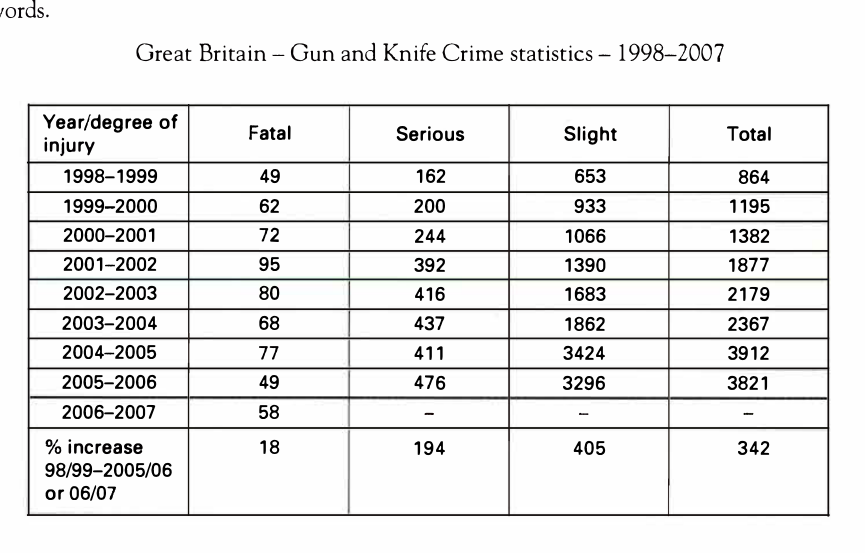
The table shows the number of fatal, serious and slight injuries resulting from gun and knife crime in Great Britain from 1998 to 2007 and the percentage increase for each degree of injury over the period.
Summarise the information by selecting and reporting the main features, and make comparisons where relevant.
Great Britain - Gun and Knife Crime statistics - 1998-2007
Student answer (Band 5.5)
The provided table showcases the number of fatal, serious and slight injuries by gun and knife crime in Britian from 1998 to 2007 and percentage was increased of every kind of injury with the passage of time.
Overall, it can be observed that number of fatal injuries are very low as compared with slight injuries. It is noticed that only slight injuries numbers are increased from 1998 to 2007.
In term of fatal injury, lowest injuries was recorded in 1998 and highest injuries was 95 in [redacted phone]. Fatal injuries increase percentage was 18 percent from start to end. Serious injuries was jumped from 162 in 1998 to 476 in 2007, which is 194 percentage.
Huge changes was recorded in Slight injuries, it has jumped from 653 to 3296. 405% was noticed in this segment.
As result it has been observed that overall number of injuries are increased from 864 to 3821 in 2007, which is 3
AI examiner evaluation
| Criterion | Band |
|---|---|
| Task Achievement / Task Response | 5.0 |
| Coherence and Cohesion | 6.0 |
| Lexical Resource | 5.5 |
| Grammatical Range and Accuracy | 5.0 |
| Overall | 5.5 |
Task Achievement / Task Response: Band 5.0
You identify relevant features, including the low fatal-injury figures, the peak of 95 in 2001–2002, and the overall rise in recorded injuries. However, the overview is inaccurate when it says only slight injuries increased: serious injuries also rose overall, and fatal injuries fluctuated. Some figures are misreported: serious injuries reached 476 in 2005–2006, not 2006–2007, for which the table gives no figure; the 405% increase applies to slight injuries, while the total increase is 342%. The final sentence is cut off after “which is 3,” leaving the comparison incomplete. The response is also 148 words, below the 150-word minimum; the eight words copied from the prompt are excluded from the count. Include a complete overview and check the table’s dates and percentages carefully.
Coherence and Cohesion: Band 6.0
The response has a recognisable structure: an introduction, an overview, and separate comments on fatal, serious, slight, and total injuries. This makes the information reasonably easy to follow, and phrases such as “In term of fatal injury” and “As result” signal movement between points. However, the progression is weakened by the abrupt ending, which leaves the final comparison unfinished, and some links between claims are unclear. For example, the overview says only slight injuries increased, but the later paragraph reports a rise in serious injuries. Grouping the main trends more consistently and using clearer references to the relevant years would improve cohesion. The paragraphing is functional, though the short, list-like treatment limits the flow.
Lexical Resource: Band 5.5
You use a range of task-relevant terms, including “fatal,” “serious,” “slight,” “percentage,” and “recorded,” so the reader can generally understand the categories being compared. There are also attempts at more descriptive language, such as “Huge changes” and “jumped.” However, several choices are imprecise or unnatural: “percentage was increased,” “number of fatal injuries are very low,” and “Fatal injuries increase percentage” do not express the intended ideas idiomatically. “Britian” is also misspelled, and repeated use of “injuries” and “increased” makes the vocabulary less flexible. Choose standard collocations such as “the percentage increase” and “the number of cases rose,” and use “rose sharply” rather than “jumped” for a more suitable report style.
Grammatical Range and Accuracy: Band 5.0
You attempt both simple statements and longer comparisons, for example, “Serious injuries was jumped from 162 in 1998 to 476 in 2007, which is 194 percentage.” However, errors in agreement, tense, articles, and sentence construction are frequent enough to make some statements difficult to interpret. Examples include “number of fatal injuries are,” “lowest injuries was recorded,” and “Huge changes was recorded.” The phrase “which is 3” is also an incomplete clause, so the final sentence does not communicate its intended comparison. Use a consistent past tense for the historical data, check singular and plural agreement, and form complete sentences. For instance: “The number of serious injuries rose from 162 in 1998–1999 to 476 in 2005–2006.”
See this exact question answered at other band scores. The same prompt compared across bands.
Browse more IELTS Writing model answers or get your own writing scored by the same AI examiner.