Band 6.0 IELTS Writing Task 1 Model Answer
Overall Band Score: 6.0 · IELTS Momentum Workout · 2026-11-23
IELTS Writing Task 1 question
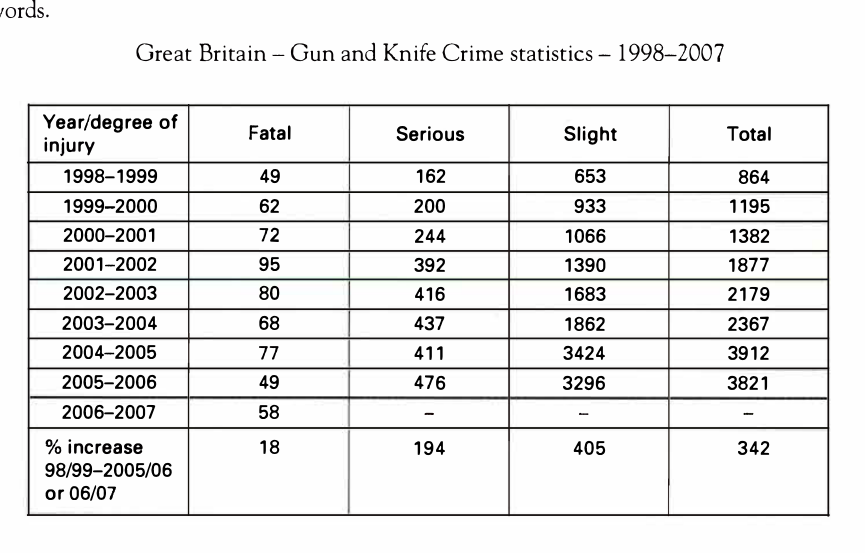
The table shows the number of fatal, serious and slight injuries resulting from gun and knife crime in Great Britain from 1998 to 2007 and the percentage increase for each degree of injury over the period.
Summarise the information by selecting and reporting the main features, and make comparisons where relevant.
Great Britain - Gun and Knife Crime statistics - 1998-2007
Student answer (Band 6.0)
The table illustrates the information regarding the serious injuiries resulting from knife and crime in great britian from 1998 to 2007.
Overall,the total number of crimes increased dramatically over the period,driven mainly by a sharp rise in slight injuries.In contrast fatal injuries reprents the lowest and relativitly stable throughout.
in [redacted phone] the total number of crimes were 864,This figure rose steadily each year,reaching at the peak of 3912 in [redacted phone],before falling to 3821 in [redacted phone].The main reason for this trend is just because of slight injuries,which roses surgely.
serious injuries also showed a significant increase,rising from 162 to 476,which was accounted for 194%.However,fatal injuries showed a different pattern which from initial increases smoothly goes to its peak in [redacted phone] and then fell back to 49 in [redacted phone].In addition it just only increased by only 18% which was much lower than the other categories .Data for serious and slight injuries was not available for [redacted phone].
AI examiner evaluation
| Criterion | Band |
|---|---|
| Task Achievement / Task Response | 6.5 |
| Coherence and Cohesion | 6.0 |
| Lexical Resource | 5.5 |
| Grammatical Range and Accuracy | 5.5 |
| Overall | 6.0 |
Task Achievement / Task Response: Band 6.5
You identify the main overall pattern: the total rose substantially before easing, slight injuries drove much of the increase, and fatal injuries were the smallest category. You also include relevant figures, such as the total rising from 864 to 3,912 and serious injuries increasing from 162 to 476. This covers the key task features, with some comparison and an overview. However, a few details are unclear or inaccurate: the total fell in 2005–06, not “2005–2007,” and the table gives no total for 2006–07. The claim that the total rose steadily also overlooks the later decline. The account of slight injuries would be stronger with figures, and the fatal-injury trend needs clearer description of its fluctuations. These gaps keep the report from being fully precise and developed throughout.
Coherence and Cohesion: Band 6.0
The response has a recognisable structure: an introduction, an overview, and two paragraphs presenting figures and category trends. The progression from totals to injury types is generally logical, and linking expressions such as “Overall,” “In contrast,” and “However” help signal relationships. Some connections are less clear or mechanical, though. For example, “The main reason for this trend is just because of slight injuries” repeats the causal link rather than developing it, while “which was accounted for 194%” does not clearly connect the percentage to the increase. The final sentence about missing data feels appended rather than integrated into the comparison. More precise referencing and smoother links between the total trend and the category figures would make the organisation easier to follow.
Lexical Resource: Band 5.5
You use a reasonable range of task-related vocabulary, including “dramatically,” “sharp rise,” “peak,” “pattern,” and “percentage,” and the reader can generally understand the trends you intend to describe. There are, however, noticeable spelling and word-choice problems that reduce precision: “injuiries,” “reprents,” “relativitly,” and “roses surgely” are inaccurate, and “crimes” is not the best label for the table’s injury counts. Some phrasing is also awkward, such as “the main reason … is just because of” and “increased smoothly.” Aim for accurate collocations and use the table’s categories consistently. A more controlled vocabulary would let you describe changes clearly without relying on vague or conversational wording.
Grammatical Range and Accuracy: Band 5.5
You attempt a mix of simple and more complex sentences, including clauses with “before,” “which,” and “while,” and most of the intended meaning remains understandable. Some grammatical errors nevertheless affect clarity. For example, “the total number of crimes were 864” has a subject–verb agreement problem, and “reaching at the peak” uses an incorrect construction. The sentence “fatal injuries showed a different pattern which from initial increases smoothly goes to its peak” has an unclear clause structure and inconsistent tense. Capitalisation and punctuation are also inconsistent, particularly where a new sentence begins after a comma. Work on agreement, verb tense consistency, and sentence boundaries while retaining your attempts at complex structures.
See this exact question answered at other band scores. The same prompt compared across bands.
Browse more IELTS Writing model answers or get your own writing scored by the same AI examiner.