Band 5.0 IELTS Writing Task 1 Model Answer
Overall Band Score: 5.0 · IELTS Momentum Workout · 2026-11-23
IELTS Writing Task 1 question
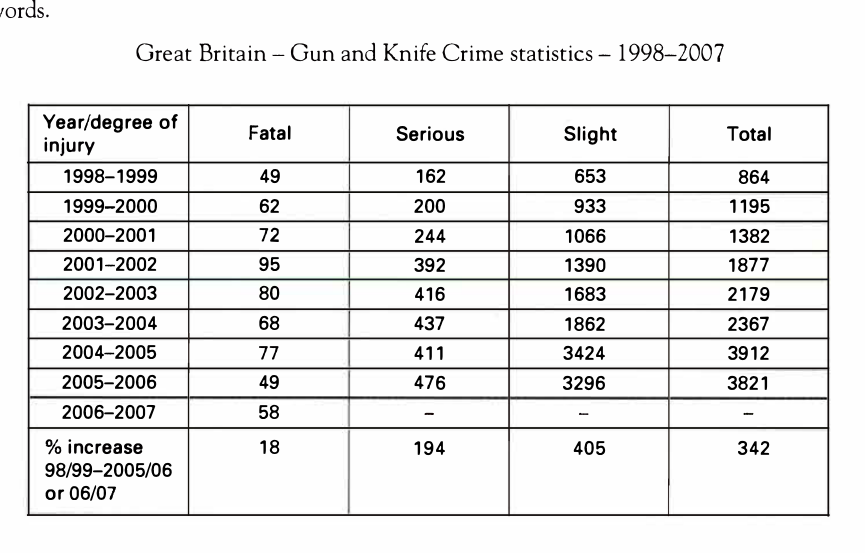
The table shows the number of fatal, serious and slight injuries resulting from gun and knife crime in Great Britain from 1998 to 2007 and the percentage increase for each degree of injury over the period.
Summarise the information by selecting and reporting the main features, and make comparisons where relevant.
Great Britain - Gun and Knife Crime statistics - 1998-2007
Student answer (Band 5.0)
The table shows the number of fatal , serious and slight injuries,resulting from gun and knife crime in Great Britian from 1998 to 2007.
Overall, the percentage grew comparesons where relevant, fatal had the heighest fugure in the middle of the period but the serious and slight in the end .
in the begenning make the fatal start with 49 injuring from 1998 to 1999 this number rose gradually until in 2001 and 2002 made the top point of crime 95 but he start decresed to 58 in 200- to 2007 however the serious start from 162 in 1998 and 1999 climp year after another until 2005 to 2006 mark 476 but the slight he was 864 in 1998 and 1999 rose significantlly to 3424 in 2004 to 2005 and the number decrtesed to 3296 in 2005 to 2006
morever we get the total number starting from 864 IN 1998 to 1999 incresed to 3912 make it the peak number and he fall to 3821 in 2005 to 2006
AI examiner evaluation
| Criterion | Band |
|---|---|
| Task Achievement / Task Response | 5.0 |
| Coherence and Cohesion | 4.5 |
| Lexical Resource | 5.0 |
| Grammatical Range and Accuracy | 4.5 |
| Overall | 5.0 |
Task Achievement / Task Response: Band 5.0
You identify the table’s subject and report several relevant figures, including the fatal-injury peak of 95 in 2001–02 and the total peak of 3,912 in 2004–05. However, the overview is unclear: “the percentage grew” does not explain the main pattern, and the claim that fatal injuries had the highest figure is inaccurate, since slight injuries were much more numerous throughout. Some trends are also incomplete: serious injuries reached 476 in 2005–06, while slight injuries peaked at 3,424 in 2004–05 before falling. The percentage increases shown in the final row are not discussed. A clearer overview and more accurate selection of the main comparisons would make the report more complete.
Coherence and Cohesion: Band 4.5
There is a basic sequence from an introduction to an overview and then details about injury categories and totals. However, the progression is difficult to follow because the overview is unclear and most of the data are compressed into one long paragraph. Connectors such as “however” and “morever” are attempted, but their relationships are not always clear; for example, “however” does not clearly signal the change in fatal injuries. References such as “he” and “this number” also make it hard to tell which category is being discussed. Separate the overview from the detailed comparisons, group related figures, and use clear references such as “fatal injuries” or “the total” to guide the reader.
Lexical Resource: Band 5.0
You use some task-relevant vocabulary, including “fatal,” “serious,” “slight,” “rose,” “decreased,” and “peak,” so the main subject is generally recognisable. However, the range is limited and several spelling and word-choice errors make parts difficult to understand, such as “heighest fugure,” “climp,” and “significantlly.” Some expressions are also imprecise or unnatural, including “top point of crime” and “the slight he was 864”; the table reports injuries, not crime totals in those phrases. Use accurate terms consistently and check spelling. More precise trend language, such as “reached a peak” and “declined,” would help you describe the figures clearly.
Grammatical Range and Accuracy: Band 4.5
The response attempts to combine several trends in longer sentences, but these structures are often faulty, and sentence boundaries are not consistently controlled. For example, “fatal had the heighest fugure in the middle of the period but the serious and slight in the end” lacks a complete, parallel structure. In “the serious start from 162 … climp year after another,” the verb form and sentence construction are unclear. There are also problems with articles, agreement, and punctuation, including spaces before commas and missing full stops. These errors sometimes make the intended comparisons difficult to follow. Build shorter, complete sentences first, then add a few accurate clauses using “while” or “whereas” to compare categories.
See this exact question answered at other band scores. The same prompt compared across bands.
Browse more IELTS Writing model answers or get your own writing scored by the same AI examiner.