Band 5.0 IELTS Writing Task 1 Model Answer
Overall Band Score: 5.0 · IELTS Momentum Workout · 2026-11-24
IELTS Writing Task 1 question
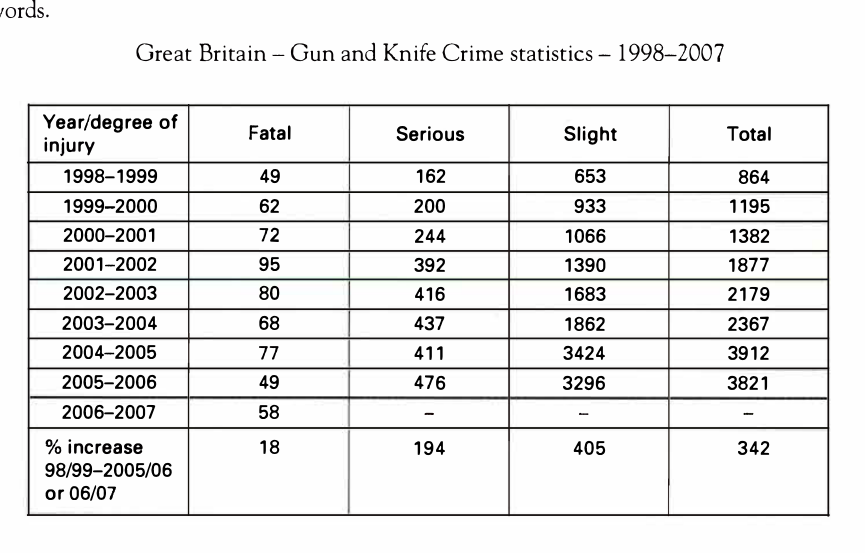
The table shows the number of fatal, serious and slight injuries resulting from gun and knife crime in Great Britain from 1998 to 2007 and the percentage increase for each degree of injury over the period.
Summarise the information by selecting and reporting the main features, and make comparisons where relevant.
Great Britain - Gun and Knife Crime statistics - 1998-2007
Student answer (Band 5.0)
The table represents the three types of injuries that are caused due to gun and knife.Furthermore how these increase the crime rate in great british from 1998 to 2007.Is also illustrate how the percentage of these injuries grew with the passage of time.
In the begining,slight injuries gained the largest number from all and remains on the top till the end.Where as Fatal injury reached its peak from [redacted phone] which is 95.While serious injuries highest number are 476 that are in [redacted phone].Further more the total injuries were calculated highest than other in the same time period.
As in [redacted phone],there were total 864 injuries from which 653 are slight,162 are serious whereas 49 fatal.Next year total injuries reached to 1195.One more yesr passed and total injuries reached to 1382. While in 2002 period,fatal injuries are 95 highest from any time.
With the passage of time the number of injuries plays a dramatic pattern further which slight injuires grew rapidly.
AI examiner evaluation
| Criterion | Band |
|---|---|
| Task Achievement / Task Response | 5.0 |
| Coherence and Cohesion | 4.5 |
| Lexical Resource | 5.0 |
| Grammatical Range and Accuracy | 5.0 |
| Overall | 5.0 |
Task Achievement / Task Response: Band 5.0
You identify the main categories and note that slight injuries were the most numerous, while fatal injuries peaked at 95 and serious injuries reached 476 in 2005–06. These are relevant observations, and the opening also establishes the period covered. However, the account only partly summarises the table: it does not clearly report the overall rise in total injuries from 864 to 3,821 by 2005–06, or the substantial percentage increases shown (especially for slight injuries and the total). The claim that slight injuries remained highest “till the end” is not fully supported because figures for 2006–07 are absent. Some figures and periods are also unclear, such as saying fatal injuries peaked “from 2001-2003.” Select the key trends and compare them accurately and explicitly.
Coherence and Cohesion: Band 4.5
The response has a basic sequence: an introduction, a paragraph describing categories, and a final paragraph about changes over time. This gives the reader some sense of the topic, and time markers such as “Next year” and “With the passage of time” attempt to connect information. However, the progression is difficult to follow because the response moves between general claims and individual figures without a clear organising principle. Several links are awkward or unclear, including “Where as” and “One more yesr passed,” and the final sentence does not clearly explain what “dramatic pattern” refers to. Group the information into a clear overview followed by comparisons of the main trends, and use precise references so each sentence connects logically to the table.
Lexical Resource: Band 5.0
You use some relevant vocabulary for describing data, including “slight injuries,” “fatal,” “serious,” “reached its peak,” and “percentage.” This shows an attempt to use task-specific language. However, the range is limited and several word choices or collocations are inaccurate or vague, which sometimes makes the meaning difficult to interpret. For example, “gained the largest number from all” is not a natural way to describe the highest figure, and “the total injuries were calculated highest than other” is unclear. There are also spelling errors such as “begining,” “yesr,” and “injuires.” Use standard terms such as “accounted for,” “rose,” and “the highest total,” and check spelling carefully to make comparisons more precise.
Grammatical Range and Accuracy: Band 5.0
The response attempts both short statements and longer sentences, and the reader can understand some basic comparisons, such as the figures for 1998–99. However, the range of sentence structures is limited, and errors occur frequently enough to make several sentences difficult to follow. For instance, “Is also illustrate” is an incomplete and incorrectly formed clause, while “slight injuries gained the largest number … and remains” has problems with verb form and agreement. Sentence boundaries and punctuation are also unreliable, as in “gun and knife.Furthermore” and “Where as Fatal.” Practise forming complete sentences with a clear subject and verb, and use consistent past-tense forms when reporting historical data. More accurate control of these basics would make your comparisons easier to understand.
See this exact question answered at other band scores. The same prompt compared across bands.
Browse more IELTS Writing model answers or get your own writing scored by the same AI examiner.