Band 5.0 IELTS Writing Task 1 Model Answer
Overall Band Score: 5.0 · IELTS Momentum Workout · 2026-11-24
IELTS Writing Task 1 question
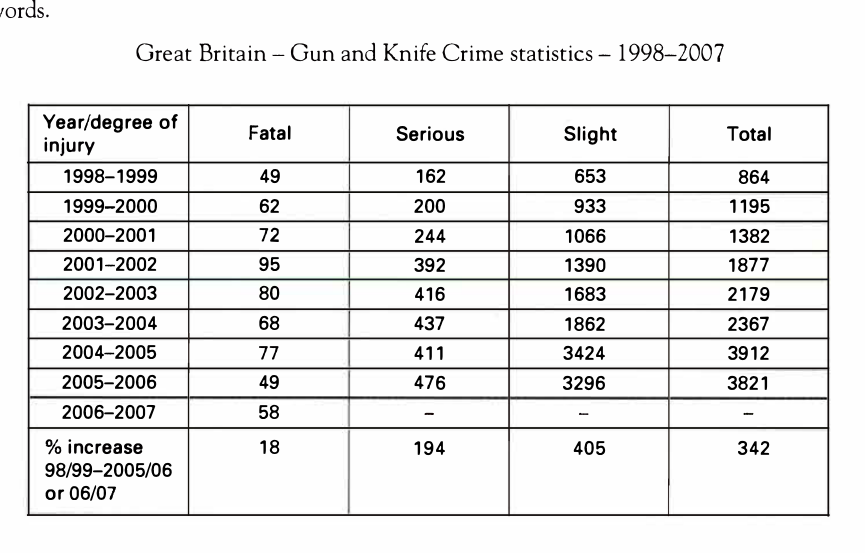
The table shows the number of fatal, serious and slight injuries resulting from gun and knife crime in Great Britain from 1998 to 2007 and the percentage increase for each degree of injury over the period.
Summarise the information by selecting and reporting the main features, and make comparisons where relevant.
Great Britain - Gun and Knife Crime statistics - 1998-2007
Student answer (Band 5.0)
This table graph illustrates the number of injuries by gun and knife crime in Great Britain between 1998 and 2007. Overall, there were larger number of injuries from 2005 to 2006. In 1998 group, there are least number of injuries.
Getting back to the details, In 1998, fatal injuries were 49, serious injuries numbere were 162 and slight were 653. There were 864 total number of injuries. In 1999, fatal were slightly increased at 62 and slight were grew to 933. There were 1195 total number of injuries. Next year, serious injuries rose significantly at 244 and slight injuries also grow at 1066. Total number of injuries were 1382 in this year.
Interestingly, In 2001, fatal were just more then previous, serious and slight jumped highly in the number of injuries in this year group. In 2002, fatal declined at 80 and slight accidents were just above the 1650. Total number of injuries in thi year were 2179.
Obviously, In the last year group fatal are fell in injuies but the other highly increased like slight injuries. In total percentage fatal were less then 20, serious were just below the 200, slight were more then 400 and total percentage were just over 400.
AI examiner evaluation
| Criterion | Band |
|---|---|
| Task Achievement / Task Response | 4.5 |
| Coherence and Cohesion | 5.5 |
| Lexical Resource | 5.0 |
| Grammatical Range and Accuracy | 5.0 |
| Overall | 5.0 |
Task Achievement / Task Response: Band 4.5
The response identifies the broad pattern that injuries were lowest at the beginning and much higher later, and it includes several accurate early figures, such as 49 fatal injuries and 864 total in 1998–99. However, the overview is vague and partly inaccurate: the highest total was 3,912 in 2004–05, not simply “from 2005 to 2006,” when the total was 3,821. Much of the later data is not reported precisely, and the 2006–07 figures for serious, slight and total injuries are unavailable. The final percentage comparisons are also imprecise, and the response does not clearly explain the overall rise or the sharp increase in slight injuries. Select key turning points and compare them accurately to make the summary more complete.
Coherence and Cohesion: Band 5.5
The response has a basic structure: an opening overview, a sequence of detail paragraphs and a final comment on percentage increases. Time markers such as “Next year” and “In 2002” help the reader follow the chronology. However, progression is uneven: the account moves from 2002 to an unclear “last year group,” and the final percentage statement is not clearly connected to the yearly figures. Several transitions, including “Getting back to the details” and “Obviously,” feel mechanical, while repeated references to “total number of injuries” make the report less concise. Grouping the early years together and then describing the later peak and decline would create a clearer progression. Use more precise references to years and link each comparison to the relevant data.
Lexical Resource: Band 5.0
The vocabulary is sufficient to communicate the general subject, with relevant terms such as “fatal,” “serious,” “slight,” “declined” and “increased.” There are also attempts to describe change, for example “rose significantly.” However, the range is limited and several word choices or collocations are inaccurate or awkward, including “table graph,” “slight accidents,” “jumped highly,” and “fatal are fell.” Spelling and word-form errors such as “num bere”/“numbere” and “injuies” also reduce precision. Aim for standard data-reporting language and use verbs such as “rose,” “fell,” “peaked” and “accounted for” accurately. This would make comparisons clearer and reduce repetition of “number of injuries.”
Grammatical Range and Accuracy: Band 5.0
The response uses mostly simple sentence patterns and attempts some longer constructions, but control is inconsistent. Errors in tense and agreement appear in phrases such as “there are least number,” “slight were grew,” and “fatal are fell”; these make some statements difficult to interpret. Articles and plural forms are also unreliable, as in “there were larger number” and “total number of injuries were.” Capitalisation after commas is inconsistent, and some sentences lack clear grammatical structure, particularly “In 2001, fatal were just more then previous.” Practise forming accurate past-tense comparisons, for example, “Fatal injuries rose to 62, while slight injuries increased to 933.” More reliable sentence patterns would improve clarity while allowing you to add variety.
See this exact question answered at other band scores. The same prompt compared across bands.
Browse more IELTS Writing model answers or get your own writing scored by the same AI examiner.